Imagemap


Hollywood Goes to Trial to Bar DVD Ripping Software

Pop Star Kusanagi Apologizes for Drunken Nudity in Park

Toyota Founder's Grandson-CEO to Race Lexus

Chinese Australian Killed by 34 Shots with Nail Gun

Blood Vessels Grown from Kidney Patients' Own Cells

5 Asian Films Among Contenders at Cannes

No Evidence Found Against Father of Slumdog Child Actor


Japanese, Mongolian Team Finds Complete Dinosaur Skeleton

apanese and Mongolian scientists have successfully recovered the complete skeleton of a 70-million-year-old young dinosaur, a nature museum announced Thursday.

     The scientists uncovered a Tarbosaurus — related to the giant carnivorous Tyrannosaurus — from a chunk of sandstone they dug up in August, 2006 in the Gobi Desert in Mongolia, said Takuji Yokoyama, a spokesman for the Hayashibara Museum of Natural Sciences, a co-organizer of the joint research project.

     "We were so lucky to have found remains that turned out to be a complete set of all the important parts," he said.

     After two years of careful preparatory work, scientists found that the fossilized skeleton only lacked neck bones and the tip of the tail.

     Young dinosaur skeletons are hard to find in good condition because they often are destroyed by weather decay or because they were torn apart by predators. The latest find would be a major step toward discovering the growth and development of dinosaurs, Yokoyama said.

     The fossil, believed to have died at age 5, measured about 6.6 feet long, he said. Adult dinosaurs of the species are believed to have grown up to 40 feet.

     The dinosaur, whose gender was unknown, came from a geological layer created about 70 million years ago in the late Cretaceous period.

     The Japanese scientists and colleagues from the Center of Paleontology under the Mongolian Academy of Sciences have been jointly conducting dinosaur excavations in the Gobi Desert since 1993.

     The Japanese museum is run by Hayashibara Co., a biotechnology firm based in Okayama, western Japan.


07/24/2008 07:35 AM
By MARI YAMAGUCHI Associated Press Writer TOKYO

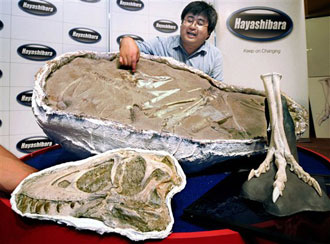
Researcher Mahito Watabe of Hayashibara Museum of Natural Sciences (HMNS) shows Wednesday, July 23, 2008 in Okayama, western Japan, the fossilized skull, foreground left, the left hind leg, foreground right, of a skeleton of 70-million-year-old young dinosaur Tarbosaurus that was uncovered in the Gobi Desert in Mongolia in August, 2006. The shown together is a reproduction model of a chunk of sandstone with the complete skeleton of the Tarbosaurus — related to the giant carnivorous Tyrannosaurus — that shows how it looked when it was uncovered by scientists from Japan's HMNS, including Watabe, and the Mongolian Academy of Sciences. (AP Photo/Kyodo News)


Asian American Family

Presented by American Family Insurance

5 Steps to a Financially Successful Marriage

Feng-Shui for a Happier Home

6 Keys to Building Your Child's Self-Image by Age 13


Asian American Videos

Ang Lee Documentary 1/6

Tey - Never Knew Love Like This

Yao Ming Tribute 2009

First Asian Boy: American Boy Parody

Paget Sings Time after Time

North Korea's Missile Launch

Wisconsin's Travel Delights

Kid Genius Pranav Veera

Spring Scream in Kenting, Taiwan

GM CFO Ray Young in Jan 2009

Jacky Cheung & Regine Velazquez Duet

Jero Revives Japanese Pop Ballads

MORE ASIAN AMERICAN VIDEOS


CONTACT US
ADVERTISING INFO
INTERACTIVE FORUMS
AA ISSUES
COMMENT ON AN ARTICLE

© 1996-2009 GoldSea
No part of the contents of this site may be reproduced without prior written permission.