ransplanting faces may seem like science fiction, but doctors say the experimental surgeries could one day become routine. Two of the world's three teams that have done partial face transplants reported Friday that their techniques were surprisingly effective, though complications exist and more work is still needed.
"There is no reason to think these face transplants would not be as common as kidney or liver transplants one day," said Dr. Laurent Lantieri, one of the French doctors who operated on a man severely disfigured by a genetic disease.
In Friday's issue of the British medical journal Lancet, Lantieri and colleagues reported on their patient's status one year after the transplant. Chinese doctors also reported on their patient, two years after his surgery.
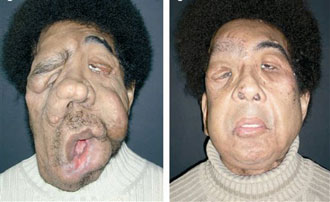
Last year, the French team operated on a 29-year-old man with tumors that blurred his features in a face that looked almost monstrous. They transplanted a new lower face from a donor, giving the patient new cheeks, a nose and mouth. Six months later, he could smile and blink.
The Chinese patient had part of his face ripped off by a bear. Surgeons in Xian gave him a new nose, upper lip and cheek from a donor. After a few months, he could eat, drink and talk normally, and returned home to Yunnan province in southwest China.
The patients were not identified although photos were included in the reports.
As is the case with all transplants, doctors use immune-suppressing drugs to prevent the recipient's body from attacking the donated tissue. In both face transplants, the patients started rejecting the transplanted tissue more than once. Their doctors solved the problem by juggling their medications.
The French patient now takes three pills a day to prevent rejection.
"That's less than most people with diabetes," said Lantieri, a plastic surgeon at the Henri Mondor-Albert Chenevier Hospital in suburban Paris.
Other doctors were reassured by the results.
"To be able to wean down the dosage of the medication in small amounts and relatively quickly, that is encouraging," said Dr. Bohdan Pomahac, a plastic surgeon at the Brigham and Women's Hospital in Boston.
Pomahac has permission to do a face transplant in the U.S., as do doctors at the Cleveland Clinic.
Experts have worried that if patients take lifelong anti-rejection drugs after a transplant, their cancer risk will jump. Some also predicted that rejection would destroy the face within a few years. Those fears seem to have been allayed, Pomahac said.
With three successful partial face transplants so far Ñ including the world's first on a woman whose face was bitten off by a dog in France Ñ doctors say that some of the surgery's initial uncertainties, like how functional the new face would be, are being answered.
For example, Lantieri's patient's face was paralyzed by tumors for more than a decade. The French team wasn't sure if nerves could grow after the transplant. But they discovered later their patient could blink, proving the brain was able to restore long-forgotten facial nerve connections.
Not everyone is convinced that face transplants are so revolutionary.
Dr. Patrick Warnke, a plastic surgeon at the University of Kiel in Germany, calls them a "dead-end road," because he doesn't think the rejection problem can be solved. Instead, he hopes to re-grow tissue from patients' own stem cells.
Still, the biggest obstacle to more face transplants may not be scientific, but social.
"When kidney transplants first began, people were reluctant to donate because there were a lot of cultural, social and religious issues," Pomahac said. "This is exactly the same scenario now."
Doctors plan to do more face transplants, but are having a hard time finding donors.
"Everyone says they would accept a face transplant if they were disfigured," Lantieri said. "The real question is, would you be a donor, or would you allow your family member to donate their face? That is the answer we need to change."