Yuriko Koike May Become First Japanese Woman PM
 fficial campaigning doesn't begin for another week, but potential successors to Japanese Prime Minister Yasuo Fukuda began rallying their forces Wednesday ahead of a vote to formally name his replacement.
Among those rumored to be interested are former Defense Minister Yuriko Koike, who first gained national prominence as anchor of TV Tokyo's World Business Satellite, a national TV business news program. Before joining the LDP, Koike belonged to the Japan New Party, New Frontier Party, Liberal Party and New Conservative Party. Koike is generally considered the top prospect to become Japan's first female prime minister.
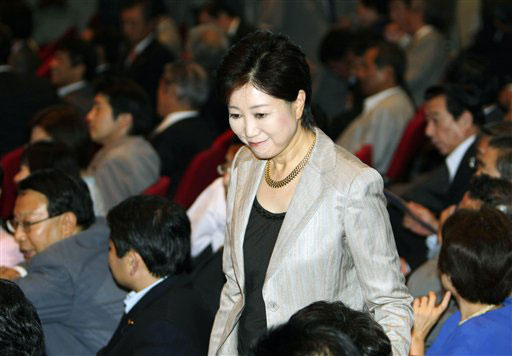
Koike rarrives at a general meeting of the LDP's Diet members at LDP headquarters in Tokyo, Japan, Wednesday, Sept. 3, 2008, two days after Fukuda abruptly announced his resignation.
(AP Photo/Shizuo Kambayashi)
Other prospects to replace Fukuda, who abruptly resigned this week, include cabinet member Sadakazu Tanigaki and lawmaker Nobuteru Ishihara, the son of Tokyo's governor. Taro Aso, a colorful former foreign minister, has indicated a strong desire to run and has been singled out by analysts as the current favorite.
The government announced it would have to shift some international meetings due to the political fallout from Fukuda's resignation. A trilateral summit scheduled with China and South Korea scheduled for later this month was postponed, officials said Wednesday, and plans for the defense minister to visit the United States have also been put on hold.
Official campaigning for the post of ruling Liberal Democratic Party president begins on Sept. 10, and candidates must secure the backing of at least 20 supporters to run. The party vote will be held on Sept. 22.
Ruling party officials have said they want to see multiple candidates run in the party race, which they hope to use as an opportunity to trumpet their policies and the differences between themselves and the main opposition party, the Democrats.
Following the party election, Japan's parliament will convene on Sept. 24 to vote on a successor to Fukuda, news reports said Wednesday.
The parliament vote is largely a formality because the ruling party and its junior coalition partner have a comfortable majority in the powerful lower chamber, which has the final say, and the ruling party president generally becomes prime minister.
Fukuda resigned late Monday after less than a year in office, saying he could not break a deadlock with opposition parties that has seriously delayed his efforts to pass major legislation. Polls indicated voters were growing increasingly frustrated with his failures and dissatisfied with rising food and fuel prices.
But whoever replaces Fukuda was expected to face similar difficulties.
The Democrats are now calling for nationwide elections, saying the ruling party has lost its mandate with the public and its ability to effectively run the government. Many analysts believe the opposition, which now controls the upper house of parliament, could make big gains if elections were held soon.
The Liberal Democrats have controlled Japan's government for most of the post-World War II period.
9/3/2008 6:05 PM
By ERIC TALMADGE
Associated Press Writer
TOKYO