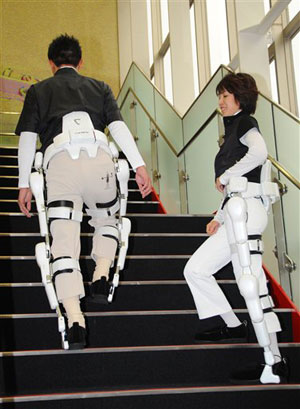
robotic suit that reads brain signals and helps people with mobility problems will be available to rent in Japan for $2,200 a month starting Friday — an invention that may have far-reaching benefits for the disabled and elderly.
HAL — short for "hybrid assistive limb" — is a computerized suit with sensors that read brain signals directing limb movement through the skin.
The 22-pound battery-operated computer system is belted to the waist. It captures the brain signals and relays them to mechanical leg braces strapped to the thighs and knees, which then provide robotic assistance to people as they walk.
Cyberdyne, a new company in Tsukuba outside Tokyo, will mass-produce HAL. Two people demonstrated the suits at the company's headquarters on Tuesday.
A demonstration video also showed a partially paralyzed person getting up from a chair and walking slowly wearing the HAL suit.
"We are ready to present this to the world," said Yoshiyuki Sankai, a University of Tsukuba professor who designed HAL.
Sankai, who has worked on robot suits since 1992 and is also Cyberdyne's chief executive, said a full device that covers the entire body is also being designed, though it is unclear when it will be available commercially.
HAL comes in three sizes — small, medium and large — and also has a one-leg version for a 150,000 yen, or $1,500, monthly rental fee.
Noel Sharkey is a robotics expert not affiliated with the technology. The professor at the University of Sheffield in the U.K. said HAL will have wide-ranging benefits for the elderly others with movement disabilities.
"HAL can only lead to extending the abilities of the elderly and keep them out of care for longer," Sharkey said in an e-mail to The Associated Press.
Cyberdyne said its policy is not to reveal how much it costs to manufacture the device. It is unclear when HAL will go on sale to the public or what the price tag will be.
Robotics technology is common in manufacturing sectors, but product liability concerns restrict its widespread use in everyday life. Sankai said the HAL technology is devoted to social welfare purposes only, adding he has refused requests from military officials to share it.
Some European nations have already expressed interest and HAL may soon be on the market there, but U.S. sales are still undecided, Sankai said.
The University of California, Berkeley, and other researchers around the world are working on similar robotic suits that increase mobility.