
|
404
Not Found
CAREER | PERSONALITIES | FEATURES | NEWS
NEW MILENNIUM OPPORTUNITIES
For Aoyama the key qualification that will give a candidate the biggest competitive edge is the ability to speak more than two foreign languages. Many first- and second-generation Asians speak their parents' native tongue. There are far fewer who can communicate with, say, the Shanghai stock market and the Tokyo press, or close a deal between a Korean electronics firm and a Brazilian contractor.
404
Not Found
An advanced degree, preferably an MBA, is essential. An undergraduate degree is simply not enough any more. "There are too many BAs around," says Aoyama with mild disdain. "Where you get your masters is important too. It should be from one of the top 20 business schools in the country. An MBA from a mediocre school doesnąt cut it." However, the advanced degree doesn't necessarily have to be in business. A masters or PhD in law, engineering, computer science or economics all help to make a would-be executive attractive, as long as he has some sort of advanced degree. Having degrees from two different countries isn't quite as important as the other qualifications, but it is clearly a sign that you are bi-cultural and probably bi-lingual. There's one other curious requirement Aoyama found in his study. Many of the 4,000 CEOs he interviewed were married to people from different countries or different ethnic backgrounds. "Suppose you are Japanese. Then your wife shouldn't be Japanese," he says with a chuckle. "And being an American married to an American doesn't cut it anymore in the multiethnic global corporation." A glass ceiling disappears. Perhaps another one falls into place. "We're looking for the perfect combination of culture and experience," says Aoyama. "With that and an MBA from the top 20 business schools, you're almost guaranteed to succeed." Frank Kim is a broker and financial consultant with Smith Barney, one of the nation's largest brokerage firms. He's young and he's in perhaps the most exciting and volatile field in the world: the stock market. There are only four Asians in his office of 150, and two of them are well-connected to Hong Kong. But Kim sees a change coming. "Everything in this business is done over the phone. In this business there are no racial barriers. It's all about how you present yourself." The stock market is anything but the stable career choice of past generations. It's a wild ride with its own share of rewards, financial and otherwise; a ride that more Asian Americans are climbing aboard. "I had an opportunity to work in my dad's company," Kim says, explaining that his father's company in Korea is a manufacturer of semiconductors. "I'm the oldest son, so I was supposed to. But I wanted to see what I could do on my own." It wasn't an easy struggle. He sent his resume three times to the same company, only to be refused each time. In determination, Kim offered to work without salary. "I figured that I could get in as an intern and show them what I could do." Not one to pass up unpaid labor, Smith Barney hired him as an intern. "I worked 12 hour days for free for months," he explains.
404
Not Found
|
With no sales experience and little stock market background, Kim was starting from the ground up and knew it. "I always thought 'if all else fails, I can always go back and work for my dad.'" Perhaps that's one reason he kept at it. After four long months of unpaid labor, Kim was given a break: an introductory salary and a corporate training course in New York. He was in. 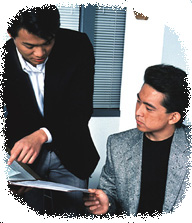
Kim loves the work, even when it's hard and pays little more than he was making as an intern. "The first couple of years consist of long hours and no money," he explains. But the eventual rewards can be phenomenal. "After 3 or 4 years, a broker averages 40 to 50 thousand a month. And the broker keeps 40% of that." The other reward lies in the sheer high energy of the stock world itself. "The stock market is exciting," says Kim. "Millions are made and millions are lost. You get to do international interactions and you get to see exactly what's going on around the world." Kim doesn't feel that he is above the kind of work his immigrant parents did. In fact, he sees himself as a direct link in his father's tradition. "My father came over here and made it on his own. If I want to maintain the lifestyle he's given to me and my family, I have to work my butt off." Chris Yee, a business major at the University of Irvine waxes enthusiastic when he speaks of a career in finance. It's not a new field for his family; his father is a high-ranking executive in a well-known California-based trans-Pacific bank. "I've always been around business," he says. "It's such a broad field and you can do a lot in it." Yee explains the lure that draws many who might have once gone into medicine. "In business, you're not limited. Even as a doctor, you have a cap on the number of patients you can see in a day. But in business you can have several deals all going on at once. There's no limit to what you can achieve." That seems to be the sentiment prevailing among young Asian American professionals in all the hot new growth fields to which they are being drawn in once unimagined numbers. [END] RETURN TO CAREER CENTER
|
||||