
|
PERSONALITIES | FEATURES | NEWS
WOMEN WITHOUT MEN
The net effect of the Joy Luck Club -- which could more aptly have been titled Joyless, Luckless Club -- is to reinforce existing strereotypes in which Asian life is miserable and cheap and Asian women are plentiful and available in the absence of virile, sympathetic Asian males. What's more, it subtly supports the notion that the faults of white males are superficial, even cute, and easily correctible (i.e., learning to use chopsticks, learning not to slop soy sauce on the mother-in-law's culinary masterpiece) while Asian males are incorrigible sadists and hopeless geeks. An Asian girl -- or boy for that matter -- would likely come away from the movie thinking that anything is preferable to marrying an Asian and suffering unrelenting misery. All this is made worse by the fact that the movie is directed by an Asian American though Tan's book was adapted for the screen by a veteran Hollywood screenwriter who probably had much to do with making the changes calculated to make the movie play to white audiences (like making the miserable tightwad, a White in the book, an Asian). Putting Wayne Wang's name on the thing as director says it's okay to look at Asians as a race of women without men. Despite all their rhetoric about being solicitous of the Asian image, neither Amy Tan nor Wayne Wang evidences concern about the stereotypes that Asian men must .suffer day in and day out. They've been turned into willing accomplices by the lure of Hollywood success. Then there's David Henry Hwang's M. Butterfly which not only won a Tony but will be turned into a movie. The main characters are a French diplomat and a Chinese male spy who becomes a drag queen to seduce the diplomat and steal state secrets. Don't ask me how the couple manage to be lovers for some ridiculous number of years. I know that this is supposed to be based on a real-life incident. I know that Hwang's artistic rationalization for writing the play is to show that racial preconceptions hurt both sides. But there's no escaping the play's visceral impact. The handsome, slightly effeminate John Lone playing a devious and cunning drag queen not only undercuts Asian masculinity on a fundamental level, it reinforces the image of Asians as being so debased that we would do anything for a cause. |
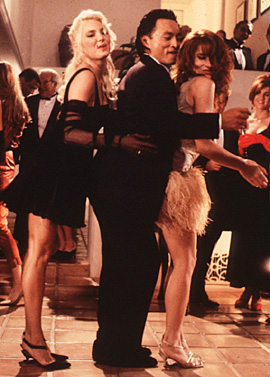
Rising Sun, starring Sean Connery and the charismatic Cary-Hiroyuki Tagawa, provided a badly needed relief from the usually sorry portrayal of Asian males but was booed by some on the ground that it made Japanese seem too threatening. Amy Tan and David Henry Hwang have rubber stamped the most egregiously offensive exploitation of Asian stereotypes in recent memory and we're supposed to applaud just because they're Asian. Yet we're supposed to rise up in outrage over a movie like Rising Sun which treated Asian males with far more dignity than either of the so-called Asian American works. At least Rising Sun portrayed Asian men as effective, fun-loving and virile. Rather than blindly applauding the likes of David Henry Hwang, Amy Tan and Wayne Wang just because they're Asians, no matter what kind of offensive drivel they produce, let's ask ourselves this question: How would we feel about their works if they had been written and produced by non-Asians? By that test we would be outraged. Should our response be different because Asians are the nominal creative forces behind them? On the contrary, I think we should be even more outraged that they've let themselves be used as proxies for the white imagination. Asian artists who let their imaginations get coopted that way are the saddest victims of racial strereotyping.
|
||||