
|
PERSONALITIES | FEATURES | NEWS
HOLLYWOOD'S ASIAN STRATEGY
Gray knows whence he speaks. It was he, as a young studio executive in the 1970s, who first exported Jackie Chan's films to the South American market, beginning his long-standing relationship with Golden Harvest. Asked if the Hollywood-Hong Kong connection could be analogous to the pupil coming back to teach the teacher, Gray, whose company imports and distributes Hong Kong films to the American market, confesses that the notion bears a degree of truth. "Hong Kong took American movies and added their own Hong Kong style," he says. "Then Hollywood saw it and said, 'Hey, this is really unique. This is fantastic!' But they've forgotten where it originally came from." Gray's comments suggest some differences of opinion concerning Hollywood's real agenda for Hong Kong talent. The truth is, both views are correct. That's why, in the end, Hollywood's Hong Kong relationship seems certain to strengthen. "Hollywood has to make a good film with universal characteristics that will appeal to Europeans, Latin Americans, Africans and Asians," Gray points out. "What they're doing now is using the strengths of Asian talent for the greater, wider audiences. That's what is significant." Lee Stollman, whose clients at the William Morris Agency include Chow Yun-Fat and director Kirk Wong, agrees. "Two-thirds of revenues are coming from foreign markets. The domestic box office is only a small portion of the big picture now." Regarding Chow Yun-Fat, who will make his American debut next year opposite Mira Sorvino in The Replacement Killers, Stollman explains the agency's strategy matter-of-factly. William Morris, Stollman claims, has no internal strategy for attracting Asian talent. The strength of their Asian roster suggests otherwise. In addition to Chow, Wong and John Woo, clients include Jackie Chan's Supercop director and co-star Stanley Tong and former Miss Malaysia Michelle Khan. "William Morris is a company that's a hundred years old and very aggressive in the foreign markets to begin with," Stollman says. "We've identified that there is a real window of opportunity right now in Asia and I think the studios have also recognized that window. What we're trying to do is bridge the gap between Asia and the U.S. in terms of helping bring forth new talent." "And they're all making Van Damme films!" laughs Klein of the fact that by mid-1997, three of Hong Kong's most acclaimed directors--John Woo, Ringo Lam and Tsui Hark--will have made their Hollywood debuts with the one American star who is definitely not respected in Hong Kong: Jean-Claude Van Damme. Ringo Lam's Van Damme debut Maximum Risk (previously titled Bloodstone and The Exchange) is due for release later this year while Hark's The Colony is slated for 1997. More curious is the fact that neither Woo, Lam nor Hark is known as a martial arts specialist. Woo, who is currently re-teaming with Travolta and Nicolas Cage on Face-Off, is often berated by fans for having strayed so far from his gangster film roots. Many observers claim to be mystified by this tendency to plant Asian directors in unfamiliar, even hostile terrain, but Klein still sees Hollywood operating from a long-term perspective. "I think those directors might want to do stuff with Asian subject matter," he continues, "but strategically they can't. They are coming over, proving themselves to the American studios. Nobody is going to take the chance on letting them direct Chow Yun-Fat for their first American directorial effort. They want to use Steven Seagal, Van Damme or, if they're lucky, Arnold. But they have to show that they can make profitable films within the studio framework." |

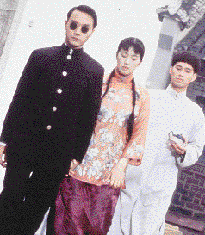
Chen Kaige's Temptress Moon, to be released in the U.S. in January, is the latest high-profile mainland production to get the ax from China's censors. Below, Chen calls the shots. 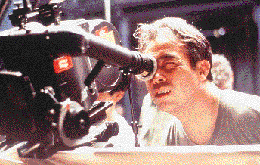
A less obvious, though equally significant factor in the success of Hong Kong talent, says Mun, is the easily overlooked fact that most of them speak English. And though the language skills may vary--Chow hardly speaks the language while Michelle Khan speaks it fluently--it is a sobering fact that no foreign actor or director has ever succeeded in Hollywood without learning English sooner or later. Outside of Hong Kong, in fact, only Taiwanese director Ang Lee--who was educated in the United States--and mainland actress Joan Chen have made the jump to Hollywood. Only Gong Li, famous for her collaborations with Chen Kaige and former companion Zhang Yimou, has been courted by Hollywood despite her almost non-existent English. She declined the chance to star opposite Robert De Niro and Al Pacino in last year's Heat, saying that she will make the move to Hollywood only when her English is acceptably good for American audiences. She clearly knows the rules. Meanwhile, with Asian stars and directors faring well stateside and traditional Hollywood product faring equally well throughout Asia, the studios seem content to leave well enough alone, even if it's probably not quite the scenario they originally had in mind. But then sating Asian appetites for entertainment has never been among Hollywood's more daunting challenges. If anything, American films have proven too popular, causing some nations to fear for the health of their own fragile film industries. In markets where Hollywood has long enjoyed domination--like Japan, Corea and Taiwan--Mun expects to see little change. "Sure, they'd love to find the next Wayne Wang or Ang Lee, but there are so many people already in Hollywood. And they've had the Asian markets already without having Asian talent. Hollywood will always be Hollywood whether they have Asian talent or not." PAGE 4 | Page 1 | 2 | 3 | 4 | 5 | 6 | 7 |
|
||||
 or his part, Woo appears to have been entirely absorbed into the
Hollywood studio framework with his first two stateside outings, the
Jean-Claude Van Damme actioner Hard Target and the recent John
Travolta hit Broken Arrow. If anything, it looks as though Hollywood's
attraction to Hong Kong talent may be equally, if not more motivated by
domestic markets than Eastern ones.
or his part, Woo appears to have been entirely absorbed into the
Hollywood studio framework with his first two stateside outings, the
Jean-Claude Van Damme actioner Hard Target and the recent John
Travolta hit Broken Arrow. If anything, it looks as though Hollywood's
attraction to Hong Kong talent may be equally, if not more motivated by
domestic markets than Eastern ones.