
|
PERSONALITIES | FEATURES | NEWS
TWO DEATHS, NO JUSTICE
Rodney Peairs told police that he was in the den watching television and talking to his father on the telephone in the moments before the fateful incident. He left the den and was on his way to the kitchen when the doorbell rang. He told his son, Greg, to find out who was at the door. His wife, however, was already doing that. Moments later Peairs heard her slam the carport door shut and shout for him to get the gun. Peairs, a 30-year-old meat cutter at a local grocery store, did as his wife commanded. He went to their bedroom and retrieved a large firearm from the top shelf of his closet. It was a .44-magnum handgun, a stainless stell Smith & Wesson wiht an eight-inch barrel and Leupold scope. Peairs then went to the carport door, opened it and stood in the doorway as he sought out the source of the disturbance. At first he was nothing. Then he caught a glimpse of "movement" in the area behind his truck parked in the driveway. Moments later Yoshi, who was decked out like John Travolta in Saturday Night Fever for the Halloween party, began walking toward Peairs. He tried to tell him in his broken English that they had arrived for the Halloween party. His companion, Webb Haymaker, saw the gun in Peairs's hand and tried to call Yoshi back. But the Japanese youngster kept moving forward, certain that they had found the party. In his confusion and apprehension, Peairs badly misjudged the situation. Instead of a friendly young man inquiring about a Halloween party, he saw a threatening intruder who meant to harm him and his family. He told police that the stranger was waving his hands and saying something he could not understand and he moved briskly toward the carport door. Peairs ordered Yoshi to "freeze" and then fired a single shot when he continued toward him. Peairs thought he struck the intruder in the shoulder but didn't venture outside to determine the extent of the damage. He slammed the door and locked it and told his wife to call 911. Yoshi was struck in the upper left chest, not the shoulder. Webb screamed for help. A neighbor who heard the gunshot arrived shortly thereafter and helped Webb try to resuscitate his friend. Their efforts were in vain. According to the pathology report, the projectile had pierced the upper and lower lobes of his left lung and exited through the area of the seventh rib. Yoshi aspirated blood and other bodily fluids and minutes later died from loss of blood. After the shooting the Peairs family huddled together in the kitchen, ignoring the tumult outside their carport door. They would wait for the arrival of police and emergency medical workers before venturing outside. Badly shaken and in tears, Rodney Peairs told his family to pray with him. One of his children later told police that her mother asked Peairs, "Why did you shoot him?" |
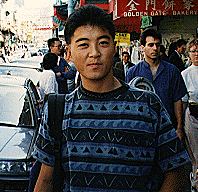
The slaying made national headlines in both the U.S. and Japan. The Japanese were outraged. In their country very few homeowners are allowed to own a firearm and fatal shootings are usually associated with organized crime. Yoshi's death reinforced their belief that America's streets are rife with guns, violence and a growing lawlessness. That sentiment was bolstered by the shooting of another Japanese exchange student, 25-year-old Masakazu Kuriyama, in August. Kuriyama was discovered near a transit station in Concord, California, with bullet wounds in the head. He died a day later. At presstime, police had no motive in the slaying and had not ruled out the possibility that it was a hate crime. Japanese television networks provided intensive coverage of the Hattori incident, which became known as "the freeze case". Many Japanese and Americans feared the slaying would exacerbate already strained relations between the two countries. In early July, nearly nine months after the shooting, President Clinton apologized to Yoshi's parents, Masaichi and Mieko, in a 10-minute phone call to their Nagoya home. After Yoshi's funeral, the Hattoris had released a statement that expressed their anger and frustration. "The thing we must really despise, more than the criminal, is the American law that permits people to own guns." Peairs was charged with manslaughter and, if convicted, faced a maximum of 40 years in prison. His lawyers argued that he was justified in shooting Hattori because he feared for his family's safety. Under Louisiana's "shoot the burglar" law, a person is allowed to use deadly force to protect his home from an intruder. The fact that Yoshi was a foreigner, indeed a Japanese national, certainly did not harm Peairs' chances of acquittal. Prosecutors argued that Peairs could have avoided the deadly confrontation by merely stepping back inside his home. It sounds so simple. Lock the door and call the police. Peairs certainly made the wrong choice, but was it a criminal lapse of judgment? The prosecution would find out how difficult that would be to prove. PAGE 5
|
||||