Patrick Chu of Loiminchay: Pens of Extravagant Beauty
Patrick Chu plumbs the depths of history and cultural origins to create pens of extravagant beauty and startling originality.
PAGE 1 OF 2
|
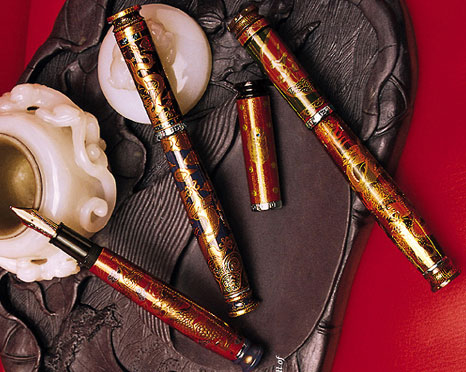
Loiminchay's Forbidden City Collection draws inspiration from the artistic and architectural motifs of various parts of the Forbidden Palace. Patrick Chu (below) was a longtime pen collector before starting Loiminchay. 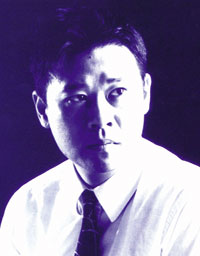
|
 n an age of laptops and PDAs, penmanship might appear a dying art. Putting up an exquisite stand is Patrick Chu. As founder and owner of Loiminchay, he creates what may be the world's most opulently beautiful Asian-themed writing instruments. Since Chu's first collection in 2001 Loiminchay pens have found inspiration in the richness of Asian history. They are fabricated using precious and semi-precious materials like gold, Chinese jade and Italian resin, according to honored Asian techniques.
Take Loiminchay's recent Forbidden City Collection. Each of the three pens depict one part of the Forbidden Palace: the Hall of Great Harmony, the Imperial Theater, and the Imperial Garden. Each locale's main visual theme is translated onto the pens using maki-e lacquer gilt with two-tone gold. Depending on whether one chooses the supreme or very high grade version, a Loiminchay pen may cost upwards of several times the price of a personal computer. They find a clientele among collectors and those in a position to capitalize handsomely by leaving an indelible impression on clients and business partners.
In starting Loiminchay Patrick Chu translated a personal passion for collecting beautiful pens into a way to share his equally strong love of his Asian cultural heritage. We spoke with him about the risks and rewards of turning a hobby into a business.
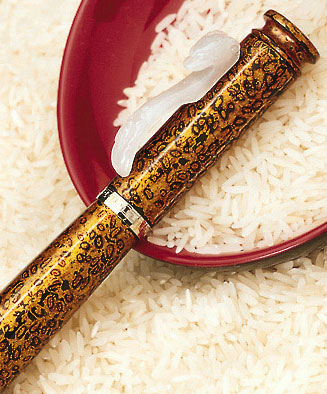
Only 63 pieces were produced of the Golden Mai collection. The pen's body is surfaced with a composite of rice grains, pure gold and urushi lacquer. |
GS: Take us back to the moment you decided to start Loiminchay.
PC: Over the years of collecting writing instruments, I
accumulated quite a collections. From time to time, I would examine
them, admire them, and play with them like a child playing with toys. In 1999 I decided to make my own pens under the Loiminchay name.
I searched back to my roots — 5000 years of Chinese art and culture. Dragon and jade come in the picture, and of course, the Chinese porcelain vases as well. Combining the three, I came up with my first Qian Long pen. On the surface, these three elements have no relationship with any of my collections of vintage and contemporary pens.
To pay tribute to the old fountain pen masters, I chose ebonite (the
original material used for fountain pens) for my pen body, no. 8 giant
nib with ebonite feeder (the largest size and flexible nib, as well as the
original feeder material). To be more specific, my first pen- Qian Long is a tribute to Mr. Waterman.
GS: What was the biggest obstacle you had to overcome in starting up
Loiminchay?
PC: Since the beginning, Loiminchay's philosophy is to produce the best
quality, high-end artistic pens. It's a rare breed in today's
budget driven world. Each product is an artistic statement in its finest and
purest form. It is simply an extraction from the best, from materials
to artistry.
To pay tribute to the old fountain pen masters, I chose ebonite (the
original material used for fountain pens) for my pen body, no. 8 giant
nib with ebonite feeder (the largest size and flexible nib, as well as the
original feeder material). To be more specific, my first pen- Qian Long is a tribute to Mr. Waterman.
We found the most difficulty in finding the right factories, studio and artisans (worldwide) to work separately on various parts and process of a pen. Each process takes from 6 to 8 months to over several years. Then we assemble them in one factory in France. Every part of the pen needs to be precise so they can fit together. And of course, deciding which pen design is more marketable is quite a risk.
GS: Take us through the process of creating a pen — the design, the
manufacture, craftsmanship, as well as the time frames involved.
PC: It is pretty complicated since each idea takes various amount of
time. On average, each pen collection takes around 1-1/2 to 2-1/2 years to
complete. Let's take our Forbidden City Maki-e pen as an example. I started the Loiminchay collections with Emperor Qian Long's art
collections as inspiration. For years, we have the idea of creating
something inspired by the Forbidden City Palace, its romance, its
inhabitants, its architecture, its art collectionsÉ The list goes on.
We chose Maki-e as one form of expression for this Forbidden City
Collection. We selected 3 different locations in the Forbidden
Palace for this 3-pen set.
The Hall of Great Harmony is the main Hall. The
exterior structure of the Hall of Great Harmony is extremely elegant
and luxurious. Its interior is just as grand and decorative, a highly
dramatic setting for the Emperors to ascend the throne. Twenty-four
pillars (each 13 some meters high and 1 meter in diameter) stand on all
sides of the elevated golden throne. The six central pillars are
decorated with dragons gilded in genuine two-tone gold, and the rest of
the pillars are painted with rich red lacquer. The Loiminchay Forbidden City maki-e lacquer pen named the Hall of Harmony has several lively
dragons swirling around the pen body, representing the Imperial status and of course there's the pillar of the pen itself.
PAGE 2
| “Each product is an artistic statement in its finest and purest form.” |