Kim Ki-duk: Poet of Silent Pain
With 3-Iron, a film about a housebreaking drifter who rescues a lonely woman from an abusive marriage, director Kim Ki-duk secures his status as a master of elemental power.
by William Nakayama
PAGE 1 OF 2
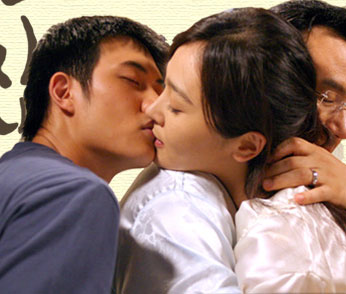
3-Iron stars Jae Hee as a young drifter who rescues a lonely housewife (Lee Seung-yeon) from an empty marriage.
|
Kim Ki-duk:
Poet of Silent Pain
 have been accustomed to a life quite different from other filmmakers,” says Kim.
That's an understatement. Anyone who has seen seen Spring, Summer, Fall, Winter and ... Spring (2004) will believe that Corean (Korean) director Kim Ki-duk's first careers were factory worker, soldier and an artist who studied in Paris,then sold paintings on the sidewalks of the French Riviera. Kim's works have an elemental focus that suggests the kind of indifference to the trappings of popular culture that can only come from an unusual range and depth of life experiences.
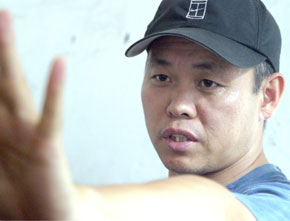
Kim Ki-duk has built up the kind of underground reputation that once beloned to Chen Kaige.
|
What is difficult to believe is that Kim didn't even begin filmmaking until the age of 35 and that he is now only 44.
“One day I awoke to discover the world of cinema and jumped into it,” he says with the kind of economy that characterizes every frame of his films.
Kim's entry into filmmaking was a screenplay he wrote entitled A Painter and a Criminal Condemned to Death. It won enough critical praise to earn Kim his directorial debut with Crocodile (1996). Since then every film has earned him increasingly lavish praise and recognition at Berlin, Sundance, Paris and Venice. A film that strikingly demonstrates Kim's ability to penetrate even the most emotionally charged political controversy to access elemental human relations is Address Unknown (2001) which looks dispassionately at the half-century U.S. military presence in Corea.
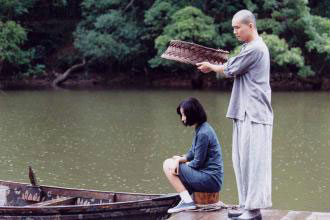
Spring, Summer, Fall, Winter... Spring is Kim's masterwork filled with scenes of silent power and elemental beauty.
|
Spring, Summer, Kim's seventh film, established his artistic stature with an elemental power and elegance reminiscent of Zhang Yimou's Red Sorghum. Set in a remote monastery, the film drives home with towering silences and relentless logic the inevitability of the human condition. It was followed by the bizarre Samaritan which won Kim the Silver Bear (best director) at the Berlin Film Festival, and 3-Iron, which won Best Director honors at Venice.
Superficially 3-Iron is a radical departure for Kim. Its setting is a modern upper-class neighborhood instead of the more stark backdrops favored by Kim in earlier works. Its plot unfolds in the context of a conventional albeit dysfunctional marriage instead of the asocial relationships in Spring, Summer.
PAGE 2
Page 1 |
2
|
“One day I awoke to discover the world of cinema and jumped into it.”
|