Stephen Chow: Kung Fu's Jim Carrey
PAGE 3 OF 3
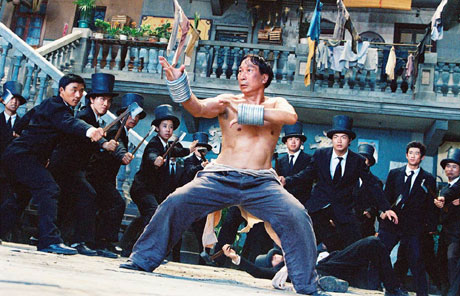
A heroic neighborhood man provides Sing an example of a heroic martial arts master.
Stephen Chow:
Kung Fu's Jim Carrey
Another inspiration for Chow has been the worldwide success of Crouching Tiger, Hidden Dragon, and more recently, of Zhang Yimou's Hero — films that elevated martial arts films to a new level of artistry. He has seen how Hollywood resources were used to produce fresh action effects in The Matrix.
Kung Fu Hustle follows the evolution of kung fu movie styles, notes executive producer Bill Borden. “At the beginning of the movie it's more 1970s — the Bruce Lee style. Then it moves to the 1980s — a more acrobatic Jackie Chan style. Then in the final scene theres more of a Matrix style where special effects come in. The movie recognizes where the martial arts film came from, where they are currently at, and where they are going in terms of filmmaking.”
What makes Kung Fu Hustle a typical Stephen Chow film is that, at heart, it's the story is a likable underdog forced to take on powerful foes.
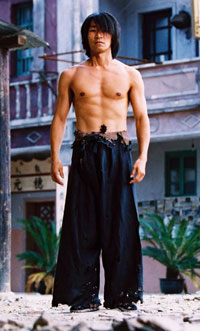
Sing ponders his fate as he considers taking on the Axe Gang.
|
“In the beginning Sing is too poor to buy any clothing himself, so all his stuff is either borrowed or stolen,” says costume designer Shirley Chan. “Then he joins the gang and starts wearing suits. Later he moves to his higher self and has a totally different look, very Chinese, elegant.”
Stephen Chow leaves an unmistakeable stamp on every one of his films. He has always been “a director playing an actor,” in the eyes of producer Jeff Lau. “When he acts, he has the mindset of a director,” says Lau, who directed Chow in A Chinese Odyssey. “For each scene, he had his own ideas and we would discuss them, then I would combine them with my ideas. It was very exciting. As an actor, he is not simply playing an isolated scene, he's also thinking about the scenes that come directly before and after.”
Chow's acting ability that gives Kung Fu Hustle its universal appeal, says Borden.
“Stephen's gift is the way he can translate his emotions without speaking. Shaolin Soccer is a great example. I have three kids who love this movie which is in Cantonese with English subtitles. They each watched this film 15 times and sometimes with the English subtitles off and it doesn't matter.”
Despite a hectic schedule Chow tries to practice martial arts at least an hour every day. “I realize that I can't become a great martial arts artist,” he admits, “but at least I can make a martial arts film in which I am a kung fu expert. It's been my dream as a filmmaker since I started making my own movies.”
Stephen Chow was born one of three children to a “very poor” Hong Kong family. His kung fu training had to stop after six weeks when his family could no longer afford lessons. Chow started his entertainment career as the host of a TV children's show, 430 Space Shuttle. His comic talents attracted attention, and in 1989 he began acting in films. His portrayal of a supporting character in Final Justice (1989) won him the best supporting actor award at the Taipei Golden Horse Awards. A year later Chow won his first starring role in All for the Winner (1990), a Chow Yun-Fat spoof. Chow's hilarious performance as the lovable underdogs made him an overnight sensation in Hong Kong and throughout Asia. Critics have also credited Chow with giving birth to the “nonsense” comedy genre.
Today Chow is Hong Kong's undisputed king of comedy. Justice My Foot won him the best actor award at the 1992 Asian Pacific Film Awards. He won the 1996 Hong Kong Critics Society Awards and the Hong Kong Golden Bauhinia Film Awards for A Chinese Odyssey. God of Cookery (1996), which he wrote and produced, (1996) was his first directorial effort and kicked off a new era in which Chow became a full-fledged filmmaker. King of Comedy (1999) impressed Quentin Tarantino enough to call Chow Hong Kong's best actor. Shaolin Soccer (2001) became Hong Kong's third highest-grossing film of all time. At the Hong Kong Film Awards it won awards for Best Actor, Best Picture, Best Director, Best Supporting Actor, Best Sound Design and Best Visual Effects.
Page 1 |
2 |
3
|
“I have three kids who love this movie which is in Cantonese with English subtitles. They each watched this film 15 times and sometimes with the English subtitles off.”
|