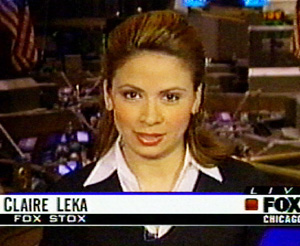
CL: My career ambition is to someday work for a news magazine. I would like to branch out of business reporting as well. I feel confident that I will reach my goals. But remember it is not a race -- its a marathon.
GS: When you say you want to work for a news magazine, do you mean print?
CL: No, a newsmagazine like Dateline or 60 minutes where I could do in-depth stories on people and subjects. I did quite a few long format pieces when I worked in Washington DC at Conus/First Business and Reuters Television here in New York. Some of the subjects I covered included a profile on Alan Greenspan, Federal Reserve Chairman, The Millenium, Kids and Investing, the Dot-com crash
GS: When you branch out of business journalism, what subject areas seem particularly appealing to you?
CL: I would love to do more profiles. I love talking to people and finding out what makes them tick. I would also love to cover national news stories like the Columbia Space Shuttle Disaster.
GS: As a correspondent we would imagine your routine is quite different from that of most of us. What is your daily routine, starting with the moment you open your eyes?
CL: I wake up around 6:30 a.m. - 7 a.m. My toddler son is my alarm clock. You can't turn him off. I go get coffee at Starbucks. A grande latte with extra foam. One for me and one for my husband. We sit and drink and read the newspapers. He reads the NY Times. I read the Wall Street Journal.
I look at the web for 1/2 an hour. My favorite sites are CBS Marketwatch, BBC (For "real" news, NY Times.) I try to scan all three before I go into work. Yahoo! Finance is also on my list.
After that I play with my son for 1/2 an hour until his nanny comes. Once she comes in I get ready for work. I do all my makeup and hair on the set. We have a makeup artist down there so it helps.
Once I get to work I prepare my scripts. I write everything. I don't have a producer. I make calls downstairs to trading desks to get a feeling for what's going on.
I am ready to go on air by 11:45am. My first live shot is at 11:50am.
My last live shot is at 7:15pm.
GS: How do you spend the odd chunks of time between live news feeds?
CL: I don't have much time between feeds, 15 -20 minutes, so I am constantly on the internet researching companies, monitoring the wires and calling sources. You always feel like you are on the treadmill.
GS: What made you decide to become a TV journalist at $25 a day after getting your masters in journalism?
CL: Well, that only lasted for two months. You have to get your start somewhere and entry level reporting jobs pay notoriously low wages.
GS: How old were you when you got your first job in Hagerstown, Maryland?
CL: I was 24
GS: How is the money these days? How does it compare with other careers you might have pursued?
CL: Money is much better now. But my advice to aspiring on-air reporters is "do what you love -- the money will come." I am sure I could have made more money if I got into Investment Banking. I do what I love. I don't do it for the money. Only a select few like, Katie Couric get paid 45 million dollars. The rest of us are workhorses.
GS: Where were you born? Tell us a bit about your childhood.
CL: I was born in Washington, DC and grew up there. I had a good childhood. It was a bit lonely because I was an only child and I was separted from my cousins who lived in the Philippines.
GS: What effect did being half Filipino play in your early life?
CL: I felt like an outsider from a very early age. I went to private school, so most of my classmates, if not all, were white. I was the only child of color besides one black girl. I think it was very difficult on me. Living in Washington DC was not very racially mixed either. We don't have a very big Asian community there. My father also doesn't speak taglog and my Mother never taught me.
Once I got older, I liked being different especially in college.
GS: How has your ethnicity influenced your professional life?
CL: I think it has been positive. It gives me a good sense of self.
GS: What have been your best professional moments?
CL: Covering the aftermath of 9/11 for CNN, Covering Dow 10,000 was quite exciting!! Interviewing the Chairman of the Stock Exchange, Dick Grasso for Reuters TV. Interviewing Deepak Chopra when I was 28 years old at First Business. PAGE 3