|
Asian Americans
|
|||||||||
|
PERSONALITIES | FEATURES | NEWS
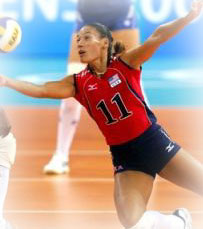
Asian Americans in Athens Yoshida was lucky to have the return of two veterans who had been stellar at the 2000 Olympics. Both are Asian Americans from Hawaii. Robyn Ah Mow-Santos had started all seven matches in Sydney. She took the Best Setter Award in the 2001 NORCEZA Zone Championships. The birth to her first child in February of 2003 didn't keep her from winning the award again at the 2003 Zone Championships. Yoshida praised her deceptive touch and ability to isolate blockers to create one-on-one situations. Not surprising given that she was the all-time assists leader (4,313) during her career at the University of Hawaii. |
|
||||||||
|
HOME | PERSONALITIES | FEATURES | NEWS |
|||||||||
That sudden rise may have been the monkeywrench in the gears engineered so laborously over the past three and a half years. From decades of success as the underdog scoring upsets over powers like Cuba, Russia and China, the U.S. women suddenly found themselves in the Olympic opener against a Chinese team ranked two notches below them. The result was a four-set loss — even in the absence of China's top player. The demoralizing effect of the loss was evident in their second match against Germany: running scared, the U.S. women scrambled to win a tight four-setter.
The dangers of top dog status for the U.S. women was again painfully evident in their shocking 5-set loss to the Dominican Republic. Overcome by errors, the Americans fell prey to the hunger of the desperate Dominicans. Their next loss to a solid Russian team was honorable, but faced them with the humiliating prospect of being eliminated. Again, their survival instincts were rekindled, and the U.S. women came alive behind Logan Tom's 19 points to give the powerful Cuban team a straight-sets thrashing. But the U.S. women had depleted their store of adrenaline for one Olympic games. Their quarterfinals matchup against the unbeaten Brazilian steamroller was exciting until the fifth set when the U.S. women seemed to have been reduced to walking dead. The experience was a heartbreaking lesson to Coach Yoshida of the dangers of peaking two weeks too soon.
More Disappointments Table tennis may be the butt of Olympic jokes in the U.S. but for three-quarters of the world's TV viewers, including Asia and much of Europe, it's a prestige event. With four Asian American Olympians (Gao Jun, Tawny Banh and Whitney Ping on the women's side, and Khoa Nguyen on the men's), the sport offered an opportunity for Asian Americans to make a visible medal contribution. It wasn't to be. Ping and Nguyen were eliminated in the first round. The third round match of the women's doubles team of Gao Jun and Tawny Banh against Corea (Korea) was broadcast on the Today Show, only to have a broader audience witness the Asian Americans being shut out in four straight sets. The last remaining hope for a U.S. gold was in women's singles. Gao Jun had won two gold medals in the 2003 Pan Am Games, but the Athens curse proved too much. She lost her third-round match in straight sets to a 15-year-old Japanese girl she was expected to dominate easily.
Badminton isn't a marquee sport, even in distant lands, but the doubles team of Kevin Han and Howard Bach were ranked 12th internationally. Medal hopes came alive after they got off to a brilliant start with an easy two-set first-round win over South Africa. The elation was short-lived: two days later the Asian American duo lost to Denmark in straight sets (15-6, 15-4) and were eliminated. The U.S. isn't an Olympic power in judo and taekwondo. Contrary to expectations, Asian Americans didn't figure on the U.S. team in those sports. More surprisingly, karate isn't even an Olympic sport yet. If it were, Asian Americans like George Kotaka and Elisa Au -- who rank at the top internationally -- might well have brightened the Asian American medal picture. Maybe in Beijing. |
|
||||||||