

Generalized Health Data Collection Is Killing Some Asian Americans
By J. J. Ghosh | 05 May, 2026
Failure to distinguish among Asian segments has deprived some subgroups of necessary treatment for cancers and cardiovascular diseases.
“Asian American” Is Not a Health Category. Treating It Like One Is Killing People.
There’s a statistic that frequently gets cited when the subject of AAPI health comes up: Asian Americans are, on average, among the healthiest racial groups in the United States.
Lower rates of heart disease. Strong cancer survival numbers. High life expectancy.
That obviously sounds like great news, and for some of us, it is. But for others, the statistics are actively dangerous.

Failure to distinguish between AAPI ethnicities results in a failure to provide the right care
Two recent studies — one on breast cancer survival rates and one on cardiovascular disease — arrive at the same uncomfortable conclusion from different directions: when you lump all Asian Americans together into a single data category, you hide the fact that some subgroups within that category are doing significantly worse than others.
And because the data hides it, the healthcare system doesn’t respond to it. And because the healthcare system doesn’t respond to it, people get sicker than they need to, and some of them die.
This is not a niche academic debate. It’s a structural problem in how American medicine sees — or more precisely, fails to see — one of the country’s fastest-growing communities.
What the Breast Cancer Data Shows
Let’s start with two facts that seem contradictory: AAPI communities have some of the highest cancer survival rates of any group in the country. And yet cancer is the leading cause of death among Asian American, Native Hawaiian, and Pacific Islander populations.
In other words: we are still better off than any other group who is diagnosed with cancer. But cancer is so prevalent in our communities that it still hits us harder than other causes of death do. And as it stands, many of the cancer deaths in our community are still happening needlessly.
When researchers broke “Asian American” down into its actual component groups, what they found was striking.
Looking at over 578,000 women with early-stage breast cancer, the ten-year overall survival rate for Asian Americans and Pacific Islanders as a group was 91%.
But that number masked enormous variation: East Asian women had a 92% survival rate, South Asian women 90%, Southeast Asian women 90% — and Native Hawaiian and Pacific Islander women just 83%.
A 9-point gap may not sound dramatic on paper. In practice, across thousands of patients, it means thousands of lives.
On adjusted analysis, Native Hawaiian and Pacific Islander women had significantly worse survival compared to white women — a disparity that is completely invisible when the data is aggregated.
The treatment delay numbers are equally troubling.
After surgery, breast cancer patients typically need radiation — and the faster that happens, the better. The median number of days between surgery and radiation was 68 days for East Asian women. For Native Hawaiian and Pacific Islander women, it was 81 days — a gap of nearly two weeks that, compounded across thousands of patients, translates into meaningfully worse outcomes.
Why the delays?
The research points to a combination of factors: language barriers, lack of culturally competent care, geographic distance from treatment centers, lower rates of health insurance, and a medical system that has historically under-resourced communities that fall outside its standard categories.
Hospitals that may think they are sufficiently equipped to care for AAPI communities may only be equipped to care for some of them. And that could mean a death sentence for the rest.
What the heart Disease Data Shows
The cardiovascular picture tells a similar story — different disease, same broken system.
Start with heart failure, which is exactly what it sounds like: the heart becoming too weak to pump blood effectively. When researchers looked at heart failure rates across Asian American subgroups separately rather than as one group, the differences were significant.
Southeast Asian patients — Vietnamese, Filipino, Cambodian, and others — had meaningfully higher rates of dying within a year of a heart failure diagnosis than East Asian patients like Chinese, Japanese, and Korean Americans. Grouped together, that gap disappears into an average. Separated out, it becomes a crisis that nobody is responding to.
The story is similarly uneven across other heart conditions.
Among South Asian patients, Asian Indians tend to have lower rates of coronary heart disease than Pakistani and Bangladeshi patients — likely because they have lower rates of high blood pressure. Filipino and Vietnamese adults, meanwhile, tend to have higher levels of LDL cholesterol — the kind commonly called “bad cholesterol” — and high triglycerides, which is a type of fat in the blood that at elevated levels raises the risk of stroke.
These are manageable conditions when caught and treated. They’re more dangerous when the research infrastructure doesn’t flag them as a priority.
Then there’s the diagnostic accuracy problem, which may be the most troubling piece of all.
Doctors use a standardized calculator to estimate a patient’s risk of cardiovascular disease — essentially a formula that takes in factors like age, blood pressure, and cholesterol levels and spits out a risk score that guides treatment decisions. If your score is high enough, you get a statin or other intervention. If it isn’t, you might not.
The problem: this calculator was not built on data that adequately included Asian Americans.
And when researchers tested it against real outcomes, they found it was overestimating cardiovascular risk for Asian Americans by anywhere from 20 to 60% — meaning it was, in many cases, telling doctors their Asian American patients were at higher risk than they actually were. The error varied significantly depending on which Asian subgroup the patient was from.
A calculator that doesn’t work correctly for your ethnicity is not a minor inconvenience. It is a tool that may be guiding your doctor toward the wrong treatment decision — and neither of you would necessarily know it.
Why This Keeps Happening
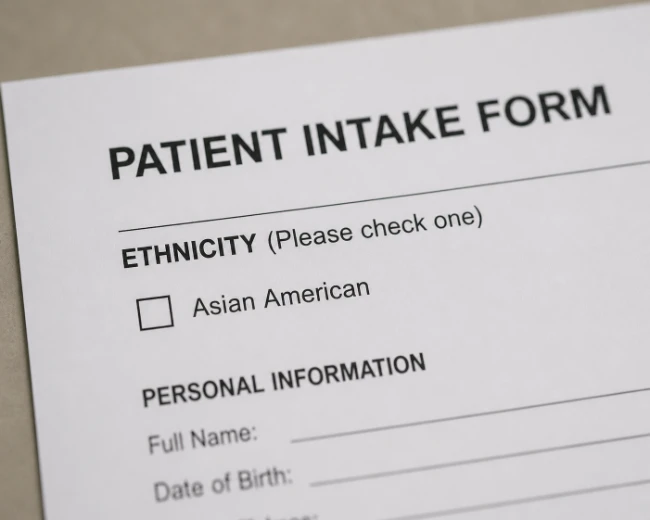
The root problem is a data collection failure that’s been baked into American medicine for decades. And it starts with a form.
When you fill out paperwork at a doctor’s office or hospital, you are typically asked to identify your race. The options usually include something like “Asian” or “Asian American” as a single checkbox. No further detail required.
That checkbox is where the problem begins — because that single data point is what gets fed into research databases, insurance systems, and public health reports. Chinese American, Hmong American, Native Hawaiian — same box. Same category. Treated as interchangeable.
For years Asian Americans were either grouped this way or classified as “other” entirely — a label that, in research terms, means your data either gets lumped in with everyone else or quietly set aside because the sample size is too small to analyze.
The Framingham Heart Study and the Cardiovascular Health Study, which are two of the most important long-term research projects in the history of American cardiology, largely fell into this trap. The cardiovascular guidelines that doctors follow today were built on data that didn’t adequately include Asian American subgroups.
Why Has This Persisted?
Part of it is practical: collecting disaggregated data — meaning data broken down by specific ethnicity rather than broad racial category — requires larger sample sizes and more resources.
Part of it is about where research funding flows, and which communities have historically had the political power to demand it.
And part of it is something more insidious: the model minority myth has a medical dimension that doesn’t get discussed enough. When the aggregate numbers for Asian Americans look good — and they often do, because East Asian subgroups tend to have strong health outcomes that pull the average up — there is less urgency to look closer.
The good headline statistic becomes institutional permission not to ask the follow-up question.
But that headline statistic is doing something harmful: it’s averaging together communities with vastly different health realities and calling the result a fact.
A Japanese American woman in Los Angeles with a regular doctor, good insurance, and access to preventive screenings is not the same health story as a Native Hawaiian woman in a rural area who saw a doctor twice last year.
Treating them as the same data point does not help either of them. It just makes the system feel like it has things under control when it doesn’t.
What Needs to Change
The fix isn’t complicated in concept, even if it requires sustained effort in practice.
First: mandatory data disaggregation. Clinical trials and government-sponsored studies need to be required to include accessible disaggregated data by Asian American subgroup. This isn’t a radical ask. It’s the same standard we apply to other racial and ethnic categories, and it’s achievable with the right institutional will.
Second: the medical tools need to be recalibrated. Risk calculators, screening guidelines, and diagnostic benchmarks were built on data that underrepresents Asian American subgroups. The established breast cancer biomarkers, benchmarks, and screening guidelines may not be optimally tailored to Asian women, and the inclusion of this group in future studies and development of risk models will be key. What’s true of breast cancer is true across cardiology, oncology, endocrinology, and most other fields.
Third: the healthcare workforce needs to reflect the communities it serves. Language barriers and cultural competence gaps aren’t soft issues. They’re measurable contributors to delayed diagnosis, delayed treatment, and worse outcomes. A Vietnamese-speaking patient who can’t fully communicate with her oncologist is at a structural disadvantage that has nothing to do with her biology.
Fourth: community-level outreach. Screening rates among Asian American women are lower than for other groups, and the reasons are well documented: distrust of the medical system, cultural stigma around certain diagnoses, lack of insurance, and geographic barriers. Closing these gaps requires meeting communities where they are, not waiting for them to navigate a system that was not designed with them in mind.
The Bottom Line
The good news buried in these studies is that the disparities are not invisible in principle — they’re just invisible when we refuse to look. The moment researchers disaggregated the data, the gaps appeared clearly. The gaps have been there all along. We’ve simply been choosing not to measure them precisely enough to act.
“Asian American” is a powerful identity category — politically, culturally, socially. But as a medical category, it is a blunt instrument that obscures more than it reveals. The communities that fall inside it are too diverse, too different in their risk profiles, their access to care, their cultural relationships with the healthcare system, and their specific disease burdens to be managed as a single group.
Some of them are, by aggregate measures, doing fine. Others are not.
And the ones who are not will keep being failed by a system that looks at the average and calls it a day — until we demand that it look harder.
A Japanese American woman in Los Angeles with a regular doctor, good insurance, and access to preventive screenings is not the same health story as a Native Hawaiian woman in a rural area who saw a doctor twice last year.
Recent Articles
- Job Openings Fell in March but Hiring and Layoffs Surged
- Musk Wanted $80 Billion to Colonize Mars Testifies OpenAI President
- Nasdaq Hits Record on Surging AI Chip Stocks
- Anthropic's Deep Push into Finance Tasks Likely to Disrupt Software Sector
- 'Yaris Moment' in the Works for Chinese Carmakers Chasing Overseas Growth
- Volvo's Q1 Full-EV Sales Rose 14% in Challenging Market
- Hong Kong Q1 GDP Expanded Fastest in Nearly Five Years
- Hugo Boss Beats on Profit Despite Iran
- PayPal Q1 Beats on Top Line on Spending by Affluent Consumers
- Coinbase Cuts Workforce on Crypto Market Volatility