

Lee Sung Jin Emerges As a Great American Screenwriter
By JL Zhang | 05 May, 2026
The darkly comic penetration of society and character that Lee brings to life in Beef and other screen projects puts him in rarefied company.
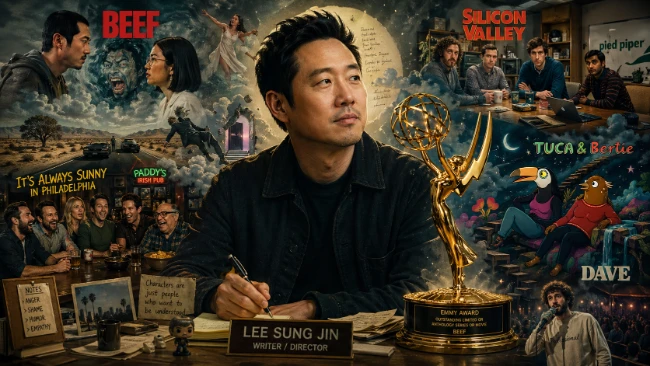
(Image by ChatGPT)
There's a version of this story where Lee Sung Jin — known to collaborators and fans alike as Sungie — never breaks through. He kicks around Hollywood for years, writes jokes for middling sitcoms, maybe lands a staff job on something forgettable, and slowly fades into the background noise of an industry that chews through writers the way it chews through everything else.
Scene from Season 2 of Beef (Netflix Video)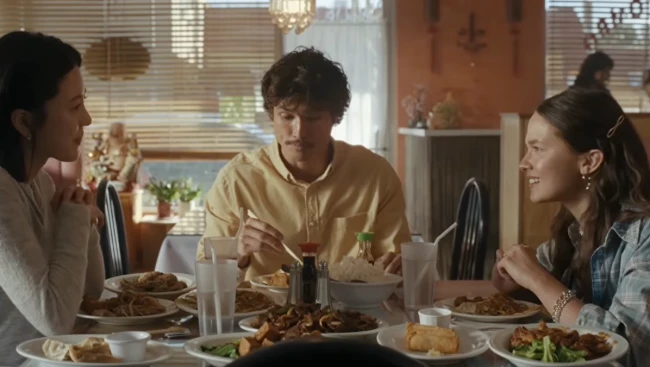
That version didn't happen. Instead, Sungie writes *Beef*, the 2023 Netflix limited series about a road rage incident between two strangers that spirals into an all-consuming war of mutual destruction, and overnight he becomes one of the most talked-about voices in American television. Overnight, in this case, meaning after roughly fifteen years of grinding.
Scene from Season 2 of Beef (Netflix Video)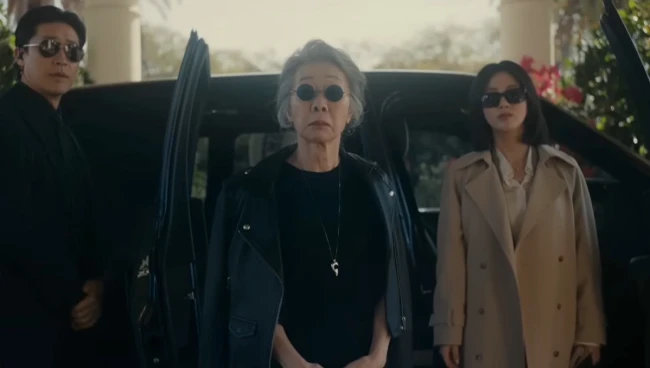
The speed at which the critical establishment anointed him was almost comical, as if the industry had collectively agreed to pretend he'd materialized from thin air. He hadn't. But the work was so singular, so obviously unlike anything else on television, that the hyperbole felt earned. Beef isn't just a good show. It's the kind of show that makes you wonder why nobody had written it before — and then makes you realize that almost nobody else could have.
What Beef Actually Does
Let's get specific, because the show deserves specificity. Beef stars Steven Yeun as Danny Cho, a down-on-his-luck contractor who nearly gets run off the road in a Home Depot parking lot, and Ali Wong as Amy Lau, the driver who nearly runs him off it. They don't exchange insurance information. They exchange gestures, and then they exchange increasingly unhinged acts of retaliation, and then they exchange something far more uncomfortable: the unfiltered truth about themselves.
The road rage is the hook, but the show's actual subject is the gap between who we present ourselves to be and who we actually are. Danny lives in a fantasy of familial obligation and deferred American success. Amy has constructed a life that looks, from the outside, like everything anyone could want — a beautiful home, a thriving business, a handsome husband — and is quietly going insane inside it. Both of them are drowning. Neither of them can say so out loud. The feud becomes the only honest thing in their lives.
What Lee does with this premise is structurally rigorous and emotionally reckless in the best possible way. He plots the show like a thriller, ratcheting tension across ten episodes with the discipline of someone who understands that chaos has to be orchestrated. But he writes the characters like a novelist — with interiority, with contradiction, with the willingness to let them be genuinely ugly without losing our sympathy. That combination is harder than it looks. Most prestige television settles for one or the other. *Beef* insists on both, simultaneously, at full throttle.
The Comedy That Isn't Comfortable
Here's the thing people sometimes miss about Lee's work: it's funny. Not warm-funny, not quirky-funny, but the kind of funny that makes you feel slightly implicated in your own laughter. A character does something so self-destructive, so nakedly human in its stupidity, that you laugh before you can stop yourself, and then you sit with what that laugh reveals about you.
This is a very specific skill, and one not universally appreciated. Dark comedy is easy to claim and hard to execute. The failure mode — and it's everywhere — is mistaking bleakness for depth, or cruelty for edge. Lee avoids this because he actually likes his characters. Even when Danny is doing something genuinely terrible, even when Amy is making a choice you can see will devastate everyone around her, there's an authorial warmth underneath it — not forgiveness exactly, but understanding. The sense that the writer has looked at these people clearly and decided they're worth the trouble.
That generosity is what separates satire from misanthropy, and it's what allows *Beef* to be genuinely devastating in its final stretch. You wouldn't care if you hadn't been laughing. The comedy is load-bearing.
An Immigrant's Frequency
Lee was born in South Korea and grew up in New Jersey, and his biography isn't incidental to his art — it's central to it. *Beef* is a Korean-American show in the sense that it's populated with Korean-American and Asian-American characters navigating a world that was not originally built with them in mind. But it's also an immigrant show in a broader, more essential sense. Its characters are all, in one way or another, performing a version of themselves that they hope will be acceptable, legible, successful — and exhausting themselves in the performance.
This is terrain that the Great American Novel has always occupied. The literature of immigration and assimilation, from the late nineteenth century onward, has consistently been some of the most electric writing produced on this continent, precisely because the immigrant perspective renders the country's foundational contradictions visible in ways that familiarity tends to obscure. Lee is working in that tradition, just on a streaming platform, with Steven Yeun throwing a bucket of urine into someone's house.
The comparison to literary tradition isn't meant to make the show sound stuffy — it's meant to explain why it hits so hard. *Beef* lands with the force it does because Lee is writing about something real and unresolved, something that American culture is still genuinely confused about, and he's writing about it from the inside. That's not a perspective you can fake.
How He Got Here
Lee's path to Beef included stints on Undone, the rotoscope-animated Amazon drama, and Dave, the Lil Dicky FX comedy that was considerably weirder and more interesting than its premise suggested. These weren't massive mainstream hits, but they were shows with distinct voices, and Lee's fingerprints were on both of them. He was developing his toolkit — learning how to sustain tonal complexity across episodes, how to use genre conventions as containers for something more personal, how to write around the edges of what network and streaming executives expected.
This kind of gradual, below-the-radar development is actually the traditional path for writers who eventually produce something great. The writers' room is a brutal apprenticeship, but it's also an education, and the writers who emerge from it with their sensibility intact — rather than sanded down to industry average — tend to be the ones who eventually do something that matters. Lee came out the other side.
Season 2 Goes Uphill, in Every Sense
If the first season of Beef was about people clinging to the bottom rungs of the California dream, the second — which premiered on Netflix in April 2026 — is about what happens to people once they've grabbed hold of a higher rung and discovered it's just as precarious up there. The setting has shifted from Home Depot parking lots and struggling small businesses to an exclusive country club in Ojai, that very California enclave of wellness retreats and wine country affluence where the rich go to convince themselves they've earned their peace of mind. They haven't, of course. That's the joke.
Season 2 is an anthology — new cast, new beef, same corrosive worldview — and Lee described his intent with characteristic precision: if Season 1's conflict was overt and aggressive, Season 2's would be the inverse, a passive-aggressive beef, which is, as he put it, more true to life, especially in a workplace.
The new premise involves Ashley (Cailee Spaeny) and Austin (Charles Melton), a young, broke Gen Z couple employed at the club, who accidentally witness a violent blowup between their millennial boss Josh (Oscar Isaac) and his wife Lindsay (Carey Mulligan). What follows is blackmail, coercion, and the kind of psychological warfare that looks perfectly civil from across a dining room. Holding it all together — and ultimately pulling everyone's strings — is Chairwoman Park, played by Korean cinema legend Youn Yuh-jung, a billionaire whose late-life romance with Dr. Kim, played by Parasite's Song Kang-ho, is entangled in a brewing scandal.
The Korean anchor is no afterthought. Chairwoman Park is the fulcrum around which all the class anxiety pivots, and the casting of Youn and Song — two titans of Korean film — signals that Lee isn't broadening his canvas so much as deepening it.
What's remarkable about the season is how deliberately Lee expanded his targets while keeping his cultural specificity intact. Season 1 was essentially a two-hander about Korean-American and Asian-American strivers locked in a death spiral. Season 2 opens the frame to include white millennials strangling each other over a Ojai property and a B&B dream, white-collar power dynamics, and the generational gap between people who thought they'd figured out adulthood and the younger generation rapidly figuring out they've been handed a much worse deal.
Lee's commentary on capitalism and aspiration gets broader, but the Korean characters at the center — Chairwoman Park in particular — give it a specific gravitational pull. The immigrant gaze remains. It's just turned on a wider swath of the landscape.
Critics received it warmly, if not unanimously at the stratospheric level of Season 1. The season landed an 87 percent approval rating on Rotten Tomatoes, with reviewers praising Lee's mastery of class satire and the quality of the ensemble. USA Today called it every bit the excruciating masterpiece the first season was. Some found the plotting more tangled and overstuffed than Season 1's lean two-character engine, a fair enough observation, but even the skeptics generally conceded that the ambition was real and the execution was well above the prestige TV average.
In Rarefied Company
When critics started reaching for comparisons after the first Beef dropped, the names that came up were telling: Paul Thomas Anderson, the Coen Brothers, early Alexander Payne. These are filmmakers who work in a mode that might be called American grotesque — darkly funny, socially acute, interested in the gap between aspiration and reality, committed to the idea that terrible behavior can be both comic and tragic at once. It's a tradition with deep roots in American literature, running through Flannery O'Connor and Nathanael West and further back than that.
Season 2 only reinforces those comparisons. The country club setting invites inevitable White Lotus references, but Lee's project is fundamentally different from Mike White's. Where White Lotus observes its wealthy characters with a kind of tourist's anthropological remove, Lee embeds himself in the contradictions. His characters don't exist to be gawked at. They exist to implicate you in their failures, to make you recognize something in their worst impulses that you'd rather not recognize.
Lee belongs in that rarefied company. That's not a small claim, and it shouldn't be hedged. Beef — both seasons of it — is the work of a writer who has internalized the form and the meaning of American storytelling: its obsession with self-reinvention, its ambivalence about success, its capacity for violence underneath the veneer of aspiration. The fact that he's doing it in a medium that didn't exist thirty years ago doesn't diminish the achievement. If anything, it makes it more interesting. The Great American Screenwriter is a newer category than the Great American Novelist, and it's still being defined.
The Work Ahead
Lee has been open about the fact that the original Beef came from something personal — that the anger animating the show was real anger, the kind that accumulates over years of feeling overlooked and underestimated and perpetually on the verge of something that keeps not arriving. He's also said he has three seasons mapped out. Season 2 suggests he's using that runway deliberately — expanding the social canvas one notch at a time, each season climbing a rung up the California class ladder while keeping Korean identity and immigrant perspective somewhere near the center of gravity.
That transformation — of personal grievance into universal art — is the whole ballgame, and it's as rare as it sounds. Most people who feel that anger either suppress it or weaponize it. Lee found a third option: he turned it into something that makes strangers feel less alone in their own suppressed fury, their own quiet desperation, their own Home Depot parking lot moments.
Whatever comes next, two seasons into Beef, Lee has done enough to matter. But it's also clearly not the end. Lee Sung Jin is the kind of writer who tends to do his best work when he has the most to say. He's got a lot to say. The rest of us are lucky he figured out how to say it.
Recent Articles
- Job Openings Fell in March but Hiring and Layoffs Surged
- Musk Wanted $80 Billion to Colonize Mars Testifies OpenAI President
- Nasdaq Hits Record on Surging AI Chip Stocks
- Anthropic's Deep Push into Finance Tasks Likely to Disrupt Software Sector
- 'Yaris Moment' in the Works for Chinese Carmakers Chasing Overseas Growth
- Volvo's Q1 Full-EV Sales Rose 14% in Challenging Market
- Hong Kong Q1 GDP Expanded Fastest in Nearly Five Years
- Hugo Boss Beats on Profit Despite Iran
- PayPal Q1 Beats on Top Line on Spending by Affluent Consumers
- Coinbase Cuts Workforce on Crypto Market Volatility