

Half-Asian Gatherings Sweep The Nation—Who's Welcome?
By J. J. Ghosh | 09 Jun, 2026
Mixed white and Asian meetups are popping up in cities across the country. The joy is real — so is the debate about who counts as Wasian enough to attend.
When Icelandic Chinese singer Laufey released her music video for “Madwoman,” the internet immediately fixated on the cast: Lola Tung from The Summer I Turned Pretty, Olympic gold medalist Alysa Liu, model Hudson Williams, and KATSEYE member Megan Skiendiel. All of them mixed white and Asian. All of them luminously, undeniably compelling on screen.
“Laufey collecting Wasians like Pokémon,” read one social media comment. “WASIAN AVENGERS,” cheered another.
And from that video, somehow, a movement was born.
Wasian is of course a portmanteau of white Asian, meant to describe those of half white and half Asian identity. And the term’s cultural resonance is going well beyond the internet.
Icelandic Chinese singer Laufey “Madwoman" music video.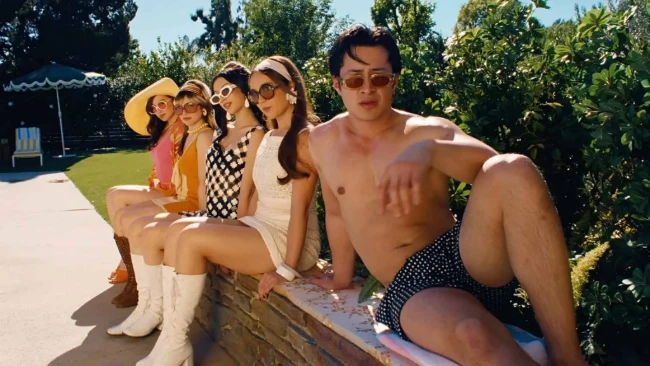
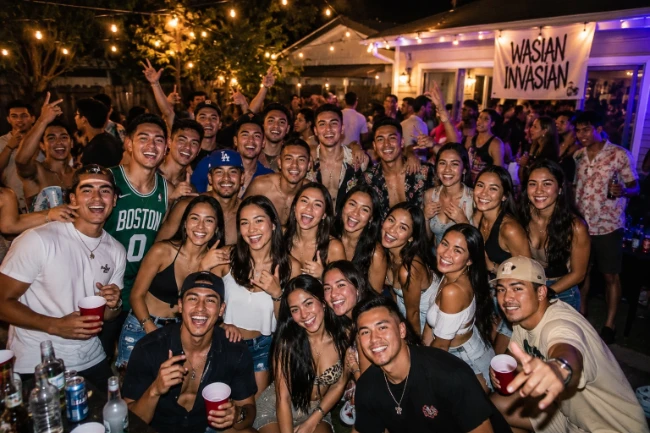
On May 10, a social meetup organized through community page Half Asian Spring drew more than 3,000 people to Central Park’s Sheep Meadow in New York City, where attendees filmed street interviews, joined celebrity look-alike contests, and celebrated shared experiences of growing up mixed-race.
Standing in the middle of it, one attendee described it as “almost like a family reunion of sorts — you could look across and feel like you vaguely know everyone around you.” The event spawned copycat gatherings across the country — San Francisco, Houston’s Memorial Park, and beyond. Harvard now has a Half Asian People’s Association. Mixed Asian meetups are, officially, a thing.
In some ways, this is great. Most celebrations of identity are. It’s also… complicated.
Why Now?
The term “Wasian” has been around since the early 2000s, but has never had this kind of cultural moment.
The timing makes sense if you follow the celebrity trail: Laufey, Olivia Rodrigo, Alysa Liu, Lola Tung, Henry Golding, Charles Melton — there is suddenly a critical mass of mixed white and Asian public figures who are visibly, specifically, unapologetically in the conversation at the same time.
When enough people who look like you are at the center of the culture simultaneously, the instinct to find each other makes sense.
There’s also something deeper happening. The gatherings reportedly served as a “third place” for mixed-race people who often felt excluded from both white and Asian-dominated spaces. That is the specific loneliness of the mixed experience: too ambiguous for one box, not enough for the other. Too Asian to be simply white, too white to be simply Asian. The kind of belonging that the Sheep Meadow crowd found on May 10 — “It felt very validating — I felt very visible for the first time in my life,” said Annabelle Oaklie, a stand-up comedian born to a white father and Korean mother — is not a small thing. It is, for many people in that crowd, a first.
But Who’s Invited?
Here’s where the party gets complicated.
Critics quickly pointed out that while the organizing group, Half Asian Spring, describes its mission as creating “half-Asian meetups around the United States,” the promotional materials, flyers, and videos focused almost exclusively on Wasians — people of mixed white and East Asian descent.
“As a Wasian who is half South Asian I also have no idea where I fit in this,” one user wrote on TikTok. “That’s something that frustrates me as a South Asian Wasian,” posted another. “As someone whose mom is Indian and whose dad is white, I’ve always had to clarify, ‘Yeah, I’m Wasian but you know my mom’s brown so I actually don’t count!’”
Black-Asian and Latino-Asian public figures rarely receive the same level of attention online or in entertainment. “The only mixed-race Asian representation that exists on this scale is Wasian representation,” TikTok creator Suyuscope explained. “The closer to whiteness you are in your mixed identity and in your appearance, the more legible and accepted your mixed identity is going to be.”
Commentators argued that the entertainment industry frequently elevates light-skinned, mixed-white Asian faces because they fit neatly into Eurocentric beauty ideals, while darker-skinned Asians, South Asians, Southeast Asians, and fully Asian individuals face continuous exclusion.
This is a legitimate critique. It is also, one suspects, a conversation the community will continue having at future meetups — which is itself a sign of health.
My Own Experience
I’ll admit my own reaction to all of this has been complicated — and not just as an observer.
As the son of a South Asian parent and a white parent, I feel like I can weigh in on this with some sincerity. The South Asian community — and the AAPI community as a whole — has never treated me like anything less than one of them. Whatever concerns I had about being fully accepted were entirely in my own head. The irony is that by breaking off to form a Wasian-only group, I would have been the one doing the excluding.
I think about a date I once went on, where an Indian woman paid me what she clearly intended as a compliment. She said she thought half-Indian guys were more attractive than Indian guys.
My knee-jerk reaction was to be proud. Until I stopped to think about what she was actually saying. The less Indian you are — in complexion, in cultural identity, in accent, in mannerisms — the more appealing you are. I wouldn’t have accepted that from a non-Indian woman. So why did I almost let it slide from her?
The Wasian meetups are joyful. The belonging people found in Sheep Meadow is real. The visibility of Laufey’s Wasian Avengers is genuinely meaningful for a generation of biracial kids who never saw themselves reflected anywhere.
But the community might want to do what I eventually did on that date: pause, let the initial rush of pride settle, and then ask what the celebration is actually saying about who counts and who doesn’t.
The joy is real. So is the question.
Commentators argued that the entertainment industry frequently elevates light-skinned, mixed-white Asian faces because they fit neatly into Eurocentric beauty ideals, while darker-skinned Asians, South Asians, Southeast Asians, and fully Asian individuals face continuous exclusion.
Recent Articles
- Corsair Sea Drone Rescues Crew of Crashed US Army Chopper Near Hormuz
- China Prepares $295 Billion Plan to Fund Nationwide AI Buildout
- Musk's Starlink Far Ahead of Bezos' Amazon in Wi-Fi Rush by Airlines
- Volvo-Parent Geely's Driver Assistance System Certified by EU
- Xi Embraces North Korea As Key Ally in Contest with US
- Samsung Electronics Considers Building Chip Packaging Plant
- How Honda’s CEO Survived a Putsch by the Old Guard
- Chinese Hackers' Spying Poses Biggest Threat to Tech Firms Says CrowdStrike
- J.M. Smucker Upbeat on Annual Profits on Higher Coffee Prices, At-Home Dining
- Embraer's Electric Aircraft Subsidiary Provides Revenue Boost