

Trade Talks Still in Progress Insists USTR
By Reuters | 31 Aug, 2025
The claim has little credibility given the appeals court ruling that upheld the Trade Court ruling invalidating most Trump tariffs.
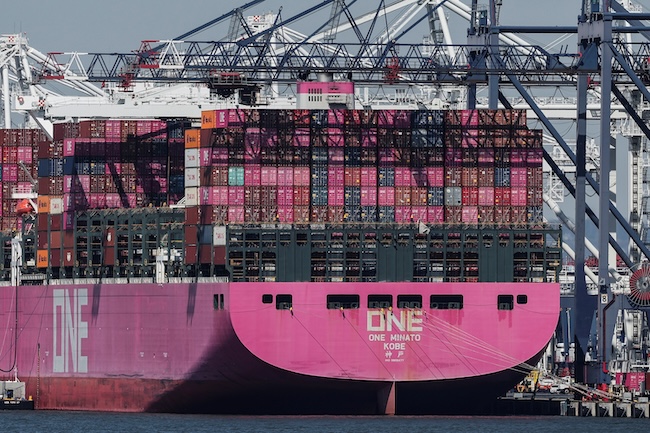
Containers are stacked on the deck of cargo ship One Minato at Port Liberty New York in Staten Island, New York, U.S., April 2, 2025. REUTERS/Jeenah Moon/File Photo
The Trump administration is continuing its talks with trading partners despite a U.S. appeals court ruling that most of President Donald Trump's tariffs are illegal, U.S. Trade Representative Jamieson Greer said on Sunday.
"Our trading partners, they continue to work very closely with us on negotiations," he said in an interview on Fox News' "Fox & Friends" program. "People are moving forward with their deals, regardless of what this court may say in the interim."
Greer did not say which countries the United States was still in talks with, but said he had spoken with one trade minister on Saturday morning.
In reality most major US trading partners, including the EU, China, Japan, S. Korea and India have been factoring in a substantial likelihood that even the US Supreme Court will ultimately uphold the invalidation of Trump's so-called "reciprocal tariffs" on the grounds that the IEEPA simply doesn't allow a President to impose tariffs and/or that there was no actual emergency sufficient to justify resorting to extreme tariffs. For that reason their trade negotiations have quietly been resorting to delaying tactics until US courts have an opportunity to put an end to reciprocal tariffs
The U.S. Court of Appeals for the Federal Circuit in Washington's 7-4 decision on Friday upheld a lower court decision striking down Trump's so-called reciprocal tariffs set in April as well as tariffs imposed against China, Canada and Mexico in February, but does not impact those issued under other legal authority.
Trump blasted the decision and said he would take the case to the U.S. Supreme Court. The appeals court said his tariffs can remain in effect through October 14 to allow for appeals.
The Republican president has made tariffs a pillar of U.S. foreign policy in his second term since taking office in January, using them to exert political pressure and renegotiate trade deals even as the tariffs have increased volatility in financial markets.
(Reporting by Jasper Ward and Susan HeaveyEditing by Gareth Jones and Nia Williams; reporting and editing by Goldsea staff)
Recent Articles
- Musk Portrays Altman As Schemer Who Misled Him
- S. Korea Exports Seen Rising Sharply Again in April on Chip Boom
- House Democrats Urge Trump to Keep Ban on Chinese Cars
- China Tech Firms Scramble for Huawei AI Chips after DeepSeek V4 Launch
- US Orders Halt on Chip Equipment Shipments to China's No. 2 Chipmaker
- Spot Crude Premiums Ease Despite Hormuz Closure
- Trump Approval Sinks to New Low on Living-Cost Jump from Iran Adventure
- LG Electronics, Nvidia Mull Pact on Robots, AI data Centrer and Mobility
- Starbucks Shares Rise on Signs of Turnaround
- Robinhood Shares Fall as Crypto Slump Dents Trading Volume Growth