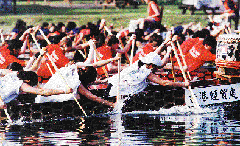
Dragon boat racing, a 2000-year-old celebration, is hosted by nearly every major City in Canada, drawing several hundred paddlers from teams across the country.
ASIAN CANADA
Page 3 of 5
Thomas Fung, Aberdeen Centre's owner, has managed to shoo away most of the sham businesses. He's in for the long haul and representative of the majority of Asian immigrants. Fung told Vancouver magazine about an employee of his who went back to Hong Kong for a better job. He lasted one month there. Colleagues who were once subordinates were now telling him what to do. He was ridiculed for failing in Canada. He came back.
| "My family were the pioneers. Whenever people see familiar faces, that's where they tend to go." |
|
Dragon boat racing, a 2000-year-old celebration, is hosted by nearly every major City in Canada, drawing several hundred paddlers from teams across the country. |
 nother planned development is having an even bigger impact. Terry
Hui, president and CEO of Concord Pacific Developments, has a few plans for
the former site of Expo 86 on False Creek's north shore in downtown
Vancouver. After 10 or 15 years and $3 billion, Concord Pacific Place will be
a 204-acre futuristic city, networking retail stores, offices and residential
areas with fiber optics automation. The 8,500 homes will be wired to
accommodate mobile control of lighting, gas fireplace, motorized blinds,
temperature, security system and even electronic appliances--all of which
can be activated by phone from anywhere in the world. Windows will use
LCD technology so they can go from transparent to opaque, blocking out the
sun's rays and ensuring privacy. All homes and offices will also be wired to
Fibre Net, which can transmit computer data at 45 megabits per second.
Residents will surf the Internet at lightning speeds and experience the full
spectrum of on-line multimedia.
nother planned development is having an even bigger impact. Terry
Hui, president and CEO of Concord Pacific Developments, has a few plans for
the former site of Expo 86 on False Creek's north shore in downtown
Vancouver. After 10 or 15 years and $3 billion, Concord Pacific Place will be
a 204-acre futuristic city, networking retail stores, offices and residential
areas with fiber optics automation. The 8,500 homes will be wired to
accommodate mobile control of lighting, gas fireplace, motorized blinds,
temperature, security system and even electronic appliances--all of which
can be activated by phone from anywhere in the world. Windows will use
LCD technology so they can go from transparent to opaque, blocking out the
sun's rays and ensuring privacy. All homes and offices will also be wired to
Fibre Net, which can transmit computer data at 45 megabits per second.
Residents will surf the Internet at lightning speeds and experience the full
spectrum of on-line multimedia.
Developer Hui may well be the unofficial head of Vancouver's
business establishment. The 32-year-old's vision for Pacific Place will
incorporate 40 high-rises and an equal number of low-rises, spanning the
equivalent of 50 city blocks. The effort is so enormous that, once completed,
Vancouver's center of gravity will actually shift southeast.
In keeping with Canada's commitment to the environment, the
development won't be 50 city blocks of concrete. Far from it. More than half
the site will be dedicated to the City of Vancouver for public
amenities--parks and open spaces, waterfront walkways and public art.
For many Asian immigrants, Canada is the real land of
opportunity. Tom Leung came to Vancouver from Hong Kong three years ago.
Within months he began work at Gordon's Film, a major North American
distributor of Asian films like John Woo's The Bullet In The Head. Now
he's the company's manager, handling 50 to 60 films a year. It's a good
business, and a growing one.
"Right now there are some big stars, like Jackie Chan and Chow
Yun-Fat. Those movies attract lots and lots of people," says Leung. So do the
movies based on comic book characters. "Teenagers these days only like to
read comic books--Japanese comic books."
Vancouverite Leung describes the relationship between Vancouver
and Richmond as akin to New York and New Jersey. During the week,
Richmond residents drive into Vancouver to work and on the weekend,
Vancouver residents like Lueng hit Richmond to shop.
The comparison may as well end there, however. "We don't have the
pollution and crime here like other cities," says Wilson of the Richmond
Chamber of Commerce. "It's not like parts of America. It's pretty safe here."
Page 4