
|
PERSONALITIES | FEATURES | NEWS
BIOTECH GOLDENBOY
"It was an incredible opportunity to see all these different cities," Kuo recalls fondly. "I was in Copenhagen, Stockholm, Amsterdam, Paris, London, Milan Rome, Florence and Frankfurt fifty million times, we'd drive all throughout Germany. I had unlimited international travel. "We had use of the company helicopter and jet. I used to take the company helicopter just to go to New Jersey sometimes when we're talking about a licensing deal. It was phenomenal. I had never ridden a helicopter before and not even in a Gulfstream IV which they had. It was incredible. It's the kind of job people in the pharmaceutical industry kill for because it allows them to stay in very expensive hotels and it's all on expense account. When you meet with colleagues in the other companies, a major part of the job is entertaining. Either you're entertaining them or they're entertaining you. It was a wonderful experience." "There's more licensing than you realize going on," Kuo says of the trend in the drug industry. "A lot of Merck's drugs are licensed, a lot of Pfizer's are licensed. Their highest-selling drug was licensed. They really want to license drugs which they can take to over $100 million. That's real money to them." "When a small biotech company comes up with a very interesting drug, they would put Merck, Abbott, Pfizer and Bristol-Myers Squibb on their list of people to contact. But if you had just visited them two months ago and other companies hadn't, you might be the first person they contact. That gives you a significant advantage in being able to fly out there and license it." The licensing and development department consisted of only nine executives and a handful of secretaries but enjoyed the dignity of being a division unto itself, occupying the entire 31st floor, just below the top floor of Pfizer's world headquarters. "It was incredibly spacious," Kuo recalls. "We had a big conference room, a small conference room, video conferencing. The place was designed to entertain and look impressive." The financial rewards of the position seem to have impressed Kuo considerably less. He doesn't complain about the six-figure salary but neither does he show any enthusiasm. "You didn't get an increase for living in New York where it's a little more expensive," he says. "They pretty much paid what pharmaceutical companies in New Jersey would. They also didn't give you very much equity, nothing to write home about." Around March of 1996, about ten months after he began at Pfizer, Kuo was approached by Steve Kanzer, a 32-year-old attorney and CPA who had been a colleague at The Castle Group where they had both worked for Lindsay Rosenwald. |
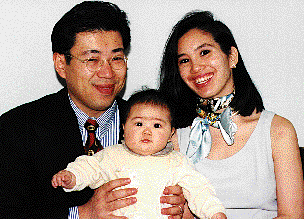
James Kuo with wife Gigi Pelaez Kuo, MD, and daughter Emmeline Susan Palaez Kuo. "I had always been in contact with everyone I had worked with," Kuo explains. "I have some of the people over for dinner at the apartment every year or two years. Usually I try to have people I know over and meet with them for lunch once a year, especially if they're in my geographical area, never thinking we'd necessarily do anything in the future. "Steve Kanzer just approached me and said he was putting together this company and would I be interested in being CEO. He thought I'd be perfect given my background and training." By the time Kanzer made that offer in March of 1996, the onetime Skadden Arps lawyer had become Rosenwald's right-hand man. When Kuo had left Rosenwald to join HealthCare Ventures, Kanzer had stayed on as The Castle Group's general counsel. In 1995 Rosenwald formed Paramount Capital as his 100%-owned investment bank for seeding and overseeing new biotech ventures and named Kanzer as senior managing director. Discovery's legal origins goes back to May of 1993 when Rosenwald incorporated a Delaware corporation called MicroBio Inc. It apparently lay dormant without employees or capital until late 1995 when he appointed Kanzer to serve as its part-time CEO. Prior to that MicroBio did nothing except issue large blocks of shares to Rosenwald and smaller blocks to Kanzer, members of Kanzer's family, and to Evan Myrianthopolous for having identified and introduced KL4-Surfactant. Between 1995 and March 1996 Rosenwald had made a series of small loans to MicroBio totaling $17,794 to be used for various administrative expenses. Rosenwald also personally guaranteed a $350,000 line of credit to enable MicroBio to license from the Charlotte-Mecklenberg Hospital Authority (CMHA) patents relating to the use of tyloxapol, the active ingredient in the SuperVent drug candidate. There are other connections between Paramount and DLI. As part of its placement agency contract, Paramount has also agreed to serve as DLI's Financial Advisory Agreement under which DLI pays Paramount $4,000 a month for a minimum of 24 months beginning November 7, 1996. What's more, Paramount is DLI's landlord. For $6,000 per month DLI shares Paramount's office space, phone lines, conference rooms and even copiers and fax machines on the 44th floor of 787 Seventh Avenue. PAGE 11 |Page 1 | 2 | 3 | 4 | 5 | 6 | 7 | 8 | 9 | 10 | 11 | 12 |
|
||||