
|
PERSONALITIES | FEATURES | NEWS
BIOTECH GOLDENBOY
The other part of Kuo's strategy for building a streamlined, bottom-line-oriented company is outsourcing research and development functions. As a result, DLI's staff of seven is only a fraction of the size of most companies with its product scope and at its stage of financing.
"It used to be that biotechnology companies would hire 30 people and have scientists and start laboratories and pilot manufacturing plants," he says. "Those activities didn't really bring any value to investors. Doing basic research in-house is not a wise thing to do. Universities are looking for sponsored research. Scientists at universities are far better than in private industry, so we sponsor research at Scripps Research Institute and other places and we feel we get better research and don't have to pay for bricks and mortar. "If we were to do it ourselves, we would have to rent laboratory space, buy centrifuges, laboratory benches, test tubes, reagents. You would pay about $60-70,000 a year for a typical bench scientist. You would have to double that for the supplies they use and increase it further for travel they would have to do and hire people to manage them. We just don't think that would be cost-effective when you're duplicating what's already available at the university. There are plenty of universities looking for sponsored research. They love to get that." The only drawback Kuo will acknowledge to outsourcing clinical research is the perception of outsiders. "A year or two ago, people wouldn't take you seriously. They would say, 'How can you possibly do anything with just seven people?' As more companies have successfully utilized this strategy--still the number is quite small--it's becoming accepted that the core management group would simply manage research contracted to various universities and profits are still being made and progress is still being made and capital goes further than doing things in house." He doesn't worry about potential leakage of trade secrets and proprietary technologies. Sponsored research agreements, he says, provides ample protection from the threat of technical piracy. "The only hangup is in publishing since universities have ambition to publicize research. Usually the compromise that's reached is that the scientists who had done the research won't publish until companies had a chance to review the data and patent if that should be the case. Kuo is working as CEO under a three-year contract which expires in March, 1999. Its renewal, Kuo says, "would be based on the fact that the company is successful, publicly trade and there's a valuation north of $200 million. "I would hope we can go from somewhere on the order of $34 million now to at least $100 million in a one year time frame. At the end of my employment contract I would hope it would be well over $200 million." To meet that rather ambitious timetable, Kuo knows that 1997 is the critical year lined with key milestones. DLI filed its SB-2 registration statement on January 7 and had begun meeting with prospective underwriters for a public offering Kuo hopes to hold in late spring or early summer. The SEC has reviewed the SB-2 and provided comments, to which DLI has provided responses. Kuo sees no reason the registration statement won't be declared effective in March or April. The precise timing and size of the public offering depends on the state of the biotech sector, the competition for deals and investor receptivity to DLI's business strategy. Kuo is confident a public offering will take place as planned. Even if one didn't, he's quick to add, DLI is sufficiently well capitalized with the $18 million in its coffers to last several years. So far its budget for 1997 is only $3 million. Around 70% of its budget is allocated for clinical trials which means the budget will jump quickly when clinical trials are fully underway on all three compounds. |
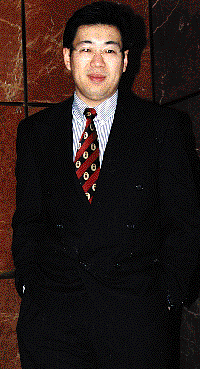
The clinical trials, Kuo admits, are the big unknown. DLI's strategy of using proven compounds certainly minimizes the uncertainty, but clinical testing involves many variables which can never be completely controlled. The SuperVent Phase I/II trials began mid March. Some time in the second quarter will begin the clinicals for KL4-Surfactant for MAS. The FDA has already signed off on DLI's proposed MAS testing protocol. Despite the fact that it has been undergoing advanced stages of clinical trials in Japan, the ST-630 trials will be the last to begin, probably some time toward late fall. DLI must first secure a supply of the compound made by a facility that meets FDA good manufacturing practices (GMP). Sumitomo and Taisho, ST-630's Japanese licensees, are reluctant to supply to DLI. "Any company that manufactures a drug used in a U.S. clinical trial must do it in accordance with GMP and are subject to inspection, including surprise inspections," says Kuo. "Since Sumitomo and Taisho are developing just for Japan, which is what their license calls for, they'd rather not be inspected." PAGE 5 |Page 1 | 2 | 3 | 4 | 5 | 6 | 7 | 8 | 9 | 10 | 11 | 12 |
|
||||