
|
PERSONALITIES | FEATURES | NEWS
BIOTECH GOLDENBOY
In fact, the only real uncertainty Kuo foresees for 1997 arises from the need to have a supply of ST-630 manufactured. "When we contract things out, it's out of our control. In the case of ST-630, we're going to have the drug made by two different companies. One will provide the actual bulk drug and the other's going to do the encapsulation. They're very reputable companies. They do work for major pharmaceutical companies, but you never know if a flood is going to hit them or a tornado or a snowstorm or icestorm or they get distracted or some other unforeseen problem." The risk of an act of an angry god certainly doesn't sound like the kind of thing that would keep a CEO awake nights. It isn't, a grinning Kuo admits. Everything suggests Kuo is very confident about DLI's prospects for meeting every objective for 1997. When that happens, he will have added the penultimate accomplishment for a young fast-track biotech CEO--a successful IPO making him a paper multi-millionaire.  ames Kuo was born in Taiwan on July 2, 1964, a year after his older
brother. His parents are ethnic Taiwanese who still speak Taiwanese at
home. James's mother was a schoolteacher and his father was a civil
engineer. The family immigrated to the U.S. in 1967 when James was three.
They settled in the Harrisburg, Pennsylvania area where they had neither
relatives nor other connections there. It was simply where the elder Kuo
found a job as a road engineer for the Pennsylvania Department of
Transportation. James's mother also found work with Penn DOT, typing
accident data into its computer system.
ames Kuo was born in Taiwan on July 2, 1964, a year after his older
brother. His parents are ethnic Taiwanese who still speak Taiwanese at
home. James's mother was a schoolteacher and his father was a civil
engineer. The family immigrated to the U.S. in 1967 when James was three.
They settled in the Harrisburg, Pennsylvania area where they had neither
relatives nor other connections there. It was simply where the elder Kuo
found a job as a road engineer for the Pennsylvania Department of
Transportation. James's mother also found work with Penn DOT, typing
accident data into its computer system.
"That was the difficult part of growing up," Kuo recalls. "We were alone, the four of us in a very isolated community." The two brothers focused on studies, spurred by sibling rivalry. "We're both competitive people," Kuo says. "He's probably more competitive than me. The relationship was partly based on competition. We pushed ourselves pretty hard. We still do." At Trinity High, a catholic school, James stayed in the top 5 or 10% of his class while playing on the basketball team and running cross country. In his sophomore year he managed to run a marathon. In the winter he spent weekends and evenings skiing at nearby Ski Roundtop, a mound with only 500 feet of vertical drop. It was enough to turn James into a practiced skier who lusted after the most difficult slopes. The really troublesome moguls in his young life were mostly on the social terrain. "Even though Harrisburg is not really that far midwest, the mentality of people is like that," he recalls. "That part of the country is mostly homogenous white caucasian with a large Catholic population. There weren't even any black people. By the time I graduated there might have been one or two other Asians and maybe one or two Blacks. "It was a tough situation. When you don't look like everyone else, I don't think you're always invited or belong to the crowd. And high school was a very cliquish environment. It was not easy socializing. I had to make an extra effort to do that. |
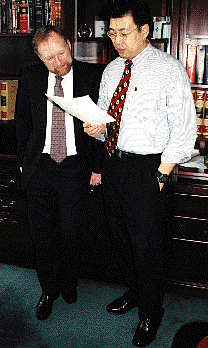
"I didn't date very much. I did go to the prom in my junior year but I didn't go out with too many women." The lack of dates Kuo attributes partly to his own shyness and partly to a general lack of social acceptance. Still James made some friends with whom he still keeps in touch, thanks mainly to athletics. The 5-9 Kuo wasn't the school's star guard but he did manage to run as high as number two on the cross-country team. Long before they even graduated from high school both Kuo and his brother set their sights on med school. To help finance their long and expensive educational odyssey, their parents began investing in residential rental property in and around Harrisburg. They used their savings and whatever they could borrow from banks and relatives to buy a handful of houses. They enjoyed some success in a fast-rising market and quickly moved up to apartment buildings. "You could buy a house in Harrisburg for $30,000 or $40,000 but you could buy an apartment building where the average cost would be $10,000 or less a unit." By the early 80s what had begun as a part-time sideline became lucrative enough to enable both to quit their jobs and devote all their energies toward building up their rental empire. Their sons were recruited into the family business. After school and weekends Kuo and his brother were mowing lawns, painting cupboards and fixing the plumbing. PAGE 6 |Page 1 | 2 | 3 | 4 | 5 | 6 | 7 | 8 | 9 | 10 | 11 | 12 |
|
||||