
|
PERSONALITIES | FEATURES | NEWS
BIOTECH GOLDENBOY
"I always thought one of my problems was that I wasn't really outgoing and I needed to gain that skill," Kuo says. "No one understood at the time why I wanted to do it. I also liked cars. I still like cars. I thought the sales experience would be valuable and my parents didn't care at that point because I had already gotten accepted to medical school. I think it's one of the most challenging fields you could do sales in. Everyone who comes into a car dealership essentially has a chip on his shoulder and thinks he's going to be ripped off. They gave me some training on how to do it but a lot of it comes from your own personal initiative." Kuo ended up doing well, placing second among the dealership's eight summer hires. His brief career as a car salesman ended that fall when he began med school at the University of Pennsylvania. It easily exceeded his expectations in terms on its demands. "It's a situation where you're going to classes eight hours a day," he recalls, "then you're studying eight hours after that. You don't' do too much other than eat and sleep. A lot of times you're just sleep deprived. I was sleep deprived for four years. Occasionally you'd try and play tennis on the weekends but it would be very minimal." On the other hand, he found medicine to be as enjoyable as he had dreamed it would be. "There are a lot of physicians who get really annoyed when patients call them in the middle of the night," Kuo says. "It never bothered me. I always felt it was good to feel needed, if you can help someone by writing a prescription or just showing up at their bedside." Kuo made up his mind to specialize in orthopedic surgery. He waxes rhapsodic about the event that inspired that decision during his first year of med school. "I had a chance to observe a cardiothoracic surgery. They gave me a little stool and I stood behind the chief surgeon and watched everything that was happening. Here these people were cutting open the chest and breaking the ribs and operating on the heart. Just the fact that in three or four years I could be one of these people doing a major part of the surgery--for someone that young to be involved in a situation like that, I thought it was like piloting a jet off an aircraft carrier. These guys are in their 20s and are responsible for these $25-million airplanes and they're at the center of it! In that operation there were several teams--one doing the bypass, one harvesting the veins from the legs to use for the bypass." |
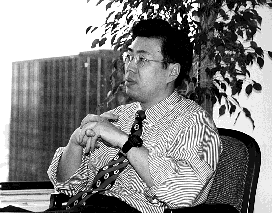
"It was a teaching hospital," continues Kuo, "so there must have been like 30 people in the room. I thought it was incredible, being part of that whole process, how you could fix someone up and see them later on that day and a few days later they'd be out the door to live as full a life as they can when before they were complaining of chest pain and not being able to walk a flight of stairs." The chance to have such a visible and dramatic impact on the lives of his patients was what attracted Kuo to orthopedic surgery. What deflated that starry-eyed enthusiasm was a remark tossed out by a respected surgeon. "It was second year going on third year," Kuo recalls. "Everything from second, third and fourth is really all together, there's no summer break. It's essentially one long process of several years. I was doing a rotation with a guy who's chief of orthopedic surgery. He told me that if he had to do it over again, he would do something else! "I thought, 'Why is this guy saying this? He has beautiful house in Gladyne, he was a collection of Jaguars and he's certainly not fearing any competition from me. He was just saying the whole field was changing. For hip replacement, they were having his patients come the morning of [surgery]. In hip operations you're operating very close to a dirty area of the body. You're supposed to do three series of washings to get rid of any bacteria which may be in the skin and contaminate the implant. The insurance companies were insisting these patients do the washing at home and arrive [at the hospital] the morning of. These patients had no idea what they were doing, they'd never had hip replacements. They're trying to read from instructions how to do all this. PAGE 8 |Page 1 | 2 | 3 | 4 | 5 | 6 | 7 | 8 | 9 | 10 | 11 | 12 |
|
||||