

GoldSea Streamers Guide to NETFLIX
By J. J. Ghosh | 19 May, 2026
Part 5 of an ongoing series assessing how streaming platforms are doing by us.

I'll just say it from the outset: Netflix gets an A grade for AAPI representation.
Granted, if Netflix is truly as Asian as we believe them to be, their parents will demand to know why it isn't an A+...which we'll also explain.
In the same way that Uber and Google are synonymous with rideshares and web searches, Netflix has come to epitomize streaming, regardless of what platform we're actually using. "Netflix and chill" for example, has definitely been used to refer to a similar activity involving Disney+.
Mindy Kaling's Never Have I Ever featured South and East Asians in lead roles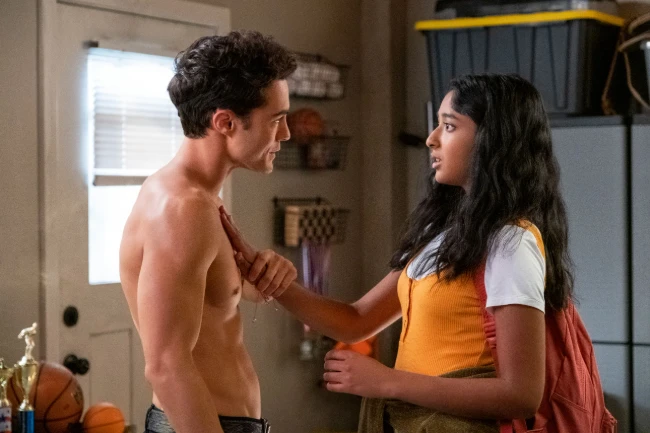
All of which is to say that the stakes are high for this one. Netflix — which began in 1997 as a mail-in DVD rental business before modernizing online film and series streaming in 2007 — does not lack for resources.
And here's how they're using those resources for our betterment.
The Hub
Netflix has a dedicated AAPI content collection called “Celebrate Asian American & Pacific Islander Stories,” which includes series, films, and specials starring AAPI talent.
It's organized into subcategories: AAPI behind-the-camera talent, AAPI stories for families, Asian comedy icons, Asian and Pacific Islander Hollywood stars, and culture and food across Asia and the Pacific Islands.
And it's the most granular AAPI hub of any platform we've reviewed in this series. Where Hulu organizes by content type, Apple by theme, and HBO by community spotlight, Netflix has built something that functions more like a cultural directory — one that acknowledges the AAPI community is not a monolith and doesn't treat it like one.
But the hub is only part of the story.
Malaysian comedian Ronny Chieng has 3 Netflix specials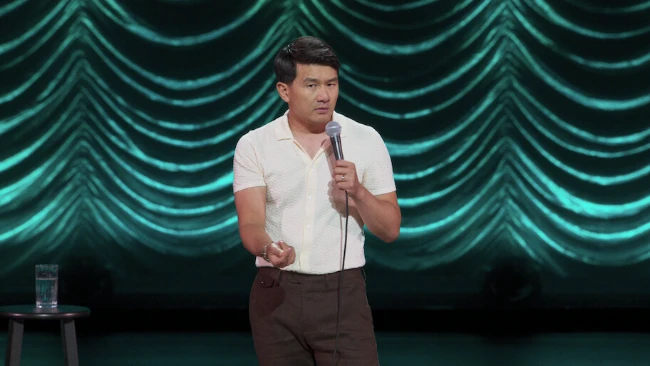
In January 2022, Netflix launched Golden — a dedicated social media channel on Instagram and YouTube celebrating the pan-Asian diaspora, spotlighting Asian talent both in front of and behind the camera.
The channel's name was inspired by the phrase “Real gold will always shine,” and the belief that all Asian stories are golden — and if given the opportunity, will shine. Golden has produced original social content including “Spill the Boba Tea,” a collaboration with Wong Fu Productions featuring Netflix stars in conversation at a boba cafe.
It's not just a content hub — it's a community-building operation that extends Netflix's AAPI commitment beyond the platform itself and into the cultural spaces where younger AAPI audiences actually live.
Golden was launched by Lucie Zhang, a first-generation Chinese American from the Midwest, who described the motivation plainly: “For me, being a part of the diaspora means existing in between cultures — and often feeling like you don't belong fully in either. With Golden, we want to give the Asian diaspora community a way to feel more connected to each other's cultures and their own.”
That isn't marketing language. It's a mission statement. And it puts Netflix in a category no other platform in this series occupies: one that's invested not just in AAPI content but in AAPI community infrastructure.
The Content List
Series:
Beef (Season 1: 2023, Season 2: 2026) — The crown jewel, and it's not close. Created by Lee Sung Jin, starring Steven Yeun and Ali Wong in Season 1, the show won five Emmy Awards including Outstanding Limited Series and has a 98% on Rotten Tomatoes. It's one of the best shows Netflix has ever produced, AAPI or otherwise — a Korean American road rage incident that unfolds into a meditation on class, identity, assimilation, and the specific loneliness of immigrant ambition in America. Season 2 premiered on April 16, 2026, with Oscar Isaac, Carey Mulligan, Charles Melton, Cailee Spaeny, and Youn Yuh-jung leading a new story set at a country club acquired by a South Korean billionaire. Early reviews suggest it doesn't quite reach the heights of Season 1, but the fact that Netflix renewed it and assembled another A-list cast is itself a statement of commitment.
Never Have I Ever (2020–2023) — Mindy Kaling's coming-of-age comedy about an Indian American teenager navigating grief, academics, and boys in suburban Los Angeles. It ran four seasons, built a devoted following, and remains one of the most specific and funny portrayals of South Asian American adolescence on any platform. Crucially, it ended on its own terms — which is rarer than it should be.
XO, Kitty (2023–present) — A spin-off of the To All the Boys franchise, centered on Korean American Kitty Song Covey attending school in Seoul. Season 3 premiered in April 2026. It's not prestige television. It's extremely watchable teen romance with more cultural texture than the genre usually attempts — and the fact that it keeps getting renewed is the market saying something.
One Piece (2023–present) — Netflix's live-action adaptation of the beloved manga and anime franchise premiered in 2023 to strong reviews and has introduced the story of Monkey D. Luffy and his crew to an entirely new generation of Western viewers. It's Japanese, not Japanese American — the same caveat we apply to Squid Game — but it's one of the most-watched things on Netflix, and it reflects a platform that has made a serious financial bet on Asian-origin content at the highest production level.
The Brothers Sun (2024) — Michelle Yeoh led this Taiwanese American family crime drama set in the San Gabriel Valley. Strong reviews. Passionate audience response. Cancelled after one season — the single most frustrating data point in Netflix's AAPI record, and one we'll address directly below.
Movies:
K-Pop Demon Hunters (2025) — The most-watched Netflix original movie of 2025 by a significant margin. An animated film about a K-pop girl group fighting demons that ended the year as the number one movie among every major demographic group Nielsen tracks. It's not a document of the Korean American experience. It is, however, proof that AAPI-centered content can achieve total mainstream crossover.
The Farewell (2019) — Lulu Wang's semi-autobiographical film about a Chinese American family keeping a terminal cancer diagnosis secret from their grandmother. Awkwafina gives the best dramatic performance of her career. One of the best films of the decade, period.
Always Be My Maybe (2019) — Ali Wong and Randall Park co-wrote and star in this San Francisco-set romantic comedy about childhood friends reuniting as adults. Warm, funny, and culturally specific in ways the rom-com genre rarely manages.
Standup:
Netflix has the strongest AAPI standup library of any platform in this series, and it's not close. Ronny Chieng: Asian Comedian Destroys America (2019), Speakeasy (2022), and Love to Hate It (2024), Ali Wong: Baby Cobra (2016) and Don Wong (2022), Jo Koy: In His Elements (2020), Sheng Wang: Sweet and Juicy (2023) — and a brand new Sheng Wang special in April 2026. When we talk about AAPI voices being given platforms, this shelf is what that actually looks like.
Room for Improvement
Netflix's AAPI record has two meaningful gaps worth naming.
The first is the Brothers Sun cancellation. A Taiwanese American family, the San Gabriel Valley, Michelle Yeoh, a genre that Hollywood has mined for Italian and Irish American stories for decades — one season, gone.
The pattern we identified at Apple TV+ applies here too: AAPI-centered content often needs more time to build its audience, and Netflix's cancellation trigger doesn't always leave room for that. Greenlighting diverse content and then cancelling it before it finds its footing isn't a representation strategy. It's a representation gesture.
The second gap is domestic versus international. Netflix's global investment in Korean, Japanese, and Southeast Asian content is substantial and real — Squid Game, the Korean drama pipeline, K-Pop Demon Hunters.
But the AAPI community in the United States, which watches Netflix in English, which grew up here, which has specific and underserved stories to tell, isn't the same audience as the global market for Korean dramas. Both deserve investment. The investment isn't interchangeable. South Asian American representation outside of Never Have I Ever remains thin. Pacific Islander representation is essentially absent.
These are real gaps. They're also gaps that exist against a backdrop of genuine achievement that no other platform in this series has matched.
The Honest Assessment
Netflix gets an A.
The standup library alone would put it ahead of most platforms. Beef is the defining AAPI prestige drama of the streaming era. Never Have I Ever gave South Asian American adolescence a four-season platform it had never had before.
The hub is the most thoughtfully organized of any platform we've reviewed. And the global scale of Netflix's investment in Asian storytelling — even accounting for the domestic-international distinction — reflects a platform that's made a genuine, sustained bet on this community.
Despite a couple of blemishes on Netflix's record, the reality is that Netflix has invested the most in AAPI storytelling, produced the most consequential AAPI content, and given the most AAPI voices a seat at the table.
That's what an A looks like. It doesn't mean perfect…as your immigrant parents will remind you. It means the standard everyone else in this series is being measured against.
Next up: Tubi.
© 2026 by Asian Media Group Inc.
That isn't marketing language. It's a mission statement. And it puts Netflix in a category no other platform in this series occupies: one that's invested not just in AAPI content but in AAPI community infrastructure.
Recent Articles
- Anthropic Allowed to Release Mythos AI Model to 'Tusted' US Organizations
- Apple Seeks Approval to Buy from Blacklisted Chinese Company to Ease Memory Crunch
- China's Industrial Profits Stay Resilient on Factories, Exports
- Meet the Teen Who Undertook a 7-Continent Solo Flight Against Cancer
- Getting Fit Pt. 2 - Raising Our Floor
- South Korea Survives World Cup Scare, Advances to Round of 32
- SpaceX Targets US Consumers with Starlink Mobile Service Push
- Former First Lady Kim Keon Hee Gets 7-Year Jail Term for Bribery
- Iran Reasserts Right to Control Hormuz Passage After Ship Hit Near Oman
- Trump's Cutoff of Clean Energy Tax Credit Drives Rush of New Projects Before Costs Soar