

How Asian Americans Built America's Most Liberal Great City
By H Y Nahm | 08 Apr, 2026
From its founding during the Gold Rush to financial hub for the tech industry, San Francisco took its atmosphere of independence and social freedom from Asian Americans who fought to secure vital rights for all Americans.
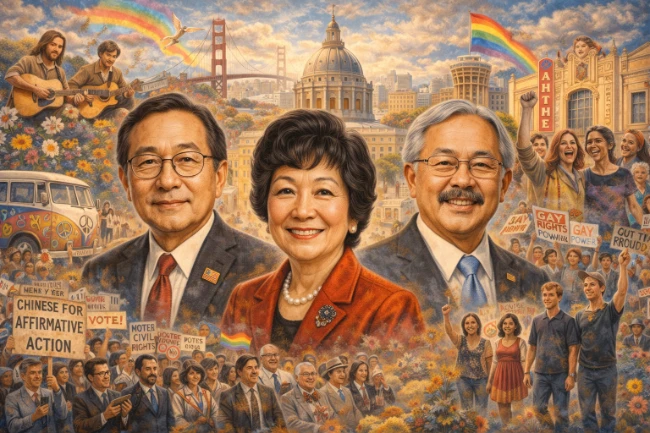
(Image by ChatGPT)
San Francisco has always been a balancing act. Since its birth during the Gold Rush of 1849 it has managed to be both a boomtown of unbridled capitalism and a sanctuary for marginalized outsiders.
The popular narrative of San Francisco’s liberalism often starts with the Beatniks of North Beach or the hippies in the Haight-Ashbury, the actual foundation of the city’s progressive soul was laid much earlier. And its liberal soul — shiny as it is — bears the grit and defiance of its Asian American pioneers.

(Image by Gemini)
From the moment the first Chinese immigrants stepped off ships during the Gold Rush, they weren't just laborers; they were the first true outsiders who forced the American legal and social system to decide if its promises of liberty actually applied to everyone. That tension—the struggle to be seen and the fight for equal protection—is the engine that drove San Francisco toward its liberal destiny. Asian Americans didn’t just move into a liberal city but created the legal and social precedents that made the city liberal in the first place.
Wong Kim Ark Established Birthright Citizenship
Wong Kim Ark is a case in point. In the late 19th century, San Francisco was the epicenter of the virulent "Yellow Peril" movement. Politicians were winning elections on platforms of pure exclusion. Wong Kim Ark, born in San Francisco, went to visit China and was told upon his return that he wasn't an American.
By taking his fight all the way to the Supreme Court, he didn't just win his own right to come home but established the principle of birthright citizenship for every single person born on American soil. That’s a cornerstone of American liberalism, and it was forged in the courtrooms of San Francisco by a man who refused to be a second-class citizen.
Tye Leung Schulze Led Women's Suffrage
As the city grew, so did the complexity of its challenges. Liberalism isn’t just about who gets to stay; it’s about who gets to participate. Tye Leung Schulze represents that early push for civic inclusion. Working as an interpreter at the Angel Island Immigration Station, she saw the worst of the city’s exclusionary impulses firsthand.
But she didn't just translate. She participated. By becoming the first Chinese American woman to vote in a primary in 1912, she helped move the needle for women’s suffrage and minority representation long before those were mainstream ideas. She was an early architect of the "Big Tent" politics for which San Francisco has become renowned.

(Image by ChatGPT)
Fred Korematsu Called Out National Security Overreach
Even in the city’s darkest moments, the Asian American community provided the moral compass that eventually pointed toward progress. During World War II, when the federal government gave in to fear and racism, Fred Korematsu stood his ground. Although he was eventually sent to an incarceration camp, his refusal to obey Executive Order 9066 started a legal ripple effect that lasted decades.
When his conviction was finally overturned in a San Francisco federal court in 1983, it served as a massive reckoning for the city and the country. It reinforced the liberal idea that "national security" isn't a blank check to violate civil liberties.

(Image by ChatGPT)
Dr Margaret Chung Championed Chinatown's Welfare
In the mid-20th century, the city’s liberalism moved from the courts into the classrooms and clinics. Dr. Margaret "Mom" Chung broke every mold imaginable. As the first American-born Chinese female physician, she set up shop in Chinatown and provided care to a community that was often ignored by the white establishment.
But she went further, becoming a patriotic icon and a social connector who bridged the gap between the insular world of Chinatown and the broader American military and political elite. She proved that the "outsider" could be the most vital part of the inside.
Alice Fong Yu Made Public Education Accessible
This era also saw the rise of Alice Fong Yu, the city’s first Chinese American public school teacher. It’s easy to overlook how radical it was to have an Asian woman at the front of a classroom in the 1920s. By fighting for bilingual education and supporting immigrant families at Commodore Stockton Elementary, she helped define San Francisco’s educational philosophy: that the city has a responsibility to meet its citizens where they are, regardless of their native tongue.
Philip Vera Cruz Gave Voice to farmworkers
The 1960s and 70s were the real turning point for the city’s modern identity, and the Asian American community was at the heart of the labor and housing battles that defined that era. Philip Vera Cruz brought the spirit of the farmworkers' movement into the urban consciousness. H
is advocacy for the "Manongs"—the elderly Filipino laborers who lived in the International Hotel—turned a local housing dispute into a global symbol of resistance against displacement. The battle for the I-Hotel wasn't just about a building; it was about the soul of the city. It asked: does a city belong to its developers or its people? The liberal answer we give today was shaped by those Filipino elders and the students who linked arms to protect them.
Henry Der Led Chinese for Affirmative Action
At the same time, Henry Der was transforming the way the city thought about systemic change. Through Chinese for Affirmative Action, he pushed the city to put its money where its mouth was. He advocated for fair employment and voting rights, ensuring that the "liberal" label wasn't just a lifestyle choice for the elite, but a functional reality for the working class. He helped build the infrastructure of advocacy that still dominates San Francisco’s City Hall today.
Tamara Ching Led the LGBQT Fight
San Francisco’s reputation as a queer sanctuary also owes a debt to Asian American activists who navigated multiple layers of marginalization. Tamara Ching, a trans activist of Chinese and Native Hawaiian descent, fought for the rights of those on the furthest fringes—sex workers and people living with HIV/AIDS in the Tenderloin.
Her work helped the city understand that true liberalism must be intersectional. You can't fight for one group while leaving another behind. She helped weave the trans community into the fabric of San Francisco’s political priorities.
March Fong Eu and Ed Lee Won Leadership Roles
In the political sphere, the transition from being a community of "outsiders" to leading the city was personified by March Fong Eu and eventually Ed Lee. March Fong Eu showed that Asian Americans could command a statewide stage, breaking barriers for women of color in the 1960s and 70s.
Decades later, Ed Lee became the city’s first Asian American mayor. Lee’s rise was the culmination of a life spent as a civil rights attorney, defending the very tenants that activists like Philip Vera Cruz fought for. His mayoralty represented a milestone where the "outsiders" finally took the helm of the ship.
But Lee’s tenure also highlighted the modern tension of San Francisco’s liberalism: the relationship with the tech industry. As a hub for global capital and innovation, the city has faced a new kind of identity crisis. Asian Americans have been central to this shift too, not just as political leaders but as the engineers, founders, and investors driving the digital economy. This has created a new layer of influence, where the community is no longer just fighting for a seat at the table—they’re building the table.
Staying in the Fight for Rights
The liberalizing influence of Asian Americans in San Francisco hasn't been a straight line. It’s been a series of corrections and challenges. It was about forcing the city to live up to its own rhetoric. When the city was racist, Asian Americans used the law to demand fairness. When the city was exclusionary, they used the ballot box to demand a voice. When the city was indifferent, they built their own hospitals and social nets.
Today, when people look at San Francisco, they see a city that is unapologetic about its progressive values. They see a place that prioritizes civil rights, celebrates diversity, and experiments with social policy. But none of those things happened by accident. They happened because people like Wong Kim Ark and Tye Leung Schulze refused to accept the status quo. They happened because Fred Korematsu and Tamara Ching stood up when it was easier to stay quiet.
Guardians of the American Dream
The history of Asian Americans in San Francisco is the history of the city’s conscience. It’s a story of how a group of people, initially brought in for their labor and then targeted for exclusion, ended up becoming the guardians of the American Dream in its most liberal form. They proved that San Francisco’s greatest strength isn't its wealth or its views, but its ability to be changed by the people who choose to call it home.
By the time the tech boom transformed the skyline, the cultural and legal groundwork had already been laid. The city’s liberalism isn't just a byproduct of the 1960s; it’s a hard-won victory that dates back to the 1800s. It’s a legacy of persistence that continues to evolve as new generations of Asian Americans take on the challenges of housing, equity, and the ethical implications of the technology they help create.
San Francisco isn't America’s most liberal great city because it’s easy to be liberal there. It’s because for over 150 years, the Asian American community has made it impossible for the city to be anything else. They’ve been the outsiders who became the insiders, the laborers who became the leaders, and the activists who became the city’s soul.
The city's Asian Americans fought for a history that declares that a great city is only as great as the rights it accords its newest arrivals.
© 2026 by Asian Media Group Inc.
Recent Articles
- Both Japan and Sweden Advance with Draw
- S. Korea to Train 500,000 'Drone Warriors' to Counter North
- Why Americans Can't Save and Chinese Can't Spend
- Samsung to Invest $648 Billion, Mostly Outside Seoul Region
- Sanjay Mehrotra's Micron Overtakes Meta, Tesla in Market Value
- Lackluster S. Korea Suffers Embarrassing 0-1 Loss to S. Africa
- China's Carmakers See Canada as 'Practice Run’ for US Sales
- China's Z.ai Closes Frontier Gap with US AI Leaders
- China Targets Solar, Wind Power Producing Half of Electricity by 2030
- US Automotive Quality Increased Industrywide Last Year