

Is Jung Hoo Lee on Track to Become an Ichiro Suzuki?
By Ben Lee | 22 Jun, 2026
The young Korean outfielder's hitting streak puts one in mind of the great former Japanese Mariner's star.
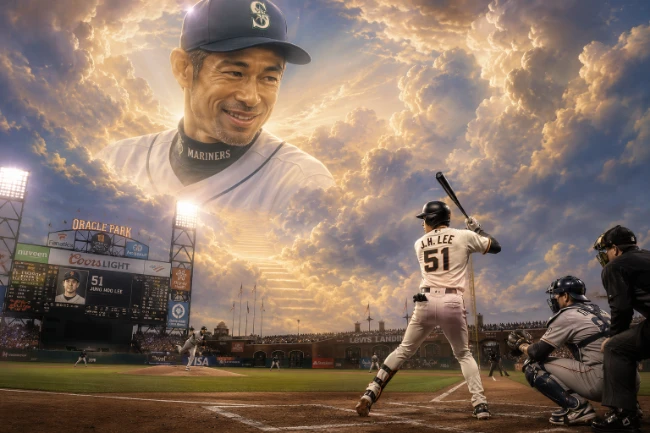
When Korean outfielder Jung Hoo Lee arrived in Major League Baseball, the comparisons came quickly. Some saw shades of Shin-Soo Choo. Others thought of fellow Korean stars like Ha-Seong Kim. But as Lee continues to pile up hits, spray line drives to every corner of the field, and frustrate pitchers with his uncanny bat control, a more ambitious comparison has begun to emerge.
Could Jung Hoo Lee become baseball's next Ichiro Suzuki?
It's a lofty standard. Ichiro wasn't merely a successful Japanese player. He was one of the most distinctive hitters the sport has ever seen. During a career that produced more than 3,000 MLB hits and over 4,300 professional hits combined between Japan and the United States, Ichiro turned contact hitting into an art form.
No player should be casually compared to him.
Yet there are enough similarities between Lee and Ichiro to make the question worth asking.
The first thing that jumps out is their shared commitment to contact.
In an era dominated by launch angles, uppercut swings, and three-true-outcomes baseball, both hitters represent a different philosophy. They put the ball in play. They force defenses to work. They make pitchers throw strikes because they're exceptionally difficult to strike out.
During his peak years in Japan's KBO, Lee routinely posted strikeout rates that would have looked remarkable in any era. His swing is compact, balanced, and remarkably direct to the baseball. Scouts evaluating him before his move to the majors repeatedly praised his hand-eye coordination and ability to adjust to pitches mid-swing.
Those same qualities defined Ichiro.
Neither hitter relies primarily on brute strength. Neither is trying to launch 40 home runs. Instead, both focus on maximizing the value of every plate appearance.
Pitchers often describe facing such hitters as exhausting. Strikeout artists can be attacked aggressively. Contact specialists force pitchers to execute multiple quality pitches within a single at-bat.
That pressure accumulates over the course of a season.
Lee's recent hitting streaks have provided a glimpse of what that approach can accomplish. Like Ichiro in his prime, he frequently strings together multi-hit games without appearing particularly hot. That's because his offensive game isn't built around power surges. It's built around consistency.
A player who depends on home runs can endure long slumps when the timing disappears.
A player who can shoot line drives to left, center, and right field has more ways to contribute.
That versatility was central to Ichiro's greatness.
Many fans remember the spectacular seasons in which Ichiro collected 242 hits or challenged long-standing single-season records. What often gets overlooked is how he accomplished those feats.
He wasn't simply lucky.
He possessed elite bat speed, exceptional pitch recognition, tremendous balance, and a nearly unmatched understanding of how to manipulate the barrel of the bat.
Lee exhibits many of those same characteristics.
His batting practice sessions rarely feature the towering home-run displays associated with modern sluggers. Instead, observers often note how effortlessly he drives line drives from gap to gap.
That's a skill that tends to age well.
Of course, becoming "the next Ichiro" requires far more than making contact.
One major difference is speed.
Ichiro was among the fastest players in baseball during his prime. He stole bases, beat out infield hits, and transformed routine ground balls into close plays. His speed wasn't merely an asset. It was an integral component of his offensive value.
Lee is athletic and an excellent runner, but he doesn't possess Ichiro's elite game-changing speed.
That difference matters.
Many of Ichiro's hits came from putting tremendous pressure on opposing defenses. Infielders often rushed throws. Pitchers hurried deliveries. Entire defenses altered their positioning because they knew any hesitation could result in a hit.
Lee's game relies somewhat more on traditional line-drive contact.
Another difference is defense.
Ichiro won ten Gold Gloves in the majors and possessed one of the strongest throwing arms ever seen in right field. His defensive contributions elevated him from great hitter to complete superstar.
Lee has demonstrated strong defensive instincts and quality range in center field. His glove is an asset. Whether it ultimately reaches Ichiro's legendary level remains an open question.
The offensive environment also complicates comparisons.
When Ichiro debuted with the Seattle Mariners in 2001, batting averages around the league were significantly higher than today's levels. Modern pitching staffs throw harder. Bullpens are deeper. Teams deploy relievers with specialized arsenals designed specifically to exploit hitter weaknesses.
In some respects, producing a .300 average today may be more difficult than it was two decades ago.
That reality works in Lee's favor.
If he can consistently maintain averages near or above .300 while limiting strikeouts and generating high on-base percentages, he'll be succeeding in one of baseball's most challenging offensive environments.
Still, the biggest obstacle to becoming an Ichiro-like figure is durability.
The Japanese legend wasn't simply great. He was relentlessly available.
From 2001 through 2010, Ichiro averaged more than 224 hits per season. He played virtually every day. Opposing teams knew exactly what was coming and still couldn't stop him.
That level of consistency is extraordinarily rare.
Lee has already demonstrated resilience after overcoming injuries that interrupted portions of his early MLB career. The question now is whether he can remain healthy enough to accumulate the counting statistics that define baseball greatness.
The encouraging news is that his style of play may support longevity.
Contact hitters generally place less stress on their bodies than players whose swings are designed to generate maximum power. Lee's smooth mechanics, balanced approach, and disciplined strike-zone judgment suggest a player capable of aging gracefully.
Even so, becoming Ichiro requires more than longevity.
It requires sustained excellence.
At this stage, the most realistic answer is that Jung Hoo Lee is not on track to become another Ichiro Suzuki.
He's on track to become the first Jung Hoo Lee.
That may ultimately be the more meaningful achievement.
The Korean star possesses his own blend of strengths: exceptional contact skills, advanced plate discipline, gap power, defensive versatility, and a calm, professional approach that has impressed teammates and opponents alike.
If those traits continue to develop, Lee could establish himself as one of the premier contact hitters of his generation.
Whether he reaches Ichiro's historic heights remains uncertain. Very few players in baseball history have.
But when fans watch Lee lace another line drive into the opposite-field gap, extend another hitting streak, or finish another game with multiple hits, it's easy to understand why the comparison keeps resurfacing.
The similarities aren't imaginary.
They're a reminder that even in an age dominated by velocity and power, there remains something timeless about a hitter who simply refuses to miss the baseball.
© 2026 by Asian Media Group Inc.
Recent Articles
- Ferrari Denies Requiring Luce EV Purchase to Access to Limited Edition Models
- SpaceX Turns to Bond Sale to Fatten $100.8 Billion Cash Stash
- Google DeepMind Signs AI Research Deal with Film Studio A24
- China's 618 Shopping Festival Sees Flat E-Commerce Sales from Cautious Shoppers
- Amazon Prime Day to Gauge US Consumer Strain as Focus Shifts to Basics
- China Closing in but US Still Leads in Biotech Innovation
- EV Surge Likely to Cut Oil Demand by Late 2027
- Kunal Shah tapped to Lead Meta's WhatsApp
- AbbVie Bets $10.9 Billion on Apogee in Next-Generation Immunology Growth Push
- Upscale AI Valued at $2 Billion After Funding Extension