

Japan Pressured to Violate Pacifist Constitution, Send Escort Ships
By Reuters | 18 Mar, 2026
Trump is pressuring Japan Prime Minister Sanae Takaichi to disregard a provision in Japan's constitution prohibiting overseas military missions.
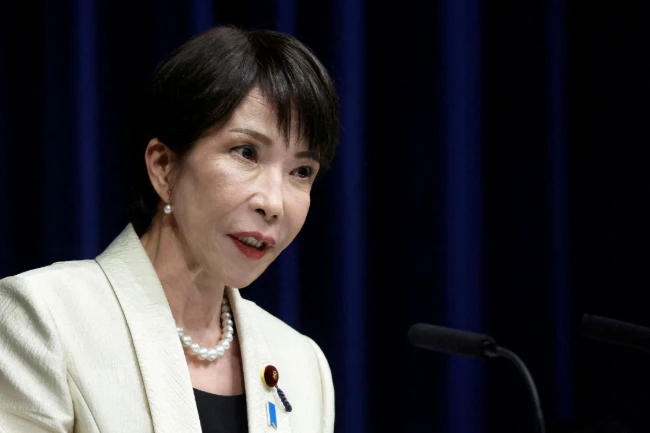
Sanae Takaichi, Japan’s prime minister, speaks during a press conference at the prime minister’s office in Tokyo, Japan, on Wednesday, Feb. 18, 2026. Kiyoshi Ota/Pool via REUTERS/File Photo
Japanese Prime Minister Sanae Takaichi visits the White House on Thursday for meetings that offer U.S. President Donald Trump a chance to lean on a key security partner for support in his Iran war, threatening to strain a decades-old alliance.
Takaichi is the first major ally set for face-to-face talks with Trump since he demanded that Japan, among a coalition of nations, send ships to escort tankers through the Strait of Hormuz waterway, largely closed by Iran in the conflict.
"Takaichi is in a tight spot," said David Boling, of the Asia Group consultancy in Tokyo and a former U.S. trade negotiator with Japan during Trump's first term as president.
"The biggest risk is that Trump publicly presses her for security commitments that she can’t deliver on."
Japanese officials involved in the preparations said Takaichi had hoped to remind Trump of the dangers posed by a regionally assertive China prior to his visit there, initially planned near the end of March, but now delayed.
Instead, she will have to find a way of placating Trump over his demand for ships to guard the Strait, a conduit for a fifth of global energy, while avoiding legal and political pitfalls.
U.S. allies such as Germany, Italy and Spain have ruled out participating in any Gulf mission, while Kaja Kallas, the European Union's foreign policy chief, said on Tuesday, "Nobody is ready to put their people in harm's way."
Japan had received no official request from the United States, Takaichi told parliament on Monday, but was checking the scope of possible action within the limits of its pacifist constitution.
Fewer than 10% of Japanese support the attacks by the United States and Israel on Iran, a poll by the Asahi newspaper showed this week.
MAKING AN EXAMPLE OF JAPAN
Trump has vacillated between chiding allies for their reticence to saying he does not need them, calling out those such as Japan that rely on the United States for their own defence and depend heavily on crude supplies through Hormuz.
About 90% of Japan's oil shipments come through the Strait.
Tokyo has offered logistical support and intelligence gathering for previous U.S. military efforts in the Middle East. But sending Japanese ships into a conflict area would be legally fraught and deeply unpopular, analysts say.
"It has turned into a discussion that shakes the very foundations of the Japan–U.S. security alliance," said Kazuhiro Maeshima, a politics professor at Sophia University in Tokyo.
But Trump has a lot of leverage when it comes to Japan, Maeshima added.
Japan relies on about 50,000 U.S. troops, a carrier strike group and squadrons of fighter jets stationed in the country to deter threats from China and North Korea.
In addition, Trump has wielded tariffs to exact billions of dollars in investments, in his effort to adjust a massive trade imbalance with Tokyo.
"If he can bring Japan into the coalition of the willing, it will increase pressure on other countries," Maeshima said. "Conversely, if Japan refuses, he can make an example of it - showing what happens when a country says no."
Public support for Takaichi has slipped slightly since a barnstorming election win last month, polls show, as her government battles to hold down rising costs partly fuelled by the Middle East energy shock.
STRUGGLING TO SATISFY TRUMP
Trump, who heaped praise on Japan's first female leader when he visited in October, will have hours to press her on Iran during the summit, over talks, a working lunch and dinner.
With U.S. allies in Asia fretting that the redeployment of U.S. security assets from the region could weaken defences against China, Japan had hoped dealing with Beijing would be top of the meeting's agenda.
Tokyo is targeting a deal with Washington that would enable it to diversify supplies of critical minerals away from China and join Trump's Golden Dome missile defence system against new hypersonic weapons being developed by China and Russia, said Japanese officials familiar with the preparations.
Anticipating the focus on Iran, Tokyo is scrambling for ways to offer help, but it is unclear if any will satisfy Trump, said another source, who spoke on condition of anonymity.
With limited military options, Tokyo could offer to be a go-between with Tehran, said Tsuneo Watanabe, senior fellow at Japanese think tank The Sasakawa Peace Foundation.
In 2019, Takaichi's mentor and assassinated predecessor, Shinzo Abe, carried a message to Iran's supreme leader during a failed peacekeeping mission, but this time around neither side appears ready for talks.
"I don't think it's going to be enough to talk to the Iranians," said Kurt Campbell, a former deputy secretary of state under Trump's predecessor, President Joe Biden.
Trump was likely to have a very specific request for Takaichi, requiring an answer either 'yes' or 'no', he added.
"This is a moment of enormous political peril."
(Reporting by Tamiyuki Kihara, Tim Kelly and John Geddie in Tokyo; Additional reporting by Michael Martina, Trevor Hunnicutt and David Brunstromm in Washington; Editing by Clarence Fernandez)
Articles
- House GOP Blocks Bid to Curtail Trump War Powers
- What Molecule Protects Your Brain, Fights Stress and Boosts Athletic Performance?
- Tesla Developing Smaller Cheaper EV
- Amazon Cloud Unit AI Revenue Exceeds $15 Billion on Annualized Basis
- List of Major AI Infrastructure Deals to Meet Booming Demand
- Mercedes Suffers Down Q1 on Plunging China Sales
- Intel and Google Expand Partnership to Address Demand for Versatile CPUs
- Chip Designer SiFive Raises $400 Million from Atreides, Nvidia to Step into Arm's Space
- Samsung Electronics Mulls Chip Testing and Packaging in Vietnam
- Relief Rally Stalls as Oil Rises on Growing Mideast Truce Doubts