

S. Korea Ex-President Yoon Gets Life Sentence for Trumpish Abuse
By Reuters | 19 Feb, 2026
Former President Yoon Sook Yeol was too trigger-happy in invoking emergency powers to declare martial law for 6 hours in December 2024, leading to his ouster and insurrection charges.
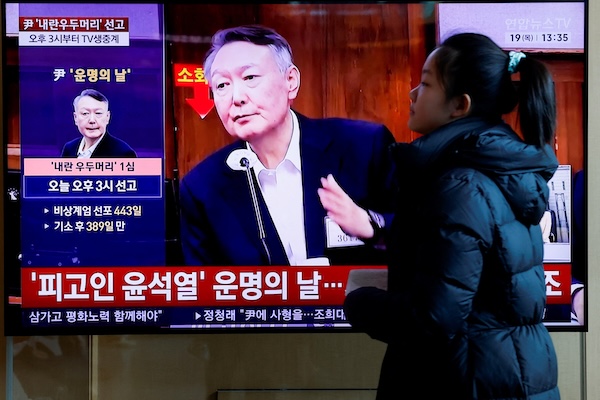
A person walks in front of a TV screen broadcasting a news report on the sentencing trial of South Korean former president Yoon Suk Yeol's insurrection case, stemming from his short-lived declaration of martial law in
A South Korean court sentenced former President Yoon Suk Yeol to life in prison on Thursday, after finding him guilty of masterminding an insurrection linked to his December 2024 attempt to impose martial law.
Prosecutors had sought the death penalty in the case, closely watched in a deeply divided country. It is the most consequential of a series of trials for the ousted leader, whose bid triggered a national political crisis and tested democratic resilience.
Yoon conspired with his then-defence minister, Kim Yong-hyun, to subvert the constitutional order by deploying troops to parliament, intending to paralyse its functions, Judge Jee Kui-youn told a packed courtroom.
"It is the court's judgment that sending armed troops to parliament ... and using equipment to try to make arrests all constitute acts of insurrection," he said, speaking for the panel of three judges.
Yoon led a number of officials and troops in criminal activities on December 3, 2024, and "because of the martial law declaration, an enormous social cost was incurred," Jee said as he handed down the life term for the former leader.
Wearing a dark navy suit without a tie, Yoon, 65, stood ashen-faced as the sentences were read out for him and seven other defendants, including Kim, the former defence minister, who received 30 years, and former top police officials.
Yoon's defence team will discuss with him whether to appeal the ruling, with one of his lawyers, Yoon Kab-keun, saying it completely ignored the key legal principle of basing findings on evidence.
A lawyer for Kim said the former defence minister would "of course appeal".
A prosecutor said the team had some "regret" over the sentencing but declined to say whether they planned to appeal.
RISK OF DEATH PENALTY
Before delivering the verdict, Judge Jee reviewed the long history of treason and insurrection, from the Roman Empire and medieval era to the trial and execution of England's Charles I for waging war against parliament.
Masterminding an insurrection carries a maximum sentence of the death penalty or life imprisonment under South Korean law. The country last handed down a death sentence in 2016, but has not executed anyone since 1997.
Yoon denied the charges. The conservative former career prosecutor said he had presidential authority to declare martial law and his action was aimed at sounding the alarm over opposition parties' obstruction of government.
The ousted former leader is likely to remain held at the Seoul Detention Centre. He can appeal the ruling and again challenge any appellate court decision at the Supreme Court.
Judicial guidelines say the first trial should conclude within six months and the entire process, including appeals, in two years, but trials often exceed that.
Yoon, who has faced eight trial proceedings, is appealing a five-year jail term handed him in January in a separate trial on charges including obstructing attempts by authorities to arrest him after his martial law declaration.
SHOCKWAVES IN SOUTH KOREA
While Yoon's bid to impose martial law lasted only about six hours before it was met by large street protests and voted down by parliament, it sent shockwaves through Asia's fourth-largest economy, a key U.S. security ally, and long considered one of the world's most resilient democracies.
Ko Jeong-suk, 65, who watched the court decision at Seoul Station, said the martial law bid deepened social divisions. "I really think it should have been the death sentence so that this doesn't become an example to repeat."
But hundreds of Yoon supporters rallied outside the court complex calling for him to be freed.
In a post on X, President Lee Jae Myung, a liberal who won the presidency in a snap election in June after Yoon's removal, commended the actions of the Korean people to thwart the martial law.
"It was possible because it was the Republic of Korea," Lee said, using the official name of the country, whose people would set an example for history, he added.
His post ahead of Thursday's ruling was attached to a newspaper report that some academics had recommended a Nobel Peace Prize nomination for the Korean public, which faced down troops and police to oppose martial law without violence.
(Reporting by Joyce Lee, Heejin Kim, Kyu-seok Shim; Writing by Ed Davies and Jack Kim; Editing by Kim Coghill, Kate Mayberry, Clarence Fernandez, Ros Russell)
Recent Articles
- 'Ghost Murmur' Used to Locate Downed Airman Was Trump's Bogus Reference to an Actual Technology
- House GOP Blocks Bid to Curtail Trump War Powers
- What Molecule Protects Your Brain, Fights Stress and Boosts Athletic Performance?
- Tesla Developing Smaller Cheaper EV
- Amazon Cloud Unit AI Revenue Exceeds $15 Billion on Annualized Basis
- List of Major AI Infrastructure Deals to Meet Booming Demand
- Mercedes Suffers Down Q1 on Plunging China Sales
- Intel and Google Expand Partnership to Address Demand for Versatile CPUs
- Chip Designer SiFive Raises $400 Million from Atreides, Nvidia to Step into Arm's Space
- Samsung Electronics Mulls Chip Testing and Packaging in Vietnam