

S. Korean President Urges US Visa Reforms, Asks to Assume Own Defense
By Reuters | 02 Apr, 2026
President Lee Jae Myung told Senators that visa reforms were needed to prevent ICE debacles involving Korean workers and that S. Korea is willing to assume its own defense.
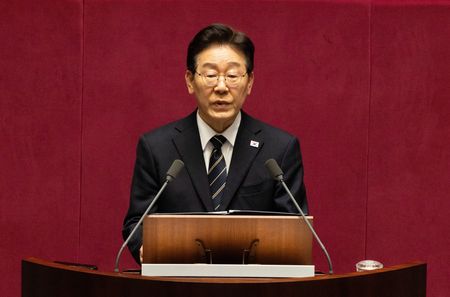
South Korean President Lee Jae Myung gives a speech on the Government's first supplemetary budget bill of 2026 at the National Assembly in Seoul, South Korea, 02 April 2026. JEON HEON-KYUN/Pool via REUTERS
South Korean President Lee Jae Myung on Thursday urged visiting U.S. lawmakers to improve visa policies for Korean workers to prevent a recurrence of last year's detentions of Korean nationals in a raid at a Hyundai Motor facility in the state of Georgia.
The presidential Blue House said Lee raised the issue during talks with a bipartisan delegation of U.S. senators in Seoul, stressing that stable residency conditions for Korean workers in the U.S. were essential for the smooth implementation of South Korea's investment package there.
He also called on Congress to support legislation aimed at creating new work visas for South Korean professionals, known as the "Partner with Korea Act", as bilateral economic and industrial cooperation deepens.
The U.S. lawmakers said they understood Seoul's concerns and pledged to pay close attention to visa-related issues affecting Korean workers, the Blue House said.
Lee also told the senators South Korea was ready to shoulder a greater role in its own defense, including through the eventual transfer of wartime operational control from the United States to South Korea.
"South Korea believes it is appropriate to defend the Korean peninsula largely with our own capabilities and to reduce the burden on Washington," Lee was quoted as saying.
Currently, the U.S. would command allied troops in the event of war on the Korean peninsula, but successive South Korean governments have sought to regain wartime operational control.
Lee's administration has signalled it aims to finalise the process during his term, which runs through 2030, once South Korea meets a set of military capability conditions agreed with the United States.
Touching on global issues, Lee said South Korea was grappling with the security and economic fallout from the Middle East conflict and sought U.S. views on how to manage the impact.
Democratic Senator Jeanne Shaheen, ranking member of the Senate Foreign Relations Committee, said efforts toward the operational control transfer were making progress but needed to be underpinned by the ability to respond effectively to crises.
Republican Senator John Curtis welcomed Seoul's pledges to raise defence spending and purchase $25 billion worth of U.S. weapons by 2030, as well as South Korea's plans for large‑scale investment in the U.S., including in shipbuilding and manufacturing.
(Reporting by Kyu-seok ShimEditing by Ed Davies and Alison Williams)
Recent Articles
- Dim Sum Raves Aim to Revive Hong Kong's Appeal
- The Fastest Growing Asian American Communities Are in the South
- China's Factory Inflation Hit 45-Month High on Energy Price Shock
- China's Domestic Car Demand Stays Weak but Exports Strengthen
- Dua Lipa Sues Samsung for Using Her Image to Sell TVs
- Trump Rejects Iran's Counter to US Peace Proposal
- Bedtime Story: The Legend of Savitri and Satyavan
- Let's Not Do the Whole "China Virus" Thing Again
- Frayed Ties with Allies Likely to Be an Enduring Trump Legacy
- Thailand's SiamAI Denies Exporting US AI Servers to China