

Top 10 Topics & Issues for Asian Americans
By JL Zhang | 30 Apr, 2026
This list of the issues that most concern Asian Americans is based on studies by UC Berkeley's AAPI Data, The Asian American Foundation and the AP-NORC Center for Public Affairs Research at the University of Chicago.
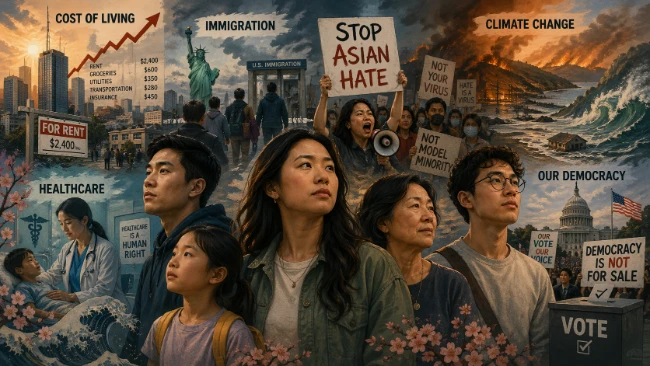
(Image by ChatGPT)
Here are the issues on the minds of Asian Americans as expressed to pollsters.
1. Cost of Living & the Economy
Cost of living is the top issue on the minds of AAPI adults (58%), while jobs and the economy follow closely behind. Support is strong for policies that freeze rent in high-cost cities (58%) and federal measures to limit medical expenses (84% for medication, 82% for care).
2. Immigration
Immigration surged to the top in January 2025, with 42% of AAPI adults naming it a key issue — a sharp rise from 29% in 2024. However, by August 2025, only 25% cited immigration as the most important issue, suggesting that Trump's approach to immigration enforcement may have alienated many in the community.
AAPI adults are far more likely than the general population to view legal immigrants as an important asset — 79% see legal immigration as a major benefit for economic growth, compared to about 42% of the general public.
3. Safety & Anti-Asian Hate
63% of Asian Americans report feeling unsafe and fear future discrimination. Despite this, nearly 80% of Americans support specific initiatives aimed at uplifting Asian American communities, with 41% backing legislation requiring Asian American history to be taught in schools.
4. Environment & Climate Change
About 8 in 10 AAPI adults reported experiencing extreme weather in the past five years — including heat waves (65%), severe winter storms (46%), and wildfires (32%). In the long run, 75% of AAPI adults think environmental protection should be prioritized over economic growth.
5. Healthcare
Healthcare reform is frequently mentioned, with 18% of AAPI adults naming it a top priority for the federal government. Support for limiting medical costs is very high, with the vast majority backing federal caps on medication and care expenses.
6. Education
Education continues to rank high, with 64% of AAPI adults saying the federal government spends too little on it. Roughly 4 in 10 identify the cost of higher education as an area Congress should address. AAPI adults overwhelmingly prioritize workplace-relevant skills (83%), critical thinking (80%), and the free exchange of ideas (69%) as higher education goals.
7. Abortion & Reproductive Rights
About 8 in 10 AAPI adults say abortion should be legal in all or most cases, and 75% support federal legislation to guarantee access nationwide — both levels higher than those seen in the general population. 82% believe abortion and reproductive rights face a threat.
8. Democracy & Political Representation
Japanese and Korean Americans are exceptions among AAPI groups, prioritizing preserving democracy above other concerns. AAPI communities' confidence in the U.S. government's ability to tackle major democratic challenges remains low, with most expecting little to no progress in reducing partisanship (71%) or unifying the country (70%).
9. Foreign Policy
Foreign policy issues are cited by 33% of AAPI adults as a top priority, often shaped by ties to ancestral homelands and global events.
10. Racial Identity & Belonging
The "perpetual foreigner" stereotype remains a pressing concern — 4 in 10 Americans believe Asian Americans are more loyal to their countries of origin than to the U.S. Asian Americans consistently report a disconnect between how they are perceived and how they actually experience life.
Key Takeaway: While stereotypes suggest Asian Americans only care about education, the data tells a much broader story. "The Asian American political agenda is much broader than some might assume," with inflation, immigration, environment, and healthcare all outranking education as top concerns. There is also significant diversity *within* the community by ethnicity, generation, and political affiliation.
© 2026 by Asian Media Group Inc.
Recent Articles
- Both Japan and Sweden Advance with Draw
- S. Korea to Train 500,000 'Drone Warriors' to Counter North
- Why Americans Can't Save and Chinese Can't Spend
- Samsung to Invest $648 Billion, Mostly Outside Seoul Region
- Sanjay Mehrotra's Micron Overtakes Meta, Tesla in Market Value
- Lackluster S. Korea Suffers Embarrassing 0-1 Loss to S. Africa
- China's Carmakers See Canada as 'Practice Run’ for US Sales
- China's Z.ai Closes Frontier Gap with US AI Leaders
- China Targets Solar, Wind Power Producing Half of Electricity by 2030
- US Automotive Quality Increased Industrywide Last Year