

Who Will Win the Race to Land a Crew on the Moon?
By H Y Nahm | 19 Feb, 2026
The complexity inherent in SpaceX's grand ambition to do the job using fully reusable vehicles creates room for delays that make this a true horse race.
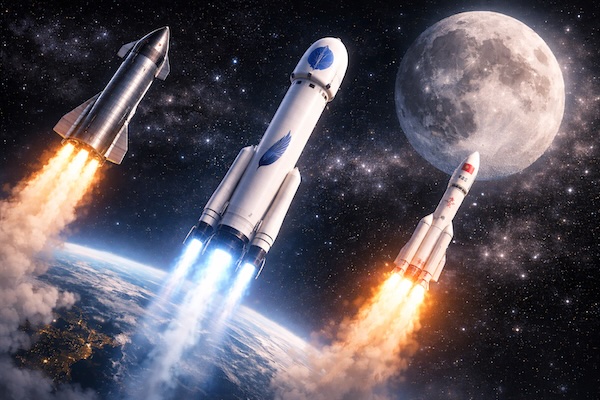
(Image by Grok)
You thought the moon had been thoroughly landed back in the '70s? Landed isn't the same thing as inhabited, settled, colonized, which is the primary intent of round two. So NASA can't just dust off the half-century old tech.
So the new era starts off as a full-on bragging-rights sprint between Elon Musk's SpaceX, Jeff Bezos's Blue Origin, and China's national space program. The winner will be the first to plant fresh boot prints on the lunar surface since Apollo 17 in 1972.

Artist depiction of Starship docking with a pre-positioned Orion lunar lander to transfer 2 crew members. (Image by Grok)
The Players
No doubt, SpaceX is the flashy favorite. But here's the potential catch. Its plans are built around its sexy reusable Starship which must be refueled in earth orbit, no less. The sheer intricacy of making everything recyclable—in keeping with Elon Musk's vision of not merely landing but enabling a commercial stampede to the moon—opens the door for slip-ups.
That's how Bezos's more traditional approach and China's steady, no-frills grind could sneak in and steal the show from the early favorite. Let's break it down.
First off, why the sudden rush? It's not just about science or exploration—though yeah, grabbing lunar ice for fuel and setting up bases for Mars jumps is huge. This race is laced with national pride and strategic muscle. The US wants to lock down the lunar South Pole, rich in resources, before anyone else stakes a claim. China's eyeing the same spot for its International Lunar Research Station, and they're not messing around.
The Umbrella: NASA's Artemis Program
NASA's Artemis program is the US umbrella, aiming to return humans to the Moon sustainably, but delays have pushed things back. As of February 2026, Artemis II—the crewed flyby test—is eyeing a March launch at the earliest, after hiccups with the Space Launch System (SLS) rocket. That's the precursor to Artemis III, the actual landing, now slotted for no earlier than 2028. If everything clicks, it'll be the first woman and first person of color on the Moon. But "if" is the operative word here.
Musk's Grand Ambition
Enter Elon Musk, the disruptor, betting the farm on Starship—a massive, fully reusable spaceship that's basically a stainless-steel skyscraper with engines. The idea is cool: launch Starship on its Super Heavy booster, refuel it in Earth orbit with tanker versions, then zip to the Moon, land, and come back without tossing away hardware like confetti. It's eco-friendly, cost-cutting, and scalable for Mars dreams.
But the complexity boggle the mind. They've nailed booster catches on recent tests, and as of early 2026, they're prepping Flight 12 for March, debuting the beefier Version 3. That's a big leap toward orbital refueling demos later this year, which is crucial because Starship needs like 10-15 tanker launches to gas up for the Moon trip. SpaceX is cranking up production at Starbase in Texas, aiming for monthly flights by mid-2026 and even ship reuse by year's end.
Musk's team has shifted gears, deprioritizing a 2026 Mars demo to focus on lunar stuff like "Moonbase Alpha." NASA's banking on them for Artemis III's Human Landing System (HLS), where Starship docks with Orion in lunar orbit, ferries two astronauts down, and brings 'em back up.
Sounds unbeatable, but reusability means everything has to work perfectly—engines relighting in space, heat shields holding up during reentry, and that refueling ballet without leaks or explosions. We've seen Starship prototypes go boom in early tests, and even recent successes had close calls. If a tanker fleet launch gets scrubbed due to weather or a glitch, the whole timeline slips. Plus, regulatory hurdles from the FAA could drag things out.
SpaceX is targeting an uncrewed lunar landing in 2027, paving the way for crew in 2028. But if Artemis II's delays are any indication—pushed from February to March over SLS fixes—Artemis III could slide into 2029. That's where the horse race tightens.
The US Backup Plan
Yes, Jeff Bezos and Blue Origin are heavy underdogs here, but don't count 'em out. Blue Origin's playing a supporting role in Artemis, developing the Blue Moon lander as a backup and for later missions like Artemis V around 2030. Their Mk1 uncrewed version is eyeing a 2026 launch on New Glenn, their heavy-lift rocket, to test cargo delivery to the Moon. The crewed Mk2 follows, using more proven tech like hydrogen engines and a traditional descent profile—no orbital refueling circus.
Bezos just paused New Shepard suborbital flights for at least two years to pour resources into lunar ambitions. That's a bold pivot, signaling they're all-in on beating China. They've got a $3.4 billion NASA contract and are testing the lander at Johnson's Space Center in Houston.
Blue Origin's approach is less revolutionary than SpaceX's, which means fewer unknowns. If Starship hits a snag, NASA could swap in Blue Moon for an earlier mission, though that's unlikely for the first landing. Still, Bezos's deep pockets and steady progress make 'em a dark horse, especially for sustainable ops post-landing.
The Underpromising Powerhouse
Then there's China, the methodical powerhouse that's been quietly racking up wins. They're not flashy like Musk, but they've got a perfect track record on robotic Moon missions—Chang'e-5 brought back samples in 2020, and Chang'e-6 is set for far-side grabs this year. For crewed stuff, they're targeting a landing by 2030, with the Mengzhou capsule and Lanyue lander.
Just this month, they aced a low-altitude test of the Long March 10 rocket and Mengzhou, proving reusability and abort systems. It's a two-launch setup: one for the lander, one for the crew ship, docking in lunar orbit like Apollo. No need for a dozen refuelings—simpler, less risky.
They've got robotic precursors like Chang'e-7 in 2026 to scout the South Pole for water ice. China's space agency is low-drama; they underpromise and overdeliver. Recent tests put them on track for uncrewed joint missions in 2028-2029, then crew in 2030. If US programs slip further—and they have a habit of that—China could pull off a 2029 surprise.
Paper Edge, History of Delays
So, who's got the edge? SpaceX is ahead on paper, with the earliest target and NASA's backing. Their iteration speed is insane—they learn from failures faster than anyone. But that reusability dream? It's a double-edged sword. One bad refueling test, and poof, delays stack up.
Blue Origin's more like a reliable tortoise, building for longevity rather than the sprint. They might not win the first lap but could dominate the marathon. China, though? They're the wildcard. No public slip-ups, state funding without shareholder pressure, and a clear roadmap. If Artemis hits another snag—like SLS issues or budget fights—China's 2030 could beat the US's stretched 2028.
The Long Game
This race isn't just about who touches down first; it's about who sticks around. SpaceX envisions Moonbases and Mars colonies. Blue Origin talks sustainable habitats. China wants an ILRS with international partners. Whoever wins, humanity scores—cheaper space travel, lunar mining, and stepping stones to the stars.
Glitches in SpaceX's reusable magic keep it exciting, but with a little luck it could still make the 2028 target. But don't be shocked if China's flag wire-frame waves on the moon first in 2029. Either way, the Moon's about to become the next hot attraction.
© 2026 by Asian Media Group Inc.
Recent Articles
- Anthropic Allowed to Release Mythos AI Model to 'Tusted' US Organizations
- Apple Seeks Approval to Buy from Blacklisted Chinese Company to Ease Memory Crunch
- China's Industrial Profits Stay Resilient on Factories, Exports
- Meet the Teen Who Undertook a 7-Continent Solo Flight Against Cancer
- Getting Fit Pt. 2 - Raising Our Floor
- South Korea Survives World Cup Scare, Advances to Round of 32
- SpaceX Targets US Consumers with Starlink Mobile Service Push
- Former First Lady Kim Keon Hee Gets 7-Year Jail Term for Bribery
- Iran Reasserts Right to Control Hormuz Passage After Ship Hit Near Oman
- Trump's Cutoff of Clean Energy Tax Credit Drives Rush of New Projects Before Costs Soar