

Why Are Asians America’s Most Pro-Choice Segment?
By Romen Basu Borsellino | 25 Mar, 2026
The clear Asian American support for abortion rights owes to several factors, including higher education, religion, a strong bias in favor of deliberate life choices, and a strong aversion to government restrictions on personal choices.
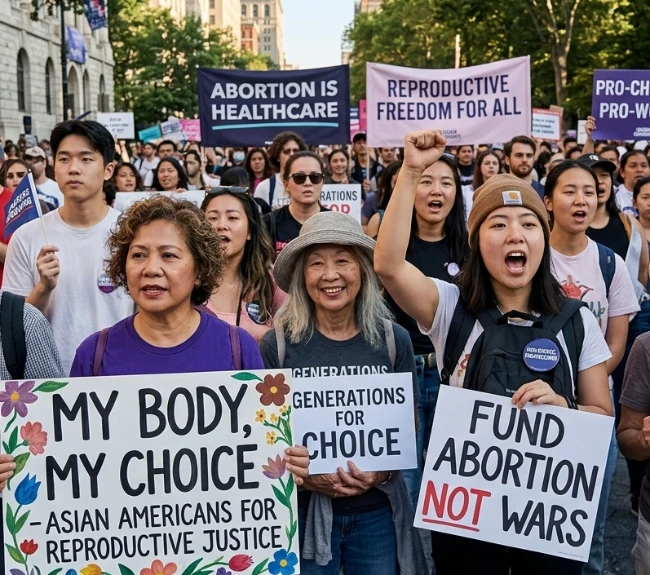
The unexpected reasons why Asian Americans support abortion rights.
Asian Americans are the most pro-choice racial demographic in America.
A 2026 Pew Research Center survey asked more than 8,500 Americans whether abortion should be legal in all or most cases and 73% of Asian Americans said yes.

I’ll be honest: While I wouldn’t say I’m surprised, I also wouldn’t say I expected this.
Yes, AAPI voters lean left. Most electoral exit polling has shown us that.
At the same time, most stereotypes projected onto Asian Americans — we are quiet, non-controversial, avoid therapy and feelings, and can be prickly particularly in old age — may not seem compatible with taking a strong stance on one of the most hot-button topics imaginable.
Here’s why it actually makes perfect sense:
By The Numbers
AAPI support for abortion puts our community ahead of any other racial group.
But the raw support number only tells part of the story. When you subtract those opposed from those in favor — a net support figure that accounts for opposition, not just enthusiasm — the gap becomes even more striking.
While 73% of Asian Americans support abortion rights, 27% say abortion should be illegal in all or most cases. That’s a net support of +46.
Black Americans are a very close second, with 71% in favor and 26% opposed, for a net of +45.
White Americans come in at 58% support and 40% opposed, for a net of +18.
Hispanic Americans trail at 56% support and 42% opposed, for a net of just +14.
And this poll isn’t an anomaly. PRRI’s 2023 American Values Atlas, which surveyed more than 22,000 adults, found that 74% of Asian Americans believe abortion should be legal in most or all cases — again the highest of any racial group, ahead of Black Americans at 71%, multiracial Americans at 65%, White Americans at 63%, and Hispanic Americans at 59%.
The Pew numbers and the PRRI numbers are telling the same story, consistently, across multiple years and multiple methodologies.
The Education Explanation
The honest answer is that we don’t know for certain why our community holds such strong support for abortion. But there are a few compelling theories worth exploring.
The most straightforward is education. The link between education and abortion support is one of the most consistent findings in American public opinion research, and the 2026 Pew data is no exception.
About two-thirds of college graduates say abortion should be legal in all or most cases, as do 61% of adults with some college education. Among those with a high school diploma or less, just 54% say abortion should be legal — while 44% say it should be illegal. As education goes up, opposition to abortion goes down.
Asian Americans, as it turns out, are the most highly educated demographic group in the country by a significant margin.
About 60% of Asian Americans over the age of 25 have a bachelor’s degree or higher, compared with 38% of the entire U.S. adult population.
While 36% of White Americans, 23% of Black Americans, and 16% of Hispanic Americans hold a bachelor’s degree or more, 54% of Asian Americans do — and 21% hold advanced degrees, compared with 14% of White Americans.
But education alone probably isn’t the whole story. After all, Black Americans, who show similarly high rates of abortion support, have lower college graduation rates than Asian Americans — which means something else is also at work.
Religion Matters
Religious affiliation is another strong indicator for views on abortion
About 74% of White evangelical Protestants think abortion should be illegal in all or most cases. By contrast, 82% of religiously unaffiliated Americans say it should be legal.
Asian Americans, broadly speaking, skew toward religious traditions that tend to be less doctrinally opposed to abortion than evangelical Christianity.
Buddhism, Hinduism, and a general tendency toward lower rates of evangelical Protestant affiliation among East and South Asian communities likely play a meaningful role here.
The AAPI community is also notably diverse in its religious makeup, with a significant share identifying as religiously unaffiliated — a group that, across all demographics, is among the most supportive of abortion access.
The Immigration Factor
Then there’s the immigration self-selection effect.
A disproportionate share of Asian Americans are immigrants or the children of immigrants who came to the United States specifically to pursue educational and professional opportunities.
That process selects for people who have made deliberate, calculated decisions about the trajectory of their lives — including family planning. A community with a strong orientation toward deliberate life planning may, not surprisingly, hold more liberal views about reproductive autonomy.
There’s also something to be said about what many Asian immigrants left behind.
Countries like South Korea, Japan, and India have complex and often permissive legal frameworks around abortion — quite different from the American evangelical-influenced opposition that shapes so much of the anti-abortion movement here.
First and second-generation Asian Americans may simply be arriving without the specific cultural and religious inheritance that drives opposition to abortion in other communities.
One more thread worth pulling: some Chinese Americans came specifically fleeing a government that exercised sweeping control over reproductive decisions — most infamously through the one-child policy.
For that community in particular, the idea of the government dictating whether and when a woman can have a child isn’t abstract. It's an historical memory. Being pro-choice, in that context, isn’t just a political position. It’s a lived value.
What It Means Politically
Each of these explanations is compelling but none is complete.
The true answer is almost certainly a layered combination of education, religious affiliation, immigration background, and something harder to quantify about each community’s historical relationship with bodily autonomy and government interference in reproductive decisions.
It’s also worth acknowledging a limitation in the data: Pew’s estimates for Asian adults are representative of English speakers only. That means the survey likely skews toward more educated, more assimilated, and more urban Asian Americans — all factors that predict higher abortion support.
The true number for the AAPI community as a whole might look somewhat different. But the general sentiment likely stands.
The limit on this poll also matters.
We are months away from the midterms and less than two years removed from a presidential election in which Asian American support for Trump increased by 5% — a shift widely attributed to economic concerns during the Biden years. Some interpreted that as evidence that Asian Americans were drifting rightward.
The abortion data complicates that narrative considerably.
A community that supports legal abortion at a rate of 73% is not a community whose values align with the current Republican platform on reproductive rights, regardless of how it voted in 2024.
It suggests that the rightward shift was driven by economics, not ideology — and that as the Trump administration’s policies increasingly collide with the values of AAPI communities, those voters may be well worth watching in the next cycle.
Republicans have spent years trying to expand their coalition among Asian Americans. The abortion numbers suggest that the project faces a significant headwind.
We know that Asian Americans largely support abortion rights. Whether or not that’s their top priority could very well shape America’s political landscape come November.
© 2026 by Asian Media Group Inc.
One more thread worth pulling: some Chinese Americans came specifically fleeing a government that exercised sweeping control over reproductive decisions — most infamously through the one-child policy. For that community in particular, the idea of the government dictating whether and when a woman can have a child isn’t abstract. It's an historical memory. Being pro-choice, in that context, isn’t just a political position. It’s a lived value.
Recent Articles
- Google Limits Meta’s Use of Its Gemini AI Models
- Key Volkswagen Shareholder Pitches Producing China Models in Germany
- S. Korea's Early World Cup Exit Triggers 'Utterly Baffled' Tirade by President
- Anthropic Allowed to Release Mythos AI Model to 'Tusted' US Organizations
- Apple Seeks Approval to Buy from Blacklisted Chinese Company to Ease Memory Crunch
- China's Industrial Profits Stay Resilient on Factories, Exports
- Meet the Teen Who Undertook a 7-Continent Solo Flight Against Cancer
- Getting Fit Pt. 2 - Raising Our Floor
- South Korea Survives World Cup Scare, Advances to Round of 32
- SpaceX Targets US Consumers with Starlink Mobile Service Push