

Air Optics Revamps Fiber Optics for Faster, Cooler Data Transmission
By Reuters | 09 Mar, 2026
Glass tubes will not only surpass glass fiber in transmitting data faster and more cheaply, but also make quantum communications more reliable.
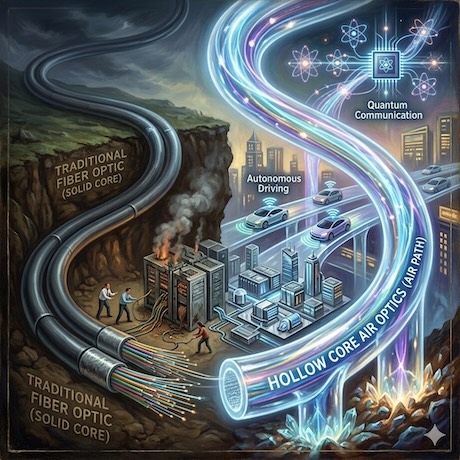
(Image by Gemini)
The backbone of today's digital world are strands of glass no thicker than a human hair. Fiber optic cables, which pulse information via infrared light through solid silica cores, have been the undisputed champions of the internet era. They’re reliable, scalable, and vastly superior to the copper wires they replaced.
But as our appetite for data reaches a fever pitch—driven by real-time AI, high-frequency trading, and the looming shadow of the quantum internet—we’re hitting a physical wall.
The problem isn't the light; it's the glass.
To move faster and cleaner, researchers are increasingly looking at hollow-core fibers. Guiding light through air rather than solid glass promises a new level of data transmission speed and energy efficiency.
Speed of Light Revisited
We’ve all been taught that the speed of light is a universal constant, roughly 299,792,458 meters per second. But that’s the speed of light in a vacuum, or "c" to those who recall high school physics. When light travels through a medium like solid silica glass, it slows down by about 31%.
In the world of high-speed data via solid-core fiber the refractive index of the glass acts like a speed limit. By hollowing out the center of the fiber and using a sophisticated internal structure to trap light in an air-filled core, we can push those speeds back up toward absolute c—the speed of light in a vacuum.
Data in these hollow-core fibers travels roughly 50% faster than in standard fiber. For a gamer, that means less lag; for a global financial institution, those few extra microseconds are worth billions of dollars of potentially lost profits.
Quieting the Noise
It’s about much more than raw speed. Traditional fiber optics suffer from something called "non-linear effects." When you cram too much light (and thus too much power) into a solid glass core, the glass itself starts to interfere with the signal. The photons essentially bump into the atoms of the glass, causing distortion, heat, and signal degradation.
To compensate, engineers have to limit the power of the signal or place expensive "repeaters" every few dozen kilometers to boost and clean the data. Air, however, is much more polite. It doesn't interact with light nearly as much as solid silica does. This means:
Higher Power Limits: You can blast more data through the tube without it getting garbled.
Lower Latency: No need for frequent electronic processing.
Simpler Infrastructure: Fewer repeaters mean lower costs for long-haul installations.
Quantum Bonus
The most exciting frontier for air optics isn't just a faster Netflix stream; it's the foundation of the quantum internet. Quantum communication relies on qubits, often encoded into the fragile quantum states of individual photons. These states are incredibly delicate. In a solid glass fiber, a photon is likely to be absorbed or scattered by the silica atoms, collapsing the quantum information.
Hollow-core fibers provide a pristine environment. Because the light is traveling through air—or, better yet, a vacuum—inside the tube, the interaction with matter is minimized. This preserves the quantum state over much longer distances.
If we’re ever going to link quantum computers across cities or continents, we’ll likely be doing it through air-filled tubes, not the solid glass fibers we use today.
Overcoming Hurdles
If air optics is so much better, why haven't we replaced every cable on the planet yet? It comes down to manufacturing complexity. Traditional fiber is made by pulling a molten preform into a long, simple strand. Hollow-core fiber, specifically Nested Anti-Resonant Nodeless Fiber (NANF), requires a complex internal geometry—microscopic glass tubes arranged in a specific pattern to keep the light reflecting inward toward the air center.
These fibers were fragile and difficult to manufacture in long lengths. But recent breakthroughs in material science have changed the game. Companies are now producing hollow-core cables that are just as durable as their solid counterparts. While they’re still more expensive to produce per meter, the total cost of ownership is dropping because they require less power and fewer signal-boosting stations.
Greener, Faster Future
The shift toward air optics also has a big environmental upside. Data centers are notorious energy hogs, and a significant portion of that energy goes toward managing the heat generated by signal processing and the power needed to push data through resistant glass. By switching to a medium with lower resistance, we can significantly reduce the energy footprint of our global communications network.
Furthermore, the "cheaper" aspect of the deck comes into play when we look at the long-term maintenance. Solid-core fibers eventually degrade due to radiation and high-power heat cycles. Air-filled cores are largely immune to these issues, meaning the infrastructure could last decades longer than current installations.
The Bottom Line
We’re standing at a tipping point. The transition from copper to fiber was the first revolution; the transition from solid fiber to air optics will be the second. By literally hollowing out the core of our technology, we're clearing the path for a future where data moves at the true speed of light. Whether it's the ultra-low latency required for the autonomous vehicles of tomorrow or the secure quantum networks of the next decade, air optics is the clear winner.
Glass fibers brought us the internet as we know it, but glass tubes will bring us the future we’ve only imagined.
Recent Articles
- Your Answers to These 7 Questions Will Reveal Whether You're Sane or a Closet Lunatic
- US Oil Companies Profit from Strait of Hormuz Closure Says Russian Oil CEO
- Trump Faces New Republican Resistance in Congress as Midterms Approach
- SpaceX IPO Already Two Times Oversubscribed
- SpaceX Signs Google As AI Compute Client After Landing Anthropic
- $1 Trillion in Stock Market Valuation Erased by AI Chip Selloff
- Anthropic Urges Industry Pause As AI Nears Recursive Self-Development
- Trump's South Lawn UFC Birthday Bash to Mix Politics with Punches
- Trump Policies Targeting 39 Nationalities of Immigrants Invalidated
- One Man Holds Back the World's Progress toward Green Energy Sufficiency and Prosperity