

Ally Kuwait Shoots Down 3 US F-15E Fighters As War Widens
By Reuters | 02 Mar, 2026
Iran counters US strikes with missile and drone strikes turning the entire Middle East into a war zone.
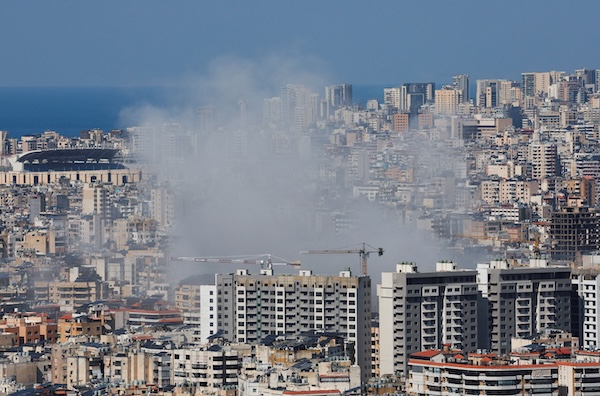
Smoke rises after an Israeli strike on Beirut's southern suburbs, following an escalation between Hezbollah and Israel amid the U.S.-Israel conflict with Iran, Lebanon, March 2, 2026. REUTERS/Mohamed Azakir
The U.S. and Israeli air war against Iran widened on Monday, with no end in sight as Israel attacked Lebanon in response to strikes by Hezbollah and Tehran kept up its missile and drone attacks on Gulf states.
President Donald Trump said a "big wave" of further attacks was imminent, without giving details, and said it was unclear who was in charge in Iran, following the killing of Supreme Leader Ali Khamenei at the weekend.
The attack on Iran has pitched the Gulf into war, thrown global air transport into chaos and shut down shipping traffic through the vital Strait of Hormuz, sending oil prices surging. [O/R]
Underlining the risks, Kuwait mistakenly shot down three American F-15E fighter jets during an Iranian attack, U.S. Central Command said. All six crew members ejected and were safely recovered. Video, filmed at a location verified by Reuters, showed one of the planes spiralling out of the sky, an engine on fire.
For Trump, facing growing discontent at home over bread-and-butter economic issues, the weekend strikes against a foe that had tormented the U.S. and its allies for generations amount to the biggest U.S. foreign policy gamble in decades.
Trump urged Americans to grieve the four U.S. service personnel killed so far. The campaign could pose a major political risk for Trump's Republican Party in this year's midterm elections, with only one in four Americans supporting the operation, according to a Reuters/Ipsos poll at the weekend.
"WE HAVEN'T EVEN STARTED", TRUMP SAYS
Trump said he had ordered the attack to thwart Tehran's nuclear program and a ballistic missile program that he said was growing rapidly. He said the war could go on past a four-to-five-week projection he made earlier.
"We haven't even started hitting them hard," he told CNN in an interview. "The big wave hasn't even happened. The big one is coming soon."
In the first formal Pentagon briefing since the campaign began, the chairman of the U.S. Joint Chiefs of Staff, General Dan Caine, described a campaign that included hitting more than 1,000 targets in the first 24 hours. He said more forces were still on their way to the region.
"This is not a single overnight operation. The military objectives that CENTCOM and the Joint Force have been tasked with will take some time to achieve, and in some cases will be difficult and gritty work," Caine said.
Iran denies seeking a nuclear weapon and says it was offering to curb its nuclear programme at talks when the United States launched an unprovoked assault.
Trump repeated his call to Iranians to rise up and overthrow their leaders.
Within Iran, where residents have jammed highways to flee the bombing, there was uncertainty about the future and emotion ranging from euphoria to apprehension and rage.
Many have openly celebrated the death of Supreme Leader Ayatollah Ali Khamenei, 86, who had ruled since 1989 and directed security forces that killed thousands of anti-government protesters at the start of this year.
But the conservative clerical leaders have shown no sign of yielding power. Military experts say U.S. and Israeli air power, with no armed force on the ground, may not be enough to drive them out. Meanwhile, scores of Iranians have been reported killed in strikes, including several that hit apparent civilian targets.
"They are killing children, they are attacking hospitals. Is this the kind of democracy Trump wants to bring us?" Morteza Sedighi, a 52-year-old teacher, said by phone from Tabriz in northwestern Iran. "Innocent people were first killed by the regime and now by Israel and the United States."
WAR SPREADS TO LEBANON
In a sign that Iran's rulers are still reaching out to the outside world, a senior Iranian security official contacted Reuters to say Iran was defending itself against aggressors and would continue to do so.
A new front in the war opened on Monday when the Lebanese armed movement Hezbollah, one of Tehran's principal allies in the Middle East, launched missiles and drones towards Israel.
Israel responded with sweeping airstrikes, which it said targeted the Hezbollah-controlled southern suburbs of Beirut and struck senior militants. The Lebanese state news agency NNA said an initial tally showed 31 people had been killed and 149 injured.
An Iranian Shahed missile that Cypriot officials said was most likely fired by Hezbollah from Lebanon also hit the British air force base at Akrotiri in Cyprus, the first strike to reach U.S. allies in Europe.
Israel declared Hezbollah leader Naim Qassem a "target for elimination". Officials said they were not for now considering a ground invasion of Lebanon, whose government on Monday banned military activities by Hezbollah.
As Washington's allies in the Gulf came under renewed attack from Iranian missiles and drones, black smoke rose above the area around the U.S. embassy in Kuwait. There were loud blasts in Dubai and Samha in the United Arab Emirates, and in the Qatari capital Doha.
Qatar, one of the world's biggest exporters of liquefied natural gas, halted production, with no prospect of being able to ship safely through the chokepoint of the Strait of Hormuz.
Saudi Arabia shut its biggest refinery after drone strikes caused a fire there, one of a number of energy installations that became targets.
European allies, which distanced themselves from Trump's initial decision to go to war, have since said they could help suppress Iran's ability to retaliate.
In an X post on Monday, Ali Larijani, a powerful adviser to Khamenei, said Iran would not negotiate with Trump, who had "delusional ambitions" and was now worried about U.S. casualties.
OIL SUPPLIES INTERRUPTED
The interruption to oil shipments through the Strait of Hormuz - where around a fifth of the world's oil trade skirts the Iranian coast - jolted global economies. Oil prices leapt by double-digit percentages when trade opened on Monday, but later gave up half those gains. Shares fell and the dollar surged. [MKTS/GLOB]
Iran's Revolutionary Guards said on Sunday they had hit three U.S. and British oil tankers in the Gulf and the Strait. Shipping data showed hundreds of vessels including oil and gas tankers dropping anchor in nearby waters.
Global air travel was also heavily disrupted as airstrikes kept major Middle Eastern airports closed.
(Reporting by Alexander Cornwell, Laila Bassam in Lebanon, Jana Choukeir in Dubai, Andrew Mills in Doha, Michele Kambas in Nicosia and Yiannis Kourtoglou at Akrotiri; Additional reporting by Parisa Hafezi in Dubai, Emily Rose and Reuters bureaux; Writing by Martin Petty, Peter Graff, James Mackenzie; Editing by Jon Boyle and Timothy Heritage)
© 2026 by Asian Media Group Inc.
Recent Articles
- The Making of a Striking Tiger
- Japan's World Cup Prospects Brighter Than Their Single Group Point Might Suggest
- International Stars in the Red Devils' Lineup Suggests a Deep World Cup Run for S. Korea
- Italy's Meloni Says Trump 'Totally Invented' Story That She Begged Him for Photo
- Lebanon Ceasefire Agreed After US-Iran Talks in Switzerland Scrapped
- Qantas Bets on Sleep and Light Science to Sell 20-Hour Flights
- High-Wire Diplomacy Delivered US-Iran Deal but the Tricky Part's to Come
- Pentagon Asks for $80 Billion for Iran War Bills
- Ukrainian Drone Makers Zero in on Demand Created by Taiwan Tensions
- Bedtime Story: Tenali Raman and the Thieves