

China Consumer Prices Decline Accelerates
By Reuters | 09 Sep, 2025
Producer deflation eased in August even as consumer prices fell at their fastest pace in six months.
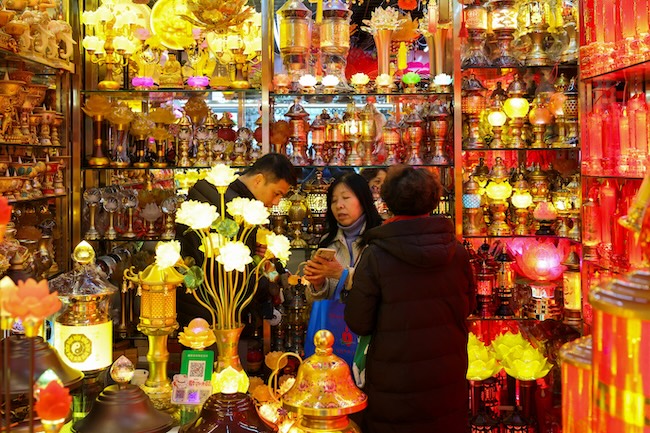
People shop at Yiwu International Trade Market in Yiwu, Zhejiang province, China, February 9, 2025. REUTERS/Go Nakamura/File Photo
China's consumer prices fell at the fastest pace in six months in August but producer deflation eased, suggesting policymakers' efforts to rein in excessive competition and price cuts in key industrial sectors were starting to bear fruit.
The producer price index dropped 2.9% year-on-year in August, National Bureau of Statistics (NBS) data showed on Wednesday, narrowing from a 3.6% decline the previous month. Economists polled by Reuters had projected a 2.9% fall.
The easing in factory-gate deflation comes after authorities recently stepped up calls for key sectors to scale back cut-throat competition. A prolonged price war, for instance, in the auto sector, has taken a toll on major automakers' financial metrics.
Producer price deflation in China has persisted for almost three years, hurting profits of manufacturers who also have to weather weak consumer confidence and uncertainties stemming from U.S. trade policies.
The consumer price index was down 0.4% last month from a year earlier, NBS data showed, worse than the Reuters poll forecast of a 0.2% dip. Prices were unchanged in July.
Food prices fell 4.3%, compared with a 1.6% decline the previous month.
Weak consumer demand has weighed on China's economic growth as the property market downturn persists and U.S. tariffs squeeze exports.
Customs data released earlier this week showed China's export growth slowed to a six-month low in August as a brief boost from a tariff truce with the U.S. faded.
On a monthly basis, CPI was unchanged versus a 0.4% increase in July, slower than economists' forecast for a 0.1% uptick.
Core inflation, which excludes volatile food and fuel prices, was up 0.9% in August from a year earlier, quickening from July's 0.8% rise and the highest in 2-1/2 years.
Policymakers have repeatedly pledged to boost consumption and in August rolled out interest subsidy schemes for individual borrowers of consumer loans as well as businesses in eight consumer service sectors including catering and tourism, in a bid to spur borrowing and spending.
(Reporting by Qiaoyi Li, Yukun Zhang and Ryan Woo; Editing by Tom Hogue and Shri Navaratnam)
© 2025 by Asian Media Group Inc.
Recent Articles
- Jane Fonda to Host First Amendment Celebration Opposite Trump's UFC Event
- SK Hynix Picks Nasdaq for Planned US Listing
- Ukraine's Defense AI Chief Predicts 'New Paradigm' of Warfare
- How Musk's Tactics Blinded Investors to SpaceX Risks
- Baidu, PostBus Get Certified for Robotaxi Service in Eastern Switzerland
- Nvidia Begins Pitching Vera Agentic-AI CPU Sales to Chinese Clients
- Crypto Exchanges Cash in on SpaceX Frenzy with Pre-IPO Derivatives
- Empty World Cup Match Seats Renews Concerns over Ticket Prices
- TSMC Boss's Fear of Shortages of Talent Should Alarm SpaceX Investors
- SpaceX Whets Chinese IPO Appetites but Tech Gap Persists