

Did the K-Wave Culturally Appropriate American English?
By Goldsea Staff | 15 Mar, 2026
Seeding productions with English helped earn Korean media a global fan base and made the nation a soft-power giant.
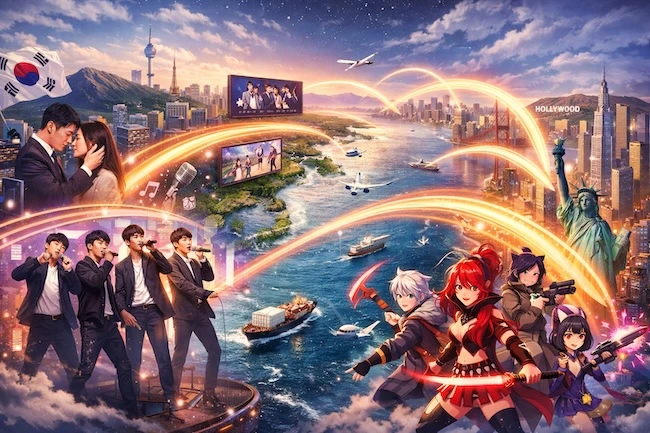
(Image by ChatGPT)
If you’ve spent any time on TikTok or YouTube lately, you’ve heard it. It’s that catchy hook in a Blackpink song, the dramatic dialogue in a Netflix K-drama, or the sudden English punchline in a Korean variety show. It’s not just a few loanwords here and there; it’s a calculated, rhythmic integration of American English into the very DNA of Korean entertainment.

(Image by Gemini)
But as Korea cements its status as the world’s coolest cultural exporter, a cheeky question has started bubbling up in academic circles and late-night Reddit threads: Did Korea culturally appropriate English to build the Hallyu (Korean Wave) empire?
Now, before the linguists lose their minds, let’s be real. Usually, we talk about cultural appropriation when a dominant power takes something from a marginalized group. Suggesting Korea "stole" English—the most dominant language on Earth—sounds a bit like accusing a bucket of water of stealing from the ocean.
But if we look at how the South Korean "culture industry" has systematically mined, polished, and repackaged American linguistic tropes to sell them back to the West, we find a fascinating story of soft-power jujitsu.
The Global Hook Strategy
Back in the 90s K-pop was mostly for Koreans. But the masterminds at agencies like SM, YG, and JYP realized something early on: if you want to go global, you need a bridge. That bridge was English.
They didn't just translate songs. They started "seeding" them. They hired American songwriters and Swedish producers to bake English hooks into the choruses. Think about BTS’s "Butter" or Dynamite." They aren't just songs that *happen* to have English; they are built on a foundation of American disco-pop sensibilities and linguistic patterns that feel familiar to a kid in Ohio or a commuter in London.
By using English "hooks"—those repetitive, catchy phrases—Korean firms lowered the barrier to entry. You don’t need to speak a lick of Korean to scream "Hit you with that ddu-du ddu-du du" or "Love dive." This isn't accidental but a high-level business strategy designed to make Korean media "sticky" in a crowded global marketplace.
Appropriation or Appreciation?
The term "cultural appropriation" is a heavy one. Usually, it implies a lack of respect or a stripping of context. When Korea uses English, is it doing that?
Actually, it’s doing something much more interesting. It’s practicing transculturalism. Korean creators take the "vibe" of American English—the swagger of hip-hop, the earnestness of R&B, the slickness of Hollywood dialogue—and they filter it through a Korean lens.
Take "Konglish" for example. Words like skinship (physical affection), fighting! (encouragement), or selca (selfie) aren't "proper" English, but they are uniquely Korean. Korea didn't just "take" English but broke it down and rebuilt it into something that serves their own social hierarchy and emotional expression.
If appropriation is about taking without permission, this feels more like a covert infiltration of the linguistic boardroom. Korea saw that English was the global currency and decided to start minting its own version of the coins.
The Soft-Power Payoff
Why does this matter? Because it worked. Korea is now a soft-power giant.
Economic Impact: The export of K-culture (music, games, food, and beauty) is worth billions.
Tourism: Millions of people visit Seoul every year because they fell in love with a world where people speak a melodic mix of Korean and English.
Diplomacy: When the UN wants to reach Gen Z, they call BTS.
By appropriating (or strategically adopting) English, Korea neutralized the foreignness of its content. It made the East feel accessible to the West. In a way, Korea used the West’s own language to sell the West a better version of pop culture. They took the shiny, high-production values of 90s Americana, scrubbed away the grit, added a layer of impeccable choreography and skincare, and sent it back across the Pacific.
Irony of the Exchange
There’s a delicious irony here. For decades, the Western world—specifically the US—was the primary "appropriator." American pop culture absorbed jazz, blues, and rock from Black communities and sold it globally. Now, Korea is doing the same thing with the entire Western aesthetic.
When you watch a K-pop group perform a hip-hop routine while rapping in a mix of AAVE (African American Vernacular English) and Korean, you’re seeing a complex layers of cultural exchange. Is it a bit cringe sometimes? Sure. Is it appropriation? It’s certainly a borrowing of a very specific cultural signifier to gain street cred. But in the grand scheme of the K-Wave, English is the grease that keeps the gears turning.
Is the Pure Korean-ness Getting Lost?
Some critics in Korea worry that by leaning so hard into English and Western styles, the "Korean-ness" of the art is being diluted. If a K-pop song is 90% English and produced by a guy in Nashville, is it still K-pop?
The industry’s answer seems to be: "Who cares, as long as the stocks are up?" But more importantly, the fans don't seem to care either. The global fanbase loves the hybridity. They love the fact that they can understand the chorus but still feel like they’re part of an "exotic" and "exclusive" fandom. The English isn't replacing the Korean culture. Rather, it’s the packaging. You come for the English hook, but you stay for the Korean values of hard work, respect for elders, and intense emotional storytelling (the Han).
The K-Pop Demon Hunters Phenomenon
The hot smoking gun for how this English-seeding strategy conquered the worldis the 2025 Netflix juggernaut, K-Pop Demon Hunters. It wasn't just a hit; it was a cultural reset that proved the "hybrid wave" is the most potent force in modern media.
The show’s premise—a girl group that moonlights as supernatural assassins—was already catnip for Gen Z. But the secret sauce was the linguistic choreography. Unlike older K-dramas that relied on subtitles, K-Pop Demon Hunters utilized a Code-Switching Script. The characters moved fluidly between Korean and American English, not just to show off, but to signal emotional depth.
The Global Hook: The show’s original soundtrack featured songs that were 70% English, produced specifically to trend on global charts before the show even premiered.
Narrative Accessibility: By having the lead characters be "Global Trainees" from Los Angeles and Sydney, the show justified a constant stream of English dialogue. This meant Western viewers felt like they were watching a "local" show with "exotic" flair, rather than a foreign production.
Netflix didn't just stumble into this. They used the soft-power giant playbook: take a hyper-Korean aesthetic (the rigorous idol training system), infuse it with the universal language of American snark and English slang, and serve it on a platform that reaches 200+ million homes.
As a result K-Pop Demon Hunters became a Top 10 mainstay in over 90 countries. It proved that appropriating English wasn't about losing Korean identity—it was about building a bigger stage for it. The show didn't ask the world to learn Korean; it used English to invite the world into a Korean story.
A Masterclass in Adaptation
So, did Korea culturally appropriate English?
If we’re being technical, no. You can’t really appropriate a global lingua franca that was spread through centuries of trade and empire. What Korea did was much smarter: they optimized it. They recognized that English isn't just a language; it’s a delivery system.
By seeding their media with American English, Korean firms didn't dilute their culture. Instead, they expanded the definition of what "global" looks like. They proved that you don't have to be from Hollywood to own the English-speaking world. You just have to be better at using the tools than the people who invented them.
The K-Wave isn't just a trend; it’s a blueprint for how a nation can use the dominant culture's own tongue to become the new cultural epicenter. And if that requires a few thousand catchy English hooks and a Netflix hit about singing assassins? That’s just the cost of doing business in the 21st century.
What’s Next for Hallyu
As we move further into the 2020s, the English-seeding is only getting more sophisticated. We’re seeing more "all-English" tracks from K-pop groups and more Western actors appearing in K-dramas as a standard, not a gimmick. The line between Korean media and Global media is blurring into non-existence.
The world is speaking a new language now. It’s not quite English, and it’s not quite Korean. It’s a hybrid—and it sounds like a billion-dollar hit.
© 2026 by Asian Media Group Inc.
Recent Articles
- GoldSea Votes: An Asian Governor in Maine...and Oklahoma?
- 'I Love the Inflation,' Trump Says of Prices Rising Amid Iran War
- China's JUNO Neutrino Detector Advances Precision in Mass-Ordering Quest
- Only 11% of Europeans View US as Ally, Survey Shows
- BYD Will Be World's Biggest Automaker in 5 Years Says Its Chairman
- US Consumer Prices Increase at Fastest Pace in 3 Years
- Traders Keep Bets on Fed Rate Hike by October
- Drone Risks Keep World Cup Security Planners Frantic
- Bill Gates to Face Congress in Probe of Epstein Case Handling
- Musk’s xAI, SpaceX Hit with Class Action over Data Center ‘Nuisance’