

SpaceX Ties Musk Compensation to Mars Colony with 1 Million Population
By Reuters | 28 Apr, 2026
A Mars colony with 1 million people and running data centers in space are key benchmarks underlying an astronomical potential payday for the SpaceX founder.
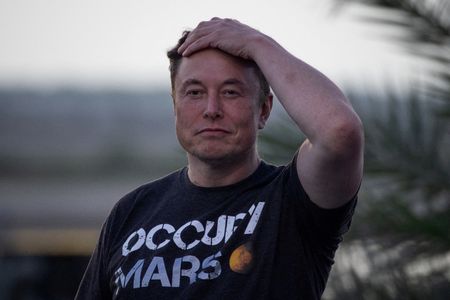
SpaceX Chief Engineer Elon Musk takes part in a news conference at the SpaceX Starbase, in Brownsville, Texas, U.S., August 25, 2022. REUTERS/Adrees Latif
SpaceX's board has approved a compensation plan for founder Elon Musk with goals as futuristic and celestial as the company's ambitions: colonizing Mars and running data centers in outer space.
The details of Musk's sweeping pay package, which have not been widely reported, were revealed in the company's confidential registration statement filed in recent weeks with the Securities and Exchange Commission and reviewed by Reuters last week.
The lofty rewards dangled for Musk by SpaceX show the challenge of holding the attention of the serial entrepreneur as he prepares to take the rocket maker public. They also potentially set up SpaceX investors for tensions with shareholders of Tesla, where Musk is CEO, say corporate governance experts.
Connecting science-fiction visions with accounting commitments, the SpaceX board in January approved a pay package for the world's richest man that will award 200 million in super-voting restricted shares if the company hits a market value of $7.5 trillion and establishes a permanent human colony on Mars with at least 1 million people, according to excerpts from the company's registration statement reviewed by Reuters.
His Mars-shot performance package also gives him as many as 60.4 million in restricted shares awarded on March 23 if SpaceX meets separate valuation goals and operates data centers in space that provide at least 100 terawatts of compute capacity – a colossal amount of power equal to 100,000 gigawatts, or about 100,000 one-gigawatt nuclear reactors running all at once. Both awards come with super-voting Class B restricted stock, which carries 10 votes to every 1 Class A share, and vest in tranches as the company's value rises.
CONDITIONAL REWARDS, STOCK OPTIONS
However, he will not receive a single share if the company fails to reach the board's lofty valuation targets, which are not tied to a specific timeline other than his continued employment. He has received a nominal salary from SpaceX of $54,080 per year since 2019.
The value of the pay package could not be determined since SpaceX is privately held. SpaceX is targeting an initial public offering around the time of Musk's birthday on June 28, which could value the company at some $1.75 trillion, Reuters has reported.
As of December 31, he held 68.8 million in previously awarded Class B stock options with a strike price of about $42 that expire in 2031, allowing Musk to pocket any profit above that amount if he exercises the options before that date.
Musk is already worth $776 billion by Forbes' estimate. SpaceX aside, he could more than double that if he achieves separate, ambitious performance goals at Tesla, the EV automaker he also runs. He owned about 20% of that company's stock as of November, according to the registration statement.
SpaceX and Tesla did not respond to requests for comment. The Information and Reuters have previously reported SpaceX pay targets for Musk linked to a Mars colony and to space data centers.
Executive compensation expert Eric Hoffmann, chief data officer for corporate governance consulting firm Farient Advisors, said he knew of nothing remotely comparable in compensation packages at other companies.
SPACE TARGETS STAND ALONE
“I’m not a physicist or astronomer and I wouldn’t know where to start," he said. "The measuring stick is, has it been done in human history? These haven’t. So that’s hard.”
Now, SpaceX and Tesla effectively are competing over Musk, Hoffmann said. He noted how just last autumn, Tesla's board argued it needed to pay Musk generously to keep him focused on the automaker. Musk, in fact, threatened to leave Tesla if shareholders failed to approve the plan, Tesla previously disclosed.
"What’s interesting about this situation is now, SpaceX and Tesla, both effectively controlled by Elon Musk, are now bidding against each other for his attention," Hoffmann said.
Equilar Director of Research Courtney Yu also said the goals of colonizing Mars and building space data centers stood out because he could not remember any other company – aside from Tesla – using metrics beyond standard financial ones like measures of earnings or revenue to set CEO pay.
It is up to the boards of the respective companies, SpaceX and Tesla, to determine how best to structure Musk's time, Yu said. While a $7.5 trillion market capitalization for SpaceX may seem extraordinary, Yu said in a telephone interview, "it does help with setting expectations for investors as to what the goals of the company really are."
(Reporting by Ross Kerber in Boston; Additional reporting by Echo Wang in New York; Editing by Dawn Kopecki and Matthew Lewis)
© 2026 by Asian Media Group Inc.
Recent Articles
- Qantas Bets on Sleep and Light Science to Sell 20-Hour Flights
- High-Wire Diplomacy Delivered US-Iran Deal but the Tricky Part's to Come
- Pentagon Asks for $80 Billion for Iran War Bills
- Ukrainian Drone Makers Zero in on Demand Created by Taiwan Tensions
- Bedtime Story: Tenali Raman and the Thieves
- Fujimori Edges Toward Peruvian Presidency as Sanchez Calls for Protests
- Republicans Blast Trump's Iran Agreement as Details Emerge
- SK Hynix Veteran Seok-Hee Lee Tapped to Lead Intel Foundry Packaging Push
- Mamdani Plans to Air World Cup for Free Throughout New York
- Myra Molloy Parlays Historic Broadway Success into a Leading Film Role