

The Powerhouse Leading China Up Ranks of Top Drug-Developing Nations
By Ben Lee | 13 Apr, 2026
With one of the world's top-5 drug-development pipelines, Jiangsu Hengrui is leading China up the ladder of global pharmaceutical powers.
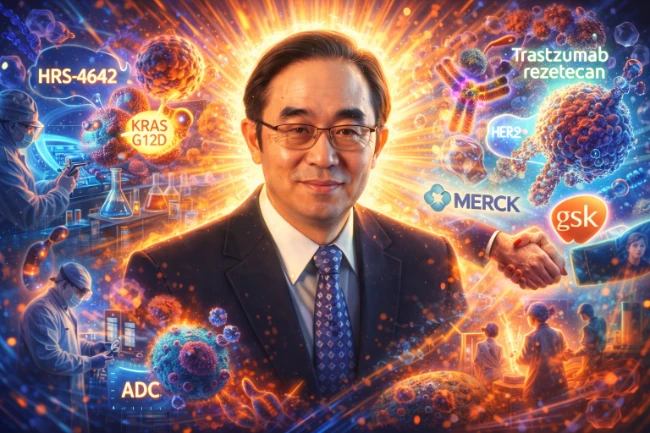
(Image by ChatGPT)
Not long ago, the idea of a Chinese pharmaceutical company competing with the likes of Roche, Pfizer, and AstraZeneca would've seemed far-fetched. Today, Jiangsu Hengrui Pharmaceuticals has quietly, then suddenly, become one of the most formidable drug developers on the planet.
The firm was founded in 1970 as a modest state-owned factory making generics on China's eastern coast. With over 147 pipeline candidates, more than 400 ongoing clinical trials, and a landmark $500 million partnership with GSK signed in 2025, Hengrui isn't just China's leading pharmaceutical company. It's a global leader dragging an entire nation into the upper echelon of global pharmaceutical power.
A Country That Needed a Champion
China's pharmaceutical industry has long been a tale of two tracks. On one side, a vast generics and active pharmaceutical ingredient (API) manufacturing sector — indispensable to the world's drug supply, but not exactly where breakthroughs are born. On the other, an ambitious but still-maturing biotech innovation ecosystem that's been racing to close the gap with the US, Switzerland, the UK, and Germany.
For years, that gap was measured in decades. American and European giants had the research infrastructure, the regulatory experience, the capital, and — critically — the culture of long-horizon, high-risk drug discovery that produces Nobel Prizes and blockbuster therapies. China had scale and government ambition. What it didn't have, at least not yet, was a Roche. It didn't have a Pfizer.
Then Hengrui got serious.
From Generics to Groundbreaking: The Transformation
Hengrui's story isn't one of overnight disruption but a decades-long drama of strategic patience. The company began as the Lianyungang Pharmaceutical Factory in 1970, producing generic medicines for a nation that desperately needed them. It restructured into a joint-stock company in 1997 and listed on the Shanghai Stock Exchange in 2000 — a move that unlocked the capital that would eventually fuel its transformation.
The pivot toward innovation came at the direction of the company's Chairman Piaoyang Sun. As one company executive put it, "[Sun] had the guts and started [to develop innovative drugs] much earlier than anyone else in China." It wasn't a comfortable bet. Generic drugs were the reliable revenue engine, and walking away from that certainty — or at least deprioritizing it — meant years of heavy investment with uncertain returns.
But the strategy worked. By the early 2010s, Hengrui had moved into oncology in a serious way, and in 2014 it launched apatinib, a targeted cancer therapy that represented one of China's first genuinely homegrown innovative drugs. In 2015 came the moment that changed the narrative entirely: Hengrui out-licensed global rights to its PD-1 cancer immunotherapy to US-based Incyte in a deal valued at up to $795 million — at the time, the largest sum ever paid for a Chinese pharmaceutical asset. The message to the global industry was unmistakable. China wasn't just making cheap copies anymore.
A Pipeline That Rivals the World's Best
Fast-forward to 2025, and Hengrui's pipeline is one of the most formidable on earth. The company has over 100 independently developed innovative drug candidates in clinical development, and it's ranked among the top 25 global pharmaceutical companies by pipeline size for four consecutive years by Citeline, the industry's leading data firm. Among those companies, Hengrui holds the distinction of having the most originated drugs — molecules it invented itself — a statistic that speaks directly to the depth of its scientific capability, not just its capacity to acquire or license assets.
Oncology remains the beating heart of the pipeline, with nearly 100 candidates targeting everything from lung cancer to pancreatic tumors. Among the most closely watched is HRS-4642, a first-in-class inhibitor targeting the KRAS G12D mutation — a genetic driver found in three to five percent of all cancers, including some of the deadliest: pancreatic, colorectal, and lung. KRAS G12D has historically been considered "undruggable," which makes Hengrui's progress there one of the more scientifically audacious bets in oncology today.
The company's antibody-drug conjugate program is another source of genuine global excitement. In May 2025, its ADC drug trastuzumab rezetecan became the first China-developed ADC approved for HER2-mutant non-small cell lung cancer — a therapy that, in clinical trials, doubled the efficacy of conventional treatments and is now being evaluated across eight additional cancer indications. ADCs are currently the hottest frontier in oncology, and Hengrui's ability to deliver a best-in-class candidate from its own labs signals that it's not just chasing trends but helping to define them.
Beyond cancer, the pipeline's expansion into metabolic diseases, cardiovascular conditions, respiratory and immunological disorders, and neuroscience is rapidly diversifying the company's revenue profile. Non-oncology product revenue grew by 73.4 percent year-over-year in 2025 — a number that tells you Hengrui's breadth is becoming real, not just aspirational.
Global Partnerships Validate Hengrui's Success
Nothing validates a pharmaceutical pipeline quite like the willingness of established global giants to write large checks for it. By that measure, Hengrui's credentials have never been stronger.
In July 2025, the company announced its most significant partnership to date: a collaboration with GSK to co-develop up to 12 innovative medicines across oncology, respiratory disease, and immunology and inflammation. GSK paid $500 million upfront, with total potential deal value exceeding $12 billion across milestones and royalties. GSK's Chief Scientific Officer described the deal as reflecting a "strategic investment in programs that address validated targets" — pharmaceutical-speak for "we believe in this science."
It wasn't an isolated moment. Earlier agreements with Merck & Co., Elevar Therapeutics, and a portfolio of other global partners have turned Hengrui into one of the most active out-licensing operations in the world. In 2024, the company surpassed AstraZeneca to become the world's top clinical trial sponsor by volume — a staggering benchmark for a company that, a generation ago, was producing generic antibiotics in a coastal Chinese city.
The Enabling Investment in Science
None of this happens by accident. Hengrui's ascent is the direct product of an R&D investment philosophy that would look aggressive even by Western standards. In 2025, the company spent RMB 8.72 billion on R&D — roughly 27.6 percent of total revenue. For context, most major pharmaceutical companies spend between 15 and 20 percent. Hengrui has been above that threshold for years, sustaining that commitment even through the difficult 2021–2022 period when China's centralized drug procurement policies hammered the unit prices of generic drugs and compressed margins across the industry.
Today, the company operates 15 R&D centers across China, Japan, the United States, Australia, and Switzerland, staffed by more than 5,600 researchers. Its offices in Princeton, New Jersey, and Basel, Switzerland — opened in 2020 — sit in two of the world's most concentrated pharmaceutical innovation ecosystems, and their proximity to academic institutions, biotech startups, and global talent pools is no accident.
By mid-2025, Hengrui had cumulatively invested more than RMB 50 billion in R&D since its transformation began. It's also built one of China's most significant patent portfolios, with over 2,600 patent applications filed in Greater China alone and more than 750 patents granted in other markets, including the US, EU member states, and Japan.
What Hengrui Means for China
It's tempting to view Hengrui simply as a corporate success story, but its significance extends well beyond a single company's earnings. In a global pharmaceutical landscape still dominated by American and European players, Hengrui's rise represents something larger: evidence that China's innovation ecosystem has matured to the point where it can produce world-class science, navigate the world's most demanding regulatory systems, and earn the trust of the industry's most sophisticated partners.
China's government has clearly recognized this. The country's "Made in China 2025" initiative and subsequent biotech investment programs have created an environment where companies like Hengrui can thrive — faster clinical trial timelines, improving regulatory pathways, and growing access to global capital markets, exemplified by Hengrui's Hong Kong Stock Exchange listing in 2025, which raised US$1.5 billion in the largest pharmaceutical IPO in Hong Kong in five years.
The pharmaceutical industry's center of gravity is shifting. It isn't moving entirely away from Boston, Basel, or London — but it's expanding to include Shanghai, Nanjing, and Lianyungang. Hengrui didn't just benefit from that shift. In many ways, it's the reason the shift is happening.
© 2026 by Asian Media Group Inc.
Recent Articles
- Qantas Bets on Sleep and Light Science to Sell 20-Hour Flights
- High-Wire Diplomacy Delivered US-Iran Deal but the Tricky Part's to Come
- Pentagon Asks for $80 Billion for Iran War Bills
- Ukrainian Drone Makers Zero in on Demand Created by Taiwan Tensions
- Bedtime Story: Tenali Raman and the Thieves
- Fujimori Edges Toward Peruvian Presidency as Sanchez Calls for Protests
- Republicans Blast Trump's Iran Agreement as Details Emerge
- SK Hynix Veteran Seok-Hee Lee Tapped to Lead Intel Foundry Packaging Push
- Mamdani Plans to Air World Cup for Free Throughout New York
- Myra Molloy Parlays Historic Broadway Success into a Leading Film Role