

The New Intelligentsia: Asian Big-Tech AI Researchers
By Ben Lee | 07 May, 2026
Asians over-index 700% at tech companies with at least $1 billion in funding and are magnets for elite Asian STEM grads from all over the Pacific Rim.
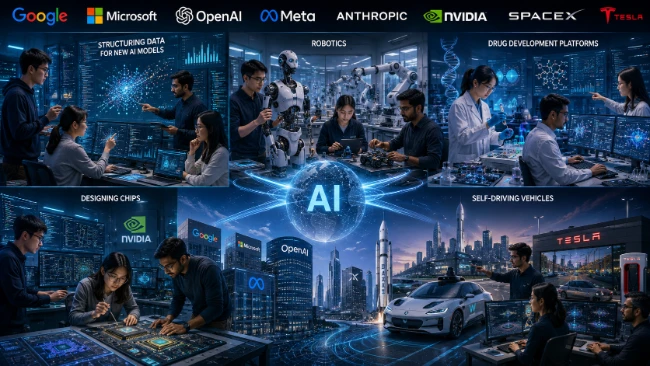
(Image by ChatGPT)
If you walk through the glass-walled corridors of OpenAI in San Francisco, Google DeepMind in London, or Anthropic’s headquarters, you aren’t just looking at the future of software; you’re witnessing a demographic phenomenon that’s reshaping the global power structure. The "AI Boom" isn't just a story of GPUs and neural networks; it’s a story of human capital. Specifically, it’s a story about the extraordinary concentration of Asian and Asian American talent at the very peak of the technological pyramid.
When we look at the numbers, the term "over-indexed" feels like an understatement. While Asian Americans comprise roughly 6% to 7% of the total U.S. population, their footprint in the AI sector is massive. In the highly specialized world of AI Research Staff—the elite group of scientists and engineers at companies with more than $1 billion in funding—Asian Americans represent a staggering 42% of the workforce. That’s a 700% over-representation relative to their share of the general population.
Rise Of The AI Intelligentsia
For decades, the "Big Tech" dream was about becoming a product manager or a full-stack developer. But the arrival of Large Language Models (LLMs) has shifted the hierarchy. The new intelligentsia consists of AI researchers—the people who understand the deep mathematics of transformers, reinforcement learning, and diffusion models.
This shift has created a magnetic pull for elite Asian STEM graduates. The path from top-tier technical institutes to the "Unicorn" AI labs has become a well-traveled highway. It’s not just about getting a job; it’s about entering the most influential priesthood of the modern era. These researchers are the ones deciding how the world’s information is processed, how bias is mitigated (or baked in), and how the next trillion dollars of economic value is generated.
Breaking Down The Workforce Data
The dominance of Asian talent isn't a fluke or a temporary spike; it’s a trend built on decades of educational investment. Data from 2024 shows that while Asian Americans make up about 20% to 22% of the general computing workforce, their presence intensifies as the technical requirements become more rigorous.
We see this most clearly in the pipeline of new AI PhDs, where Asian graduates consistently represent over a fifth of the total output from American universities. In the high-stakes environment of "Billion-Dollar AI Labs," this concentration doubles. This suggests that as the complexity of the work increases, the percentage of Asian talent increases along with it.
It’s a meritocratic feedback loop: the most difficult problems in computer science are currently found in AI, and the students who’ve spent their lives preparing for the most difficult problems are gravitating toward these roles with laser focus.
The Most Exposed Demographic
There’s another side to this story that often gets overlooked. It’s not just that Asian Americans are building the AI; they’re also the demographic most likely to be impacted by it. Statistics indicate that 24% of Asian American workers are in fields categorized as "most exposed" to AI. This is the highest share of any U.S. ethnic group.
"Exposure" in this context is a double-edged sword. On one hand, it means Asian workers are in high-value, cognitive-heavy roles—programming, finance, law, and engineering—where AI can act as a massive productivity multiplier. On the other hand, it means these roles are the primary targets for automation.
Because a quarter of the Asian American workforce sits in the "splash zone" of AI integration, the community has a unique stake in the technology’s success and safety. They aren’t just the architects of the tool; they’re the ones whose daily professional lives will be most radically transformed by its deployment.
Why The Concentration Is Happening Now
Why is this happening at a 700% over-index rate? To understand this, we have to look at the intersection of cultural values and economic reality. For many Asian immigrant families, STEM (Science, Technology, Engineering, and Math) hasn't just been a career choice; it's been a survival strategy. In a competitive global economy, technical skills offer a form of "portable equity"—expertise that remains valuable regardless of borders or social connections.
As AI became the "final frontier" of computer science, it naturally drew the highest-achieving students from these backgrounds. If you’ve spent your youth mastering multivariable calculus and competitive coding, you don’t want to build a basic mobile app. You want to build the machine that thinks.
Furthermore, the "Big-Tech" landscape has changed. The days of the "move fast and break things" generalist are waning. We’ve entered an era of "Deep Tech," where progress requires deep academic rigor and the ability to parse complex research papers. This plays directly into the strengths of a demographic that has historically excelled in high-stakes academic environments.
Global Talent Bridge
We also can't ignore the geopolitical aspect. The AI workforce in the U.S. is heavily bolstered by international talent, particularly from China, India, South Korea, and Taiwan. Many of these researchers come to the U.S. for graduate school and stay to work for the tech giants.
In 2024, the "brain drain" from Asia to Silicon Valley remains one of America’s greatest competitive advantages. These researchers bring with them a work ethic and a mathematical foundation that are increasingly rare. When a billion-funded startup like OpenAI or Anthropic hires a new researcher, they aren't looking for "culture fits" in the traditional sense; they’re looking for the ability to shave 0.1% off an error rate or optimize a training cluster. In that environment, the elite Asian STEM graduate is the most sought-after asset on the planet.
Breaking the Bamboo Ceiling
Despite this 700% over-index in technical roles, a familiar conversation persists: the "Bamboo Ceiling." While Asian Americans are the backbone of the AI research staff, they are often under-represented in the absolute highest levels of executive leadership and venture capital boardrooms.
However, AI is the force that finally shatters that ceiling. Unlike previous tech cycles, the founders of the current AI revolution—people like Jensen Huang of NVIDIA or the dozens of Asian-led AI startups emerging from Y Combinator—are proving that the "technical intelligentsia" can also be the "strategic leadership." When the product is the intelligence itself, the person who understands the code is the most qualified person to run the company.
Future of the AI Workforce
As we move toward 2025 and 2026, the demand for AI talent is only going to grow. The "AI PhD" is the new MBA—a golden ticket to the highest echelons of the economy. Given the current enrollment trends in top-tier universities, it’s likely that the 42% figure for AI research staff will actually increase.
We're seeing a fundamental clustering of talent. The "Most Exposed" status of the Asian American workforce isn't a sign of vulnerability, but a sign of integration. They are the early adopters, the builders, and the primary users of these systems.
A New Era of Dominance
The story of "Asians Over-Indexing 700% in Big-Tech AI" isn't just about a statistic. It’s about a cultural and intellectual shift. The center of gravity in the tech world has moved from the marketing departments and "product visionaries" to the math-heavy research labs.
In this new world, the elite Asian STEM graduate is the protagonist. They are the ones navigating the complexities of neural architecture and the ethics of synthetic intelligence. While the rest of the world worries about whether AI will take their jobs, this demographic is busy making sure they’re the ones holding the keys to the engine room.
By 2024, the reality is clear: you can’t have a billion-dollar AI company without a massive infusion of Asian talent. They aren't just part of the workforce; they are the architects of the new intelligentsia. Whether it's through the 42% of elite research staff or the 24% of workers leading the "AI exposure" charge, the influence is undeniable. The AI revolution isn't just coming—it’s already here, and it’s being built by a demographic that has spent generations preparing for this exact moment.
© 2026 by Asian Media Group Inc.
Recent Articles
- Qantas Bets on Sleep and Light Science to Sell 20-Hour Flights
- High-Wire Diplomacy Delivered US-Iran Deal but the Tricky Part's to Come
- Pentagon Asks for $80 Billion for Iran War Bills
- Ukrainian Drone Makers Zero in on Demand Created by Taiwan Tensions
- Bedtime Story: Tenali Raman and the Thieves
- Fujimori Edges Toward Peruvian Presidency as Sanchez Calls for Protests
- Republicans Blast Trump's Iran Agreement as Details Emerge
- SK Hynix Veteran Seok-Hee Lee Tapped to Lead Intel Foundry Packaging Push
- Mamdani Plans to Air World Cup for Free Throughout New York
- Myra Molloy Parlays Historic Broadway Success into a Leading Film Role