

The Reality Behind the Asian Child Labor Scandals that Rocked Mega Brands
By J. J. Ghosh | 22 Apr, 2026
Here's how Nike became synonymous with child labor in the 1990s what it and other big brands have done to put it behind them.
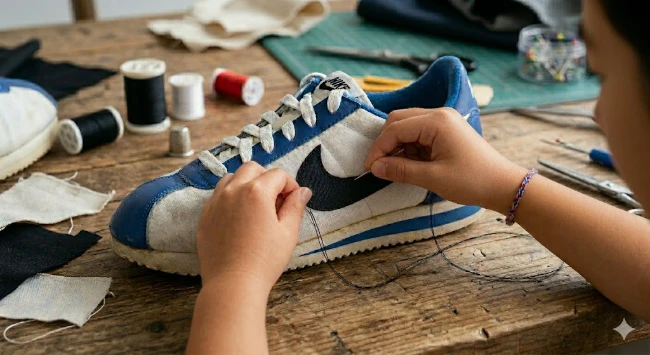
A few years ago I came back from vacation in Portland with nearly a suitcase full of new Nike sneakers. I had run amok at the company’s community store, a factory outlet near their headquarters, which had the lowest sneaker prices I’d ever seen.
I have to admit that I felt like a God in my new Air Jordans. And while I did eventually wear them into the ground, I couldn’t go out in them without getting at least a few compliments every time.
But a friend of mine had a different view on my new kicks. While he did concede that they looked cool, he explained the Nike boycott that he had participated in his entire adult life. “You know that those shoes are made by children in factories in China, right?” he asked.
Did I know that? I asked myself. Kind of.

A scathing political cartoon from the 90s depicts public sentiment of Nike
Like most kids who came of age in the 90s, I associated Nike with the Swoosh, the words “Just do it,” Michael Jordan, and yes, overseas child labor.
But admittedly over 20 years later had just assumed that those issues had been resolved and that we could wear Nikes in peace and live happily ever after.
So I decided to see if any of that was actually true — afraid I already knew the answer.

While much of the industry was equally responsible, Nike was typically the public's main target
What Was Actually True
Nike’s use of subcontracted overseas factories traces back to the 1970s, but it wasn’t until 1991 that a labor activist named Jeff Ballinger published a report detailing the appalling working conditions in Nike’s Indonesian factories — including workers earning as little as 14 cents an hour, below even Indonesia’s own minimum wage.
By the mid-1990s, Nike was being hit with damning reports that its global supply chain was supported by child labor in Cambodia and Pakistan, with minors stitching soccer balls and other products as many as seven days a week for up to 16 hours a day.
In 1996 Life magazine ran a story on child labor that included a photograph of a 12-year-old Pakistani boy sewing a Nike football. That image became one of the most reproduced and damaging in the history of corporate PR.
Later that year, CBS News ran a 48 Hours program on Nike’s manufacturing plants in Vietnam, reporting low wages, physical violence inflicted on employees, and the sexual abuse of women workers — and informing American viewers that temporary workers were being paid just 20 cents an hour.
The abuses were real. The children were real. The poverty wages were real. What is also true — and this is where the story gets more complicated — is that Nike was not unique.
Wait — China?
Before we go further, it’s worth addressing what my friend said, because it reflects a common misunderstanding of the original scandal.
The child labor issue wasn’t primarily a China story. It was an across-Asia story — Indonesia, Vietnam, Pakistan, Cambodia — with China being only one piece of a much larger picture.
China became the shorthand for a simple reason: it was already the dominant frame through which Americans understood cheap overseas manufacturing. By the 1990s, “made in China” had become a cultural punchline for low-quality goods, and the phrase had lodged itself in the popular imagination as a synonym for exploitative labor practices generally.
The reality was more geographically diffuse and more systemic. As labor costs rose in South Korea, Taiwan, and eventually mainland China, Nike continuously moved its production to wherever the lowest costs could be found — Indonesia, Vietnam, Pakistan, Cambodia.
The problem wasn’t China specifically. The problem was a business model that chased the cheapest possible labor anywhere on the planet, with no meaningful oversight of what happened in the factories that took the contracts.
China just got the credit, or the blame, depending on how you look at it.
Everyone Was Doing It
Here’s the part of the story that tends to get lost: Nike was not uniquely villainous.
Nike was neither better nor worse than any of its peers at this point.
Adidas, Reebok, New Balance, and virtually every other major athletic footwear brand was operating under the same basic model: outsource manufacturing to the lowest bidder in the developing world, don’t ask too many questions about conditions, and keep costs low enough to maintain the profit margins that Wall Street demanded.
In other words, the industry operated on the premise that “ignorance is bliss.”
The same year as the Nike stories, Kathie Lee Gifford learned on national television that a Walmart clothing line she had endorsed was being manufactured by child labor in Honduras. The Gap, Levi’s, and dozens of other American brands were caught up in the same wave of labor journalism. This was an industry-wide practice, not a Nike-specific pathology.
So why did Nike and not Reebok become the symbol of the sweatshop era?
Why Nike Specifically?
A few things converged to make Nike the face of something that was, in reality, everyone’s problem.
The first is size and visibility.
As the industry leader, Nike’s high visibility made it ripe for attack when labor rights violations were uncovered.
Nike wasn’t just a shoe company by the mid-1990s — it was a cultural institution, arguably the most powerful brand in American consumer culture. Michael Jordan, Bo Jackson, Charles Barkley, Deion Sanders. The swoosh was everywhere.
When labor activists needed a symbol for corporate exploitation, they needed a name that every American knew, and Nike was it. Attacking Reebok would have been a smaller story.
In other words these attacks were like the spiked blue shell in Mario Kart: Nike was so far ahead that they became the primary target.
The second is the price point.
Unlike Walmart Nike pocketed the surplus profit from cheap overseas labor rather than discounting its product, and it was also criticized for targeting low-income youth as consumers of expensive products.
This was the sharpest edge of the criticism — the company was paying factory workers in Vietnam 20 cents an hour while charging American teenagers $150 for shoes that those same teenagers often couldn’t afford. The gap between the cost of production and the retail price was staggering, and it was on full display.
The third factor is how Nike responded — or rather, how badly.
Nike’s initial position was essentially that it had never manufactured a single shoe in its history. Because it didn’t own the factories, the assumption was that running them was the business of the owners, not Nike.
CEO Phil Knight dismissed criticism, stating “I’m proud of our activities” and arguing that Nike was benefiting Indonesia by helping it transition from farm labor to industrial labor. This response was tone-deaf in a way that invited more scrutiny, not less.
Reebok by contrast took a quieter more conciliatory approach that kept it out of the headlines. Nike’s defensiveness fed the story.
The Turning Point
Nike stonewalled for years before reality forced a reckoning. Sales were dropping and Nike was being portrayed as a company willing to exploit workers and deprive them of the basic wage needed to sustain themselves in an effort to expand profits.
The major shift came in May 1998, when CEO Phil Knight delivered a speech acknowledging the existence of unfair labor practices in Nike’s production facilities and promising to raise minimum wages and ensure clean air in all factories.
In 1999 Nike established the Fair Labor Association to protect workers’ rights across its supply chain, and between 2002 and 2004 audited more than 600 factories for occupational health and safety. In 2005 Nike became the first major brand to publish a complete list of the factories it uses, along with a report detailing working conditions and wages.
These were not trivial steps. For a company that had spent years insisting it had no responsibility for what happened inside buildings it didn’t own, transparency of that degree represented a genuine shift.
Industry Standards
Nike was dragged into accountability under the glare of cameras and boycotts, but the pressure it absorbed had a ripple effect across the industry — partly because activists used Nike as a template, and partly because no other brand wanted to be next.
Adidas, stung by its own share of labor criticism and not wanting to inherit Nike’s reputation, moved early to establish a code of conduct for its suppliers and joined the Fair Labor Association.
Reebok, which had been Nike’s most direct competitor throughout the 1990s controversy, had actually been ahead of the curve — it had implemented human rights standards for its suppliers as far back as 1992, and established a dedicated human rights program that other brands eventually used as a model.
Gap, after its own factories-in-Honduras scandal, overhauled its vendor compliance program and became one of the first major apparel companies to publish a social responsibility report.
The broader industry response produced new institutions that hadn’t existed before: the Fair Labor Association, the Worker Rights Consortium, the Business for Social Responsibility coalition. The Clinton administration convened an Apparel Industry Partnership in 1996 that brought together Nike, Liz Claiborne, Reebok, and human rights organizations to hammer out shared standards.
It was imperfect, contentious, and ultimately incomplete — the unions walked out — but it represented an acknowledgment that the industry as a whole had a problem that could not be solved company by company.
The changes are real, if incomplete. Factory auditing is now standard practice. Supplier lists are more commonly published. Living wage commitments, while still largely unmet, are at least part of the conversation in ways they weren’t in 1995. The Rana Plaza factory collapse in Bangladesh in 2013 — which killed over 1,100 garment workers — produced another wave of accountability measures, including the Bangladesh Accord on Fire and Building Safety, signed by over 200 global brands.
Have Things Changed?
The honest answer is: somewhat.
Nike’s transparency practices are now among the more extensive in the industry. The annual corporate responsibility reports, the factory audits, the published supplier lists — these represent real accountability infrastructure that did not exist before the 1990s scandals. The conditions in Nike’s contracted factories are, by most accounts, better than they were in 1996.
But in 2019 Nike received the worst rating in the Tailored Wages UK report by the Clean Clothes Campaign, which stated that the brand could show no evidence of a living wage being paid to any workers.
And in 2020 the Washington Post reported that Nike was purchasing from a factory relying on forced labor from Uyghurs in China — a report Nike denied, though it later acknowledged the supply chain relationships involved.
The structural problem has not gone away, because it can’t go away as long as the business model remains the same.
The question is how much oversight, transparency, and accountability gets applied to that pressure. Nike’s answer to that question is better than it was in 1991.
Whether it’s good enough is a different argument.
© 2026 by Asian Media Group Inc.
When labor activists needed a symbol for corporate exploitation, they needed a name that every American knew, and Nike was it. Attacking Reebok would have been a smaller story.
Recent Articles
- Qantas Bets on Sleep and Light Science to Sell 20-Hour Flights
- High-Wire Diplomacy Delivered US-Iran Deal but the Tricky Part's to Come
- Pentagon Asks for $80 Billion for Iran War Bills
- Ukrainian Drone Makers Zero in on Demand Created by Taiwan Tensions
- Bedtime Story: Tenali Raman and the Thieves
- Fujimori Edges Toward Peruvian Presidency as Sanchez Calls for Protests
- Republicans Blast Trump's Iran Agreement as Details Emerge
- SK Hynix Veteran Seok-Hee Lee Tapped to Lead Intel Foundry Packaging Push
- Mamdani Plans to Air World Cup for Free Throughout New York
- Myra Molloy Parlays Historic Broadway Success into a Leading Film Role