

Zhao Jianhui Latest to Join Ranks of Billionaire Chinese Returnees
By Ben Lee | 06 Apr, 2026
Epiworld founder Zhao Jianhui is the latest US-trained Chinese to return home and enjoy business success in the tradition of Howard Yang, Robin Li, and Zhang Xin.
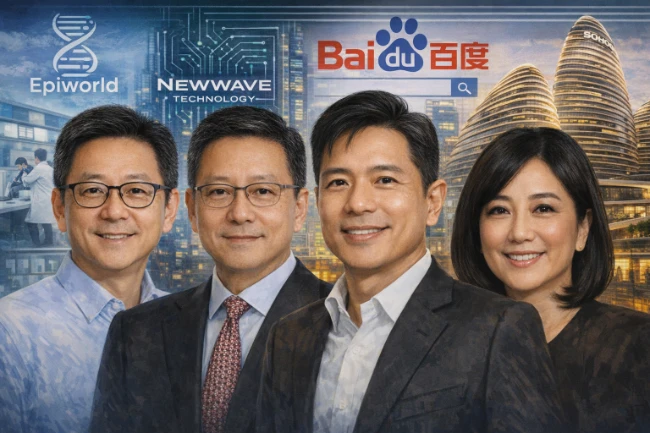
(Image by Copilot)
When Zhao Jianhui left Xiamen for Pittsburgh in the early 1990s to pursue a doctorate in electrical and computer engineering at Carnegie Mellon University, he was following the path trodden by thousands of ambitious young Chinese scientists.
He eventually came home, founded a company, and built it into the world's leading manufacturer of silicon carbide wafers. Last week, when Epiworld International's shares surged 35% on their Hong Kong trading debut — valuing the company at HK$43.8 billion and giving Zhao an estimated net worth of $1.5 billion — the 66-year-old professor-turned-industrialist became the latest addition to the club of "sea turtles" who studied in the West, came home to China, and made it big.
The Chinese term for this cohort is hǎiguī — a homophone for "sea turtle" that's become shorthand for overseas-educated returnees. The phenomenon has quietly shaped China's modern economy for three decades, producing some of the country's most important companies and most recognizable business names.
Zhao's story isn't unusual in its broad outline.
The Template: Study Abroad, Come Home, Build Something
Zhao grew up in Fujian province and completed his undergraduate physics degree at Xiamen University. He earned his PhD in the US, spent years in academia developing deep expertise in silicon carbide technology, then returned to China where he's now a chair professor at his alma mater Xiamen.
In 2011 he founded Epiworld and turned it into a company that commands 31.6% of the global market for silicon carbide epitaxial wafers, essential components in electric vehicles and power electronics.
Zhao's story follows the template established by Howard Yang, the original "sea turtle" of China's semiconductor industry. Yang returned from Silicon Valley in 1994 — decades before Zhao's Epiworld IPO — having studied and worked in the US, with the ambition of designing chips for Chinese consumers. He was the first integrated circuit design engineer to make that return journey after earning his education and early career experience in the United States.
In 1997 Yang co-founded Newave Technology Corp., the first venture-capital-funded IC design house in China, and eventually led Montage Technology to become one of China's most important chip designers. The EY World Entrepreneur awards have recognized him for a career that helped prove the model worked.
Robin Li and the Internet Generation
If Yang proved that returnees could build world-class hardware companies, Robin Li proved they could do the same with software. Li studied information management at Peking University, then headed to the State University of New York at Buffalo for a master's degree in computer science. He also worked at Dow Jones, helped build the online edition of The Wall Street Journal, and then moved to Infoseek in Silicon Valley, where he developed his RankDex algorithm for ranking search engine pages. That algorithm, awarded a US patent, was one of the foundational inventions of the modern search engine industry. Larry Page's PageRank patent, filed two years later, actually references Li's earlier work.
In January 2000 Li returned to China, hired a professor and five graduating students from Peking University, and built the first version of Baidu's search engine in a hotel room near campus. He has said that when he founded the company, he didn't know search could be so profitable. Rather than money, Li was chasing the goal of building something that hundreds of millions of people would use.
Baidu went public on NASDAQ in 2005, with shares surging more than 350% on opening day. It's now a $30-plus billion company and one of China's leading artificial intelligence research organizations. Time magazine put Li on its cover in 2018 and called him "the innovator helping China win the 21st century." It's hard to argue with that framing.
Zhang Xin and the Property Empire
Not every returnee built a tech company. Zhang Xin's path is arguably the most dramatic of all and doesn't follow the engineer-returns-and-founds-startup narrative at all.
Born in Beijing in 1965, she moved to Hong Kong at 14 and spent five years working factory jobs, putting herself through night school to learn English. At 19 she went to the UK, earned an economics degree from the University of Sussex and a master's in development economics from Cambridge, then worked for Goldman Sachs in investment banking.
She came back to China in the mid-1990s and co-founded SOHO China with her husband Pan Shiyi. What she built wasn't just a real estate company but a statement about what modern Chinese cities could look like.
Zhang brought in international architects like Zaha Hadid and Kengo Kuma, and the resulting buildings transformed the skylines of Beijing and Shanghai. She became known as "the woman who built Beijing." In 2007 SOHO China listed on the Hong Kong Stock Exchange, raising $1.9 billion in what was then Asia's largest commercial real estate IPO. Zhang's own rags-to-riches arc — from factory floor to billionaire developer — is one of the most cited stories in Chinese business culture.
The Power Behind the Pipeline
There's an irresistible force behind these success stories—China's economic rise that created a home market enormous enough to reward ambition at the highest level. Added to that is the country's government campaign to recruit returnees through talent attraction programs and state support for strategic industries.
Zhao's Epiworld, for instance, received growing government subsidies over the past three years, and its pre-IPO investors included Hubble Technology — the venture arm of Huawei — and China Resources Microelectronics, a state-owned enterprise. The combination of Western-trained expertise, Chinese market access, and state backing is so powerful as to be irresistible.
There's element adding scale to the trend. Many returnees didn't just bring technical skills home — they brought ambitions shaped by their time abroad. Robin Li watched Jerry Yang build Yahoo and thought he could build something equivalent in China. Zhang Xin watched Margaret Thatcher debate in Parliament and decided she wanted that kind of authority and impact. Zhao spent years building scientific credibility in a niche field and then asked what it would take to industrialize it. In each case the experience of being an outsider in the West — of having to prove something — seems to have focused their drive.
The Club Swells
Zhao joins a cohort that continues getting bigger and more influential. As of 2023, overseas returnees headed more than 70% of China's key national projects and accounted for about 40% of national science and technology award winners. The fields they're working in are strategic industries targeted by Beijing to help China compete against the US — semiconductors, artificial intelligence, new energy, robotics.
The irony doesn't go unnoticed. The US university system trains some of the world's most talented scientists and engineers, including tens of thousands of Chinese students each year. Some of them stay. Many of them don't.
When they go home and build billion-dollar companies in precisely the sectors where the two countries are competing most fiercely, it raises uncomfortable questions about whose investment in their education ultimately paid off.
Zhao Jianhui got his PhD at Carnegie Mellon. His company is now worth $5.6 billion and supplies critical materials to China's electric vehicle industry. Sea turtles have long memories and good instincts about where to swim.
© 2026 by Asian Media Group Inc.
Recent Articles
- GoldSea Votes: An Asian Governor in Maine...and Oklahoma?
- 'I Love the Inflation,' Trump Says of Prices Rising Amid Iran War
- China's JUNO Neutrino Detector Advances Precision in Mass-Ordering Quest
- Only 11% of Europeans View US as Ally, Survey Shows
- BYD Will Be World's Biggest Automaker in 5 Years Says Its Chairman
- US Consumer Prices Increase at Fastest Pace in 3 Years
- Traders Keep Bets on Fed Rate Hike by October
- Drone Risks Keep World Cup Security Planners Frantic
- Bill Gates to Face Congress in Probe of Epstein Case Handling
- Musk’s xAI, SpaceX Hit with Class Action over Data Center ‘Nuisance’