

Asia Markets at New Highs for Year
By wchung | 15 Jun, 2026
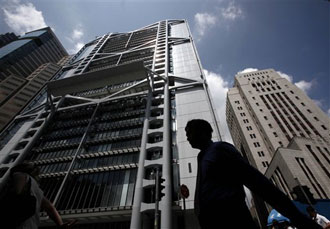
A man walks past the HSBC headquarters in Central, the business district of Hong Kong Thursday, Sept. 17, 2009. European and Asian stock markets extended the week's rally on Thursday, hitting new highs for the year, as investors became increasingly confident that the U.S. economy, the world's largest, is growing again. Hong Kong's Hang Seng gained 1.7 percent to 21,768.51 and China's Shanghai benchmark rose 2 percent to 3,060.26. (AP Photo/Kin Cheung)
Asian stock markets climbed to new highs for the year Thursday after strong U.S. industrial production data boosted confidence the world’s largest economy is growing again. European shares were higher.
Oil prices hovered about $72, lifting commodity stocks, while market indexes from Hong Kong to South Korea to Indonesia set new peaks for 2009. As trading got underway in Europe, benchmarks in Germany, France and Britain were up 0.5 percent or more.
The gains in Asia tracked Wall Street’s eighth rise in nine sessions after the Federal Reserve said industrial production jumped 0.8 percent in August — a possible precursor of greater U.S. demand for mainstay Asian exports like cars, gadgets and computer chips.
The news came a day after Fed Chairman Ben Bernanke said that the recession was likely over. Investors have been scooping up stocks for six months in anticipation of a rebound in the economy.
Most of the biggest gains in global markets this year have been in Asia, driven in part by unprecedented liquidity from government stimulus spending and low interest rates set by central banks. That has created persistent concerns the markets have risen too far, too quickly.
“Asia is outperforming right now, but this is primarily liquidity driving the market up,” said Peter Lai, investment manager at DBS Vickers in Hong Kong. “I feel the upside opportunities are quite limited but the downsides risks are high, and many people may start looking for opportunities to take profits.”
Japan’s Nikkei 225 stock average was up 173.03, or 1.7 percent, at 10,443.80 as the central bank raised its assessement of the world’s second-largest economy and kept interest rates at 0.1 percent to nurture a recovery.
Hong Kong’s Hang Seng gained 1.7 percent to 21,768.51, China’s Shanghai benchmark rose 2 percent to 3,060.26 and South Korea’s Kospi added 0.7 percent to 1,695.47.
Elsewhere, Australia’s market jumped 1.4 percent and India’s Sensex was up 0.5 percent.
Among other countries whose main stock measures hit new highs for 2009 on Thursday: India, Thailand, Malaysia and Taiwan.
In the U.S. on Wednesday, the Dow rose 108.30, or 1.1 percent, to 9,791.71, its highest close since Oct. 6, when it ended at 9,956. The broader Standard & Poor’s 500 index rose 16.13, or 1.5 percent, to 1,068.76.
Futures pointed to more gains Thursday on Wall Street. Dow futures were up 9 at 9,795 and S&P futures gained 17.7, or 1.7 percent, to 1,068.00.
Oil prices held above $72 a barrel. Benchmark crude for October delivery was down 1 cent at $72.50 a barrel by late afternoon Singapore time in electronic trading on the New York Mercantile Exchange.
In currencies, the dollar fell to 90.65 yen from 90.88 yen. The euro gained to $1.4728 from $1.4706.
___
AP Business Writer Jeremiah Marquez in Hong Kong contributed to this report.
9/17/2009 6:06 AM STEPHEN WRIGHT, AP Business Writer BANGKOK
© 2026 by Asian Media Group Inc.
Recent Articles
- China's Heavy Truck Electrification to Hit Diesel Demand
- Trump Push into Highly Dangerous Plutonium Unlikely to Fix US Nuclear Fuel Crunch
- India's May Wholesale Price Inflation Rose to 9.68% on Fuel-Cost Surge
- Tesla Presented Misleading ‘Full Self-Driving’ Safety Data to European Regulators
- Deal Includes Release of $25 Billion in Frozen Assets, US-Funded Reconstruction
- Fox Strikes $22 Billion Deal for Roku to Aid Streaming Shift
- Nvidia to Raise $20 Billion in First Corporate Bond Sale in Five Years
- Israel Remains Wild Card As Iran, US Seek Peace
- US Homebuilder Sentiment Falls in June Amid Rising Costs
- Will Cerebras' Dinner-Plate-Sized Chips Overtake Nvidia's Standard Modular Chips?