
How a Long Beach Neighborhood Became the Heart of Cambodian America
By Kelli Luu | 20 Jun, 2026
After the Khmer Rouge, Cambodian refugees fled to Long Beach California to rebuild their lives, allowing survivors of the tragedy to become a thriving community.
© 2026 by Asian Media Group Inc.
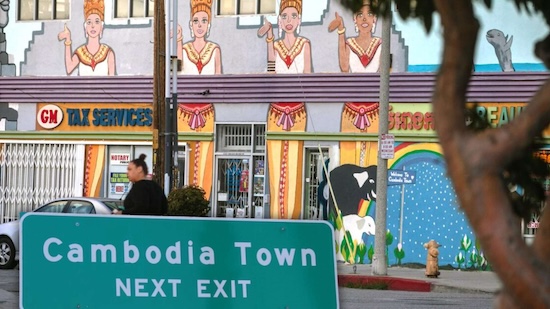
Anaheim Street in Long Beach, California is covered with Khmer script on storefronts, Cambodian restaurants serving authentic dishes, and murals that celebrate Cambodia’s history.
The Long Beach neighborhood is known as Cambodiatown with an estimated 20,000 Cambodians living in the area. The larger metropolitan Long Beach area has roughly 50,000 people of Cambodian descent, making it home to the largest Cambodian population outside of the country itself. So how did it come about?
Cambodiatown’s story dates back to 1975 when the Khmer Rouge seized control of Cambodia and carried out a genocide that killed 2 million people through forced labor, starvation, and disease causing countless of families to desperately flea the country. The United States began accepting Cambodian refugees in 1979 after the fall of the Khmer Rouge and a significant number of them found their way to Long Beach, California.
Long Beach was more affordable compared to other parts of Southern California and many jobs were available through the city’s port and manufacturing companies. The Cambodian population increased throughout the 1980s and 1990s and as more refugees arrived, the community grew stronger. Buddhist temples were established as well as Cambodian-owned restaurants and markets. By the 2000s, community leaders were advocating for recognition of the neighborhood and its cultural significance.
Their efforts paid off in 2008 when the City of Long Beach designated a part of Anaheim Street as Cambodiatown, making it the very first officially recognized Cambodiatown in the U.S. Today the neighborhood continues to be the cultural center of Cambodian America. Parades and festivals attract thousands of visitors every year and community organizations are constantly working to promote the Khmer language and history to younger generations.
Even with the many challenges affecting neighborhoods across the country, Cambodiatown has remained a powerful symbol of cultural preservation representing those who were able to rebuild their lives and create a lasting home oceans away from where their stories began.
Recent Articles
- South Korea Survives World Cup Scare, Advances to Round of 32
- SpaceX Targets US Consumers with Starlink Mobile Service Push
- Former First Lady Kim Keon Hee Gets 7-Year Jail Term for Bribery
- Iran Reasserts Right to Control Hormuz Passage After Ship Hit Near Oman
- Trump's Cutoff of Clean Energy Tax Credit Drives Rush of New Projects Before Costs Soar
- US May Goods Trade Deficit Widened Sharply on Imports Surge
- VW Eyes 100,000 Job Cuts, Closure of Four Plants in Biggest Overhaul Yet
- Small Aircraft Crashes into Beijing's Tallest Building
- Both Japan and Sweden Advance with Draw
- S. Korea to Train 500,000 'Drone Warriors' to Counter North