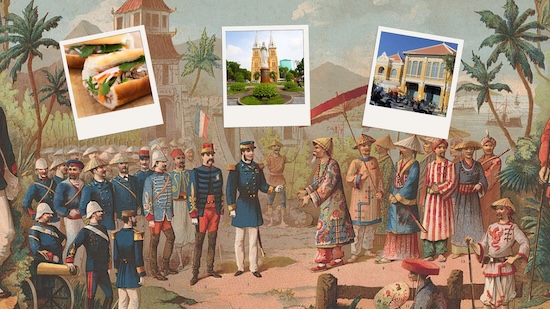

How France Left Its Mark on Southeast Asia
By Kelli Luu | 16 Jun, 2026
After controlling French Indochina for nearly a century, France’s cultural, architectural, and political influences still remain throughout the region today.
© 2026 by Asian Media Group Inc.
For almost a century, France controlled and colonized a large portion of Southeast Asia known as French Indochina and while the colonial period officially ended decades ago, its influence is still found throughout Cambodia, Vietnam, and Laos today.
As European powers were competing for territory across the world, French colonization in Southeast Asia began in the mid-19th century when France first invaded Vietnam in 1858. Over the next few years, France was able to expand its control throughout the region and established French Indochina by 1887. The colonial federation consisted of present day Vietnam and Cambodia with Laos being added in 1893 after the Franco-Siamese War.
French Indochina was one of the most important territories within the French colonial empire as officials viewed the area as a strategic outpost and economic factor. In order to strengthen their power and economic extraction, authorities invested in railways, roads, and ports to facilitate the export of rice, coal, and other resources.
The most visible legacy of French colonization is found in Vietnam. The French introduced coffee to Vietnam in 1857 and laid the foundation for what would become one of the world’s largest coffee industries. But not only did they bring coffee, the also French brought pastries, flan, pâté and many ingredients that have been completely integrated into Vietnamese cooking styles. French influence can also be seen in the architecture through Vietnam’s major cities with wide boulevards, opera houses, and Catholic churches serving as a reminder of the period that transformed the entire region.
While Vietnam became the empire’s economic center, Laos and Cambodia experienced drastic changes as well. In Cambodia, the French established a protectorate in 1863 and administrators modernized the government systems and redesigned schools and buildings. Many ancient temples were neglected during the 19th century, but French archaeologists helped restore many of them, including Angkor Wat.
At this time, Laos was not heavily industrialized, but the French had a massive influence on urban planning, culture, and education. Catholic churches and French villas still stand throughout cities and even today, Laos is still a member of the International Organization of La Francophonie.
Although France helped modernize portions of Southeast Asia, it also brought forth inequality and resistance as colonial governments maintained most of the power and limited representation for the local citizens. Throughout the early 20th century, opposition to colonial rule increased throughout Vietnam, Laos, and Cambodia and the era ultimately ended following World War II and the First Indochina War. Vietnamese forces defeated France at the Battle of Dien Bien Phu in 1954 which fully ended French control in the region.
More than seventy years later, France’s legacy remains prominent throughout Southeast Asia. French colonization may have left behind a complicated history of cultural influence and political domination, but its impact continues to shape the identities of Southeast Asian countries long after the era ended.
Recent Articles
- US Holds off Blacklisting DeepSeek, Over 100 Firms Deemed Security Risks
- Vietnam Maintains 2026 GDP Target Despite Trade Deficit, Inflation Pressure
- China Makes New Push to Take Yuan Global
- Iran Deal Includes $300 Billion Investment Fund, With Over Half Already Committed
- US Senate Narrowly Blocks New Bid to Rein in Trump War Powers
- BYD Ramps up Battery Production in Brazil
- Intel Begins Chip Production with New Fabrication Process
- 'Wingman' Drone Key Piece of EU's Defense Self-Reliance
- Keiko Fujimori Edges Ahead in Brutal Contested Vote Count
- Chip Queen He Tingbo Subverts Moore's Law to Overturn the Global Semiconductor Hierarchy