

How the US Gifted China with Its Top Rocket Scientist
By Goldsea Staff | 25 Feb, 2026
Without the Red Scare and ensuing witch hunt, Qian Xuesen would have continued providing brilliant leadership to the US space program instead of laying the groundwork for China's.
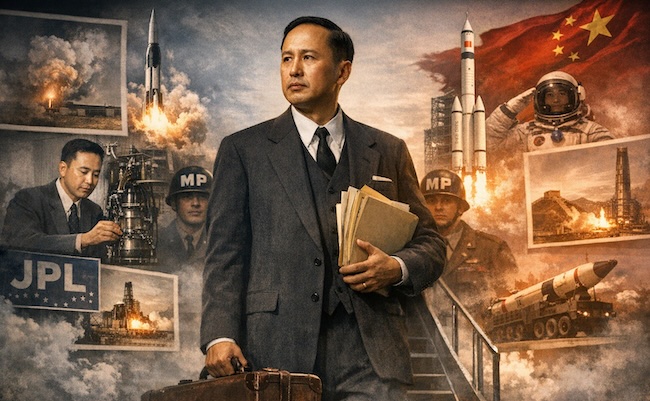
(Image by ChatGPT)
In the annals of American self-inflicted wounds, few are as staggering as the expulsion of Qian Xuesen — the brilliant Chinese-American rocket scientist who went on to become the father of China's ballistic missile and space programs.
Paranoia triumphed over reason, political hysteria overrode national interest, and the US handed one of its greatest scientific assets to a geopolitical rival.
Talented Young Immigrant
Qian Xuesen — known in the West as Tsien Hsue-shen — arrived in the United States in 1935 as a young Chinese scholar on a government scholarship. He was already exceptional, but America's academic environment gave his talents room to explode. He landed at Caltech, where he came under the wing of Theodore von Kármán, one of the greatest aerodynamicists who ever lived. Von Kármán quickly recognized that his new student as a generational talent.
Tsien became a founding member of what would grow into the Jet Propulsion Laboratory, the legendary NASA facility that today manages interplanetary spacecraft and deep-space exploration. In the early days, he and a small band of enthusiasts ran rocket experiments in the Arroyo Seco riverbed near Pasadena, earning the nickname the "Suicide Squad" for the reckless enthusiasm with which they pursued their work. It was dangerous, it was improvised, and it was the seedbed of America's entire space and missile enterprise.
War Asset
During World War II Tsien's value to the United States became undeniable. He held the highest security clearances, contributed to classified military research, and helped develop jet-assisted takeoff systems for aircraft.
When the war ended, he was sent to Europe as part of a team tasked with interviewing captured German scientists — including Wernher von Braun, who would later lead NASA's Saturn V program. By the late 1940s, Tsien was a full professor at Caltech, widely regarded as perhaps the most important rocket scientist in the country. He was, in every meaningful sense, an American scientific treasure.
Joe McCarthy and Wasted Years
Then Joe McCarthy got to work.
The Red Scare that swept through American institutions in the late 1940s and early 1950s fed on suspicion, innuendo, and fear. In 1950 an anonymous tip alleged that Tsien had once attended meetings of a Communist Party discussion group in the late 1930s.
Whether or not that allegation had any substance — and Tsien always denied being a party member — it was enough. His security clearance was revoked almost immediately. The FBI began surveilling him. The Immigration and Naturalization Service moved to deport him, and yet paradoxically, the government also refused to let him leave the country, apparently worried he'd take sensitive knowledge with him.
For five years, Qian Xuesen lived in a kind of limbo. He couldn't work on the classified research that had defined his career. He was watched, harassed, and humiliated. His mail was opened. His movements were tracked.
The man who had helped lay the foundations of American rocketry was treated as an enemy of the state, not because of anything he'd done, but because of the paranoid political climate of the era. His Caltech colleague and mentor von Kármán was outraged. So were many of his colleagues. But in the McCarthy years, outrage didn't count for much.
It's worth pausing here to appreciate the full absurdity of the situation. The United States government had in its possession one of the world's preeminent rocket scientists — a man who'd spent two decades contributing to American military and scientific supremacy — and was tearing itself apart trying to destroy him professionally rather than allowing him to keep doing what he did better than almost anyone alive.
Prisoner Swap
By 1955 the situation had become diplomatically untenable. Negotiations between the US and China led to a prisoner exchange tied to the Korean War, and as part of that arrangement, Tsien was allowed to return to China.
He boarded a ship in September 1955 and sailed away from the country he'd called home for twenty years. Navy Secretary Dan Kimball, watching it happen, was blunt about what America had just done. It was, he said, "the stupidest thing this country ever did."
He wasn't wrong.
A New Opportunity in China
Within months of his return, Tsien was given virtually unlimited resources and political support by the Chinese government. Mao Zedong and Premier Zhou Enlai understood exactly what they had. Here was a man trained at the finest institutions in the world, with deep experience in America's most classified defense research, who was now highly motivated — one might reasonably say, deeply motivated by personal grievance — to help China become a major military power. If the United States had set out to design the worst possible outcome for itself, it couldn't have done a more thorough job.
Tsien threw himself into his new work with extraordinary energy. He built China's missile program largely from scratch, combining his American training with Soviet technical assistance that was available in the early years of Sino-Soviet cooperation.
China's first medium-range ballistic missile flew in 1960. Its first nuclear-armed missile was tested in 1966. The intercontinental ballistic missile program followed. The same genius that had helped design America's early rockets was now pointing those capabilities in a very different direction.
Tsien didn't stop at missiles. He became the architect of China's entire space enterprise, helping establish the organizational structures, research institutions, and technical pipelines that would eventually send Chinese astronauts into orbit.
China launched its first satellite, Dong Fang Hong 1, in 1970 — making it the fifth country in space. The foundation for all of it was built by the man America had thrown away.
Tsien's Legacy
In China Tsien is remembered as a national hero, celebrated on postage stamps, and honored with museums and institutes bearing his name. He died in 2009 at the age of 97, having lived long enough to see China become a genuine space power.
Back in the United States, the reckoning with what had happened was slow and incomplete. The McCarthy era eventually collapsed under its own dishonesty — McCarthy himself was censured by the Senate in 1954 — but the damage had been done in countless ways, and the Tsien case was among the most consequential. There were no prosecutions of those responsible, no formal apology, no moment of national accountability.
The whole episode was quietly folded into the general acknowledgment that McCarthyism had been a dark chapter, without anyone seriously grappling with the specific, concrete, strategic catastrophe it had produced.
What Ifs
It's tempting to speculate about what might have been. Had Tsien been left alone to do his work, it's reasonable to assume he'd have played a central role in the space race of the 1950s and 1960s. His contributions to JPL and Caltech suggest someone who wasn't just a brilliant technician but a scientific visionary capable of shaping entire programs. The Mercury, Gemini, and Apollo programs drew on the work of many of the same people and institutions with which Tsien had been deeply connected. His absence from that story is a hole that's hard to measure.
What's beyond speculation is that the Chinese missile and space program that the United States spends billions monitoring and countering today was built in significant part on a foundation laid by a scientist America educated, nurtured, and then, in a fit of McCarthy-era paranoia, threw away.
It was one of history's greatest acts of self-sabotage.
© 2026 by Asian Media Group Inc.
Recent Articles
- Charles Schwab Working with Cboe to Enter Prediction Market
- Mexico's Love Affair with All Things Korean — Until Thursday's Kickoff
- The Making of a Striking Tiger
- Japan's World Cup Prospects Brighter Than Their Single Group Point Might Suggest
- International Stars in the Red Devils' Lineup Suggests a Deep World Cup Run for S. Korea
- Italy's Meloni Says Trump 'Totally Invented' Story That She Begged Him for Photo
- Lebanon Ceasefire Agreed After US-Iran Talks in Switzerland Scrapped
- Qantas Bets on Sleep and Light Science to Sell 20-Hour Flights
- High-Wire Diplomacy Delivered US-Iran Deal but the Tricky Part's to Come
- Pentagon Asks for $80 Billion for Iran War Bills