

Indian Food Deserves A Hand
By Romen Basu Borsellino | 17 Jan, 2026
An ancient food tradition has racists in a tizzy.
 By Romen Basu Borsellino | 17 Jan, 2026" style="width: 100%; height: auto;">
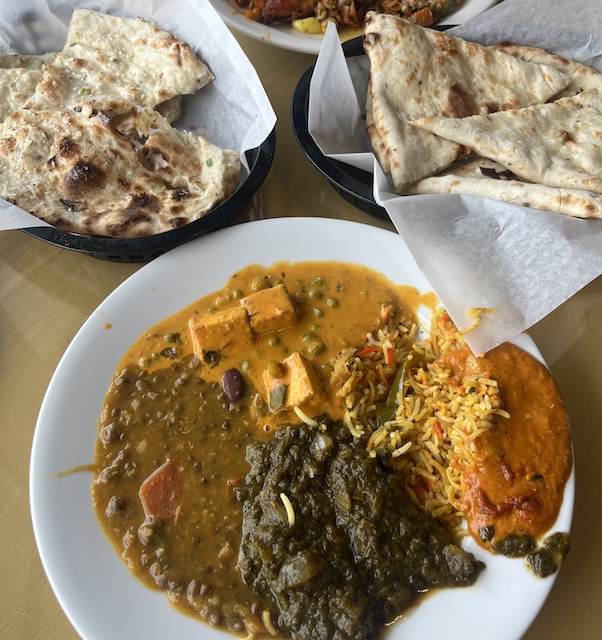
In many Indian dishes, the bread — naan, roti, dosa — serve the function of utensils.
Every action has an equal but opposite reaction. I was reminded of Sir Isaac Newton’s Third Law of Motion when my fellow South Asian Zohran Mamdani shot to fame during the 2025 New York Mayoral race.

A viral video of Zohran Mamdani eating with his hands sparked racist blowback.
Suddenly Mamdani’s presence on the political scene was giving visibility to parts of my culture that I had seen few non-Indians take interest in. Our clothing, our food, our music.
But for all of the positives, the blowback was swift. Members of the far right, frustrated by the success of a young Democratic Socialist minority, wasted little time resorting to one of their favorite tactics: racism.
Zohran was immediately hit with the same bigotry that many of us got used to post-9/11: Islamophobia and birtherism. Accusations of terrorism and Sharia law. And even some new slurs that I had never heard before like “jeet,” which is meant to be offensive but I’m still not sure why.

The viral celebrity chef "Salt Bae" is a reminder that precision in food preparation can often be achieved only by hand
And then there’s their other favorite line of attack: The way that Indians eat food with their hands.
In June Republican Congressman Brandon Gill (TX-26) posted a photo of then-candidate Zohran Mamdani eating rice with his hands along with the caption “Civilized people in America don’t eat like this. If you refuse to adopt Western customs, go back to the Third World.”
More than a few Twitter users were quick to ask the Texas Congressman how exactly he thinks his constituents eat spare ribs.
Sadly, Gill is just one in a loud chorus of racists who are suddenly fixated on the topic of how we eat.
I figured they could use a history lesson.
Misconceptions
Some are under the impression that Indians eat with our hands because we are an historically poor country that can’t afford utensils. But there’s little evidence to support this.
It's not that Indians don't own use utensils: Vegetables are chopped with knives and curries mixed with spoons. The decision to eat with our hands is a choice that isn't born out of a lack of access to kitchen implements.
To dispel the idea that this is about socio-economic status, I would also point to the numerous other cultures that have been known to eat with their hands, ranging from Middle Eastern to African to Southeast Asian.
And if the haters aren't attempting to call us poor, they’re typically trying to call us dirty. The word "unhygienic" tends to be thrown around by those critical of how Indian food is consumed.
Science, however, begs to differ. Studies when both hands and utensils are washed, there is no substantial difference in cleanliness.
Additionally, it’s customary to use one’s right hand for eating so as to keep the left hand clean just in case.
While the following are just a few of the reasons why Indians have historically eaten with their hands —not that anyone is owed an explanation — it should of course go without saying that in a country of one-billion that’s known for its vast regional variance, nothing is universal.
When you add hybrid Indian American culture to the mix, every family’s practices should be treated with the uniqueness of a snowflake.
As a person of mixed Indian and Italian descent, I was personally raised in a household that relied on cutlery for the majority of meals. But when certain dishes like keema and chapathi were on the menu in my mom’s kitchen, I was always prepared to roll up my sleeves.
On the other hand — pun intended — a close Indian American friend from from Boston revealed to me that he had never relied on utensils until he got to college—which was a culture shock.
The Ayurveda
Understanding India's tradition of eating with one’s hands requires first understanding the Ayurveda, an ancient system of whole-body medicine and philosophy that dates back about 3,000 years. Translating roughly to “knowledge of life,” the teachings of the Ayurveda concern the necessity of living life with the perfect balance of mind and body.
This means that good health depends on a firm connection between the physical and mental. Among other things it advocates for the full embrace of one’s senses. And the way we consume food is a reflection of that.
According to the Ayurveda each of our five fingers represents a different crucial element: The thumb is fire, index finger is air, middle finger is space, index finger is earth, and pinky is water.
Anyone who grew up watching Captain Planet—which was centered on the elements of Earth, Fire, Wind, Water, and Heart—may wonder if the Ayurveda stole these ideas from the show. Of course, the Ayurveda pre-dated Captain Planet by about 2,970 years.
By eating with our hands, the Ayurveda teaches, we receive the full sensory experiences. For one, it allows us to truly immerse ourselves. In the same way that smelling hot buttery popcorn is likely to make it taste better, touching food is believed to have the same effect.
While fully engaging with our food sounds symbolic, it’s rooted in a physical belief that the interaction of these elements is essential for proper digestion and thus enhances nutrient absorption.
Scientifically speaking, it is believed that through the gut-brain axis, physically touching food sends a message to your brain to prepare for the digestion process.
Precision
The world's best chefs, regardless of cuisine, will almost always prefer using their hands when it comes to preparing food. It allows for a type of precision that utensils aren’t capable of providing.
In the early 2000s, a chef now known as "Salt Bae" went viral for the suaveness with which he sprinkled salt onto a steak. Whether or not the chef intended to look as fly as he did, the photo captures the precision sometimes required to cook at the level that he does.
When it comes to the consumption of Indian food, there is typically some assembly required by the diner: rice, yogurt, curry, chutney, and additional spicing. Blending these elements together is somewhere between an art and a science.
Think of someone eating Indian food as their own personal chef and the use of one’s hands begins to feel more like a necessity than a preference.
Substance
As many have pointed out, we eat barbecue spare ribs and buffalo wings with our hands and would be laughed out of any pizza parlor in New York for eating a slice with a fork and knife. And imagine using cutlery to eat, say, a peanut butter and jelly sandwich.
It’s because those dishes were simply created to be consumed by hand. The bone in the wings and ribs serves as a natural skewer. When it comes to pizza, the bottom is meant to be handheld while the top is where the mess lives. And the very nature of a sandwich is that there is a protective layer of bread.
This is the case with many Indian dishes as well.
Roti, naan, paratha and other breads were designed specifically to serve the same function as a fork. They are the vehicle that you use to transport food from a plate to your mouth.
In Ethiopian cuisine, which is not dissimilar to Indian, a large round sourdough flatbread called injera functions as the “plate” that the stews are served on before being torn up and used like naan and roti.
Ultimately, I would liken eating Indian food with utensils to watching Christopher Nolan’s “Oppenheimer” on an airplane. It is not the intended method of consumption, but the product is good enough that it will still be an enjoyable experience.
I must say that regardless of their intentions, I've got to hand it to the racists for bringing attention to our culture. And don't worry, my hands are clean.
© 2026 by Asian Media Group Inc.
By eating with our hands, the Ayurveda teaches, we receive the full sensory experiences. For one, it allows us to truly immerse ourselves. In the same way that smelling hot buttery popcorn is likely to make it taste better, touching food is believed to have the same effect.
Articles
- [articles_link|12]