

Jawbone Shaving and the Feminization of Korean Male Beauty Standards
By H Y Nahm | 27 Apr, 2026
The surging popularity of a more feminine facial structure among K-pop and K-drama stars bodes ill for a healthy national self-image.
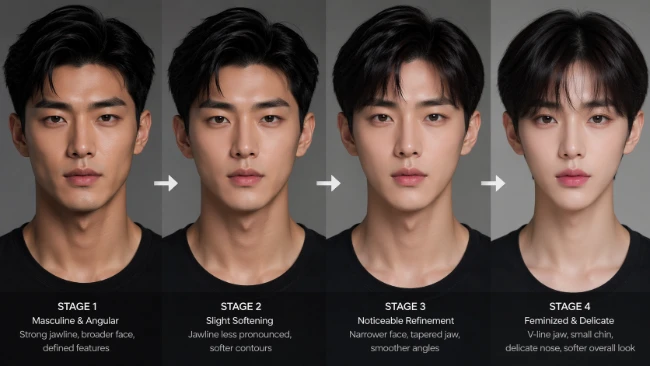
(Image by ChatGPT)
To understand where Korean beauty standards are heading, look at the jawlines of its stars.
Across K-pop stages and K-drama closeups, a very particular face has become dominant: narrow chin, tapered jaw, smooth cheek contours, big eyes, soft lips. It’s a look that reads less “rugged male lead” and more “androgynous anime prince.” And while makeup, lighting, and styling play their part, a growing share of that transformation is surgical—especially via jawbone shaving, also known as V-line surgery.
The result isn’t just a trend in aesthetics. It’s quietly reshaping how masculinity itself is defined in one of the world’s most image-conscious societies.
Rise of the V-Line
In South Korea, the “V-line” face isn’t just fashionable—it’s practically canonical. The ideal is a face that narrows sharply from cheekbones to chin, forming a delicate, almost triangular shape. It’s associated with youth, refinement, and approachability.
To achieve it, many turn to one of the most extreme cosmetic procedures in the modern beauty arsenal: mandibular contouring, or jawbone shaving. Surgeons literally cut, shave, and reshape the jaw to reduce width and angularity, often combined with chin reduction and cheekbone surgery.
This isn’t a lunchtime tweak. It’s invasive, risky, and involves weeks of recovery—sometimes with jaws wired shut and months of swelling.
And yet, it’s become so normalized that industry insiders estimate the vast majority of idol trainees undergo some form of facial contouring before debut.
From Masculine Angles to Soft Contours
What makes this trend particularly striking is how it diverges from traditional masculine ideals.
Historically, a strong jawline—square, prominent, angular—has been one of the defining features of male attractiveness across cultures. It signals maturity, strength, and dominance. Hollywood built entire careers on it.
But in South Korea, the calculus flipped.
Today’s male beauty standard leans toward softness: smaller faces, smoother lines, less pronounced bone structure. Even among men, a “boyish” or androgynous look is widely preferred in media and romantic imagery.
Jawbone shaving plays directly into that shift. By removing width and angularity, it erases one of the most distinctly masculine facial markers. What’s left is a face that reads as gentler, younger, and—depending on your perspective—more feminine.
The K-pop Effect
You can’t separate this trend from the global rise of K-pop and K-drama culture.
These industries don’t just reflect beauty standards—they manufacture them. Idols and actors are meticulously curated products, optimized for visual appeal across camera angles, lighting conditions, and international markets.
And the look they’ve converged on is unmistakable.
Take stars like V or Jimin. Both are widely celebrated for their “flower boy” visuals—soft features, smooth skin, and refined jawlines that lack the heavy angularity typical of Western male leads.
Or actors like Lee Jong-suk and Cha Eun-woo, whose faces seem almost sculpted for symmetry and delicacy. Whether through natural genetics, grooming, or surgical enhancement, they embody the V-line ideal.
It’s important to note that very few celebrities openly confirm procedures like jaw shaving. The culture of secrecy around plastic surgery remains strong. But the broader industry pattern is well documented: facial contouring—including jaw and cheekbone reduction—is among the most common modifications for idols.
And when millions of fans see that look as the gold standard, the pressure trickles down fast.
Feedback Loop of "Perfection"
Here’s where things get complicated.
South Korea already has one of the highest rates of cosmetic surgery per capita in the world. ([Wikipedia][5]) That’s not just about vanity—it’s tied to real social and economic pressures. Job applications often require photos. Dating culture emphasizes appearance. Success, in many ways, is visually mediated.
Into that environment, K-pop injects a hyper-idealized image of beauty—one that’s not just unattainable, but increasingly artificial.
Young men, in particular, are caught in a new kind of bind. On one hand, they’re expected to present a polished, almost flawless appearance. On the other, that appearance is drifting away from traditional markers of masculinity.
The result is a feedback loop:
Media promotes softer, more androgynous faces →
Fans internalize that as “ideal” →
More people seek procedures to match →
The baseline standard shifts even further.
And because many of these changes involve bone structure—not just makeup or styling—they’re permanent.
When Enhancement Becomes Erasure
There’s nothing inherently wrong with wanting to look your best. Cosmetic procedures, done thoughtfully, can boost confidence and correct genuine insecurities.
But jawbone shaving raises a deeper question: at what point does enhancement become erasure?
When a culture systematically narrows the range of acceptable male appearances—literally shaving away diversity in facial structure—it risks flattening identity itself.
The V-line isn’t just a look. It’s a filter. And like any filter, it excludes as much as it includes.
Men with broader faces, stronger jaws, or more traditionally “masculine” features may find themselves subtly devalued—not because they’re unattractive, but because they don’t fit the dominant aesthetic.
Over time, that can distort self-perception on a national scale.
The Feminization Debate
Calling this trend a “feminization” of male beauty standards is, admittedly, provocative. But it’s not entirely off base.
The traits being emphasized—smaller faces, softer contours, youthful features—overlap heavily with conventional feminine ideals. Even the language used to describe male idols (“pretty,” “delicate,” “flower-like”) reflects that shift.
Some see this as progress: a loosening of rigid gender norms, allowing men to explore a broader range of self-expression.
Others see it as something more troubling: a new kind of conformity, where men are expected to fit a narrowly defined aesthetic that just happens to be softer rather than stronger.
The reality is probably somewhere in between.
But what’s undeniable is that the standard is becoming more extreme—and more artificial.
Cost of Chasing the Ideal
Beyond the cultural implications, there are very real physical risks.
Jawbone shaving is not a minor procedure. Complications can include nerve damage, permanent numbness, and in rare cases, life-threatening outcomes.
Recovery can take months. The face—arguably the most identity-defining part of the body—is permanently altered.
And yet, for many young Koreans, the perceived benefits outweigh the risks. In a society where appearance can influence career prospects and social mobility, cosmetic surgery becomes less of a choice and more of an investment.
That’s a powerful—and potentially dangerous—dynamic.
A Global Export
What makes this trend even more significant is its global reach.
K-pop isn’t just a domestic phenomenon anymore. It’s a worldwide cultural force. Fans from Los Angeles to Jakarta are absorbing Korean beauty standards, often without realizing it.
The V-line is going global.
You can already see echoes of it in Western fashion and social media: slimmer faces, softer jawlines, a move away from hyper-masculine aesthetics. Whether this represents a lasting shift or just another cycle in the ever-changing world of beauty remains to be seen.
But South Korea is clearly setting the pace.
Finding a Healthier Balance
So where does this leave us?
On one level, the rise of jawbone shaving and V-line aesthetics is a testament to South Korea’s cultural influence. The country has redefined global beauty standards in a way few others have managed.
On another level, it raises uncomfortable questions about conformity, identity, and the cost of perfection.
A healthy national self-image depends on embracing the natural features that differentiate males and females into contrasting and complementary aesthetics. Of course this natural balance is the one that prevails among the general population.
When that diversity is narrowed to a converging single feminized standard, much of importance to national identity is lost.
The challenge for South Korea—and for the global audience now watching and emulating it—is to enjoy the artistry and innovation of its beauty culture without letting it harden into a single, unforgiving ideal that destroys both a population's self-respect and the crucial distinctions bestowed by biology.
© 2026 by Asian Media Group Inc.
Recent Articles
- Samurai Blue Sweep Aside Tunisia, Japan Fans Sweep Monterrey Stadium
- Lebanon Fighting Threatens Switzerland Negotiations
- Danone-Chobani Yoghurt Protein War Underscores GLP-1 Impact
- Italy's Meloni Tells Trump to Focus on His Own Popularity as Row Continues
- Trump Unveils Gifted Qatari 747 As Addition to Air Force One Fleet
- A Warm World Cup Welcome Endears the US to Fans
- China's May Refined Oil Exports Rose from April, Australia Received Agreed Volume
- New Bangladesh Premier to Seek Investments, Jobs in China, Malaysia
- Charles Schwab Working with Cboe to Enter Prediction Market
- Mexico's Love Affair with All Things Korean — Until Thursday's Kickoff