

Red Bull Gave Wings to Its Thai Owners and Its Austrian Marketing Genius
By J. J. Ghosh | 06 Apr, 2026
The world's most recognizable energy drink quietly enriched its Thai inventor's family for 40 years until the marketing partner died, creating a real life 'Succession' drama on the F-1 circuit.
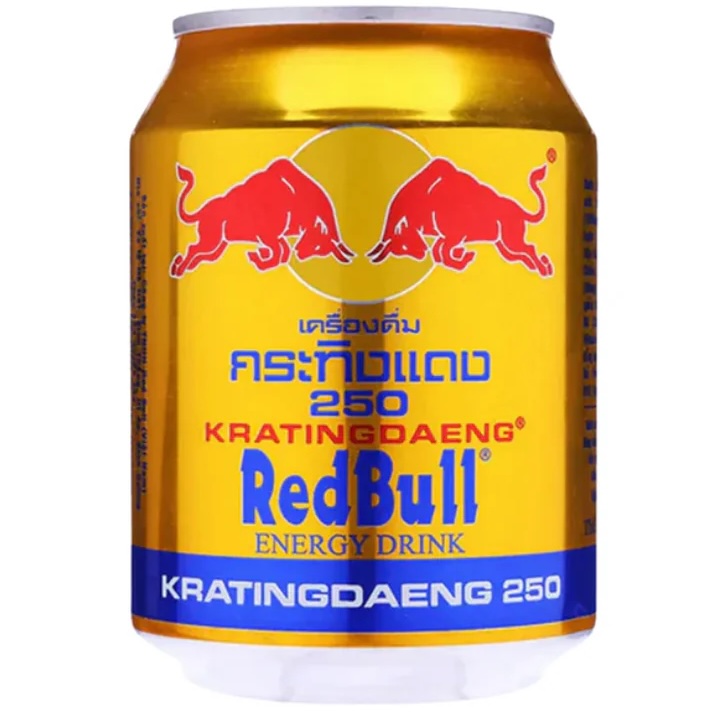
The original Thai Red Bull can
There’s a decent chance you’ve downed a Red Bull at some point in your life, possibly at a party, at an airport, or mixed into a drink of questionable wisdom at 1 am. Maybe you needed to pull an all-nighter. Maybe you just liked the can.
What you probably didn't know while you were drinking it: Red Bull is Thai.

In 2012 the Red Bull Stratos project had skydiver Felix Baumgartner jusp from space
It was invented by Chaleo Yoovidhya, a man who was born into modest circumstances, worked for his parents, moved to Bangkok, became an antibiotics salesman, quit, and set up his own small pharmaceutical company in the early 1960s.
In the 1970s Yoovidhya developed a drink to help laborers stay energized during long work shifts. The original formula contained ingredients specifically tailored for Thailand's working class. To promote the drink, he handed bottles out at boxing matches.
It was functional, affordable, and popular with truck drivers and factory workers. It was called Krating Daeng — literally "Red Bull" in Thai — and it was emphatically not a lifestyle brand. It was also completely unknown outside of Southeast Asia.
Until Dietrich Mateschitz came along.
Taking Flight

Red Bull purchased a New York soccer team and renamed it the Red Bull Bulls.
While employed as a marketing director for a German cosmetics company in 1982, Mateschitz traveled to Thailand and discovered that Krating Daeng, produced by Chaleo's company TC Pharmaceuticals, helped relieve his jet lag.
Recognizing its potential appeal to Western markets, he entered into a partnership with Chaleo to adapt and introduce the drink internationally.
Chaleo provided the original formula, adapted for Western tastes under Mateschitz's guidance, and Mateschitz provided the marketing. Under the terms of their agreement, eacj partner invested $500,000 apiece. Mateschitz was appointed to oversee management and global marketing strategy.
That strategy, rolled out globally in 1987 along with the ubiquitous slogan "Red Bull gives you wings," helped create the entire energy drink industry as it's known today.

Red Bull's ads are easily recognizable by their art style and ubiquitous slogan
The division of labor was clean, and it made both men extraordinarily wealthy — the company now sells 12.7 billion cans a year, posting $12.8 billion in revenue — but it also set up a dynamic that would quietly shape the company for the next four decades: the Thais owned the majority, and the Austrian ran the show.
The Man With the 2%
Each of the founding partners held a 49% ownership stake, while the remaining 2% was assigned to Chaleo's son, Chalerm.
Chalerm, born in 1950, is the eldest son of Chaleo — and while Mateschitz was busy turning Red Bull into a global phenomenon through extreme sports marketing, Formula One sponsorships, and a Felix Baumgartner jumping from the edge of space, Chalerm was building his own quiet empire in parallel.
He founded Siam Winery in 1986 with a vision to develop a wine market in Thailand, eventually building it into Southeast Asia's leading wine company with over 1,000 employees.
He diversified into healthcare through part-ownership of Piyavate Hospital, into real estate, and into other ventures that made the Yoovidhya family's wealth far less dependent on any single can of carbonated taurine.
And when the elder Yoovidhya passed in 2012, Chalerm became the majority owner of Red Bull.
Was he qualified to take on the company? Or was this simply another nepo-baby situation?
In some ways, qualification was beside the point. Even his father had never been involved in the day-to-day operations of Red Bull. That was always Mateschitz's domain, by design and by agreement.
Chalerm's role was ownership, not management — and he played it with the same low-key patience that defined his father: No splashy interviews, no public persona, no documentary series about the difficulty of being a billionaire. Just the steady accumulation of one of the largest fortunes in Asia.
As of 2025, Forbes estimates the family's collective net worth at $44.5 billion, marking them as Thailand's richest.
And as it turns out, there are a lot of things that the richest family in Thailand can buy: like legal impunity.
For as skilled as both Yoovidhya’s were at staying out of the public eye, Chalerm’s son made that difficult.
In the early hours of September 3, 2012, Vorayuth Yoovidhya — then 27— struck Police Sergeant Wichian Klanprasert with his Ferrari and dragged his body along a Bangkok street before speeding away.
Vorayuth was charged with speeding, fleeing the scene of an accident, and reckless driving causing death. He has never been arrested.
For a full five years after striking and killing a man with his car, Vorayuth continued life as normal — cheering on the Red Bull Formula One racing team from VIP seats in Bangkok, posing next to his black Porsche in London, and dining in upscale restaurants with his family.
He missed court dates eight times, each time citing illness or overseas business. By the time prosecutors finally issued an arrest warrant in April 2017, Vorayuth had already fled Thailand on his private jet. He has been a fugitive ever since.
The charges have been evaporating quietly, one statute of limitations at a time. And the reckless driving causing death charge — the last one standing — will expire in 2027.
But the case did not go entirely unpunished. In April 2025 two former senior prosecutors were jailed for conspiring to alter evidence to help Vorayuth evade prosecution — one receiving three years, the other two. So someone faced consequences after all, just not for the man who drove the car.
Nevertheless, the company remained relatively unscathed by the incident.
TCP group — the company founded by the eldest Yoovidhya — publicly noted that Vorayuth "never assumed any role in the management and daily operations of TCP Group, was never a shareholder, nor has he held any executive position within TCP Group."
Who Built the Bull
The honest answer to who had a bigger impact on Red Bull's global expansion is Mateschitz. And it isn't particularly close.
Chaleo invented the drink. That is foundational and cannot be overstated.
But the Red Bull that the world knows — the slim silver can, the extreme sports empire, the Formula One teams, the brand that somehow convinced a generation that watching a man jump from a balloon at 128,000 feet was a reasonable advertisement for a beverage — was Mateschitz.
He achieved his wealth by taking a drink already popular in Asia and adapting it to Western tastes. He was the one in the boardroom, making the calls, building the machine.
The Yoovidhya family's genius, in retrospect, was knowing what they had and being willing to let someone else build it.
They held the majority stake for forty years without ever needing to run the company. They collected the dividends while Mateschitz collected the glory. In a world where founders typically want operational control, the Yoovidhyas took a different approach: own the bull, let the Austrian ride it.
That arrangement worked beautifully — until Mateschitz died in October 2022.
Suddenly Chalerm’s qualifications did in fact matter.
The 2% That Changed Everything
Following Mateschitz's death, the Yoovidhya family initially took a stronger role in core operational matters. There was even talk of relocating the headquarters from Fuschl am See in Austria to Dubai or Amsterdam, likely for tax-related reasons. This idea was met with strong resistance from both the management team and staff in Fuschl.
The tensions that had been smoothed over by Mateschitz's authority for four decades suddenly had nowhere to go. And they surfaced in an unexpected place: Formula One.
Chalerm's personal 2% stake had proved crucial in preventing the Austrian side from dismissing Red Bull Racing team principal Christian Horner.
When Horner faced misconduct allegations, the Austrian shareholders wanted him gone. The Thai side, led by Chalerm, backed him, and for years Horner's alignment with the Thai ownership was considered his trump card — an almost guaranteed source of protection against any internal challenge.
Then, in May 2025, Chalerm transferred his personal 2% stake to a Geneva-based trust company. With the Yoovidhya family now holding 49% — equal to the Mateschitz side — the Thai dynasty was no longer the majority shareholder for the first time in Red Bull's history.
The Austrians then quickly ousted Horner, and this time they had the votes.
Research has since strengthened the suspicion that the trust is managing the 2% under a mandate from Yoovidhya — meaning the Thai side still effectively controls 51%. The power, in other words, may not have shifted as much as it appeared. Just the visibility of it.
Which is, in many ways, the Yoovidhya family story in miniature. Majority owners of one of the most recognizable brands on earth. Never quite in the foreground. Always, quietly, in control.
One could say that the Yoovidhyas initially had a limited vision for taking Krating Daeng beyond the borders of Thailand. But Dietrich Mateschit's vision for Red Bull, on the other hand, gave them wings.
In a world where founders typically want operational control, the Yoovidhyas took a different approach: own the bull, let the Austrian ride it.
Recent Articles
- China Feels Targeted by QUAD Cooperation
- South Korea Aims to Launch First Nuclear-Powered Submarine by the Mid-2030s
- Sam Altman Argues AI Unlikely to Lead to 'jobs Apocalypse'
- 'Zero-Gravity' Seats Under Scrutiny in China's Draft EV Safety Rules
- China Restricts Overseas Travel for Top AI Talent at Alibaba and DeepSeek
- Colonial-Era New Delhi Club Ordered to Move, Sparking Debate on India's Elites
- Australia-India-Japan-US Quad to Build a Port, Unveil Pact on Critical Minerals
- Foreign-Branded Phone Sales in China up 1.8% on Year in April
- Trump Claims 2020 Election 'rigged' at Least 107 Times in Six Months as Midterms Loom
- Pentagon Spars with SpaceX over Starlink Price Hike During Iran War