

The Startups Most Likely to Beat Tech Giants in Realizing Quantum Computing Potential
By JL Zhang | 26 May, 2026
IBM, Microsoft, Google and IBM have strong competition in the race to build fault-tolerant, scalable and energy-efficient quantum accelerators that can create breakthroughs to alien-level technology.
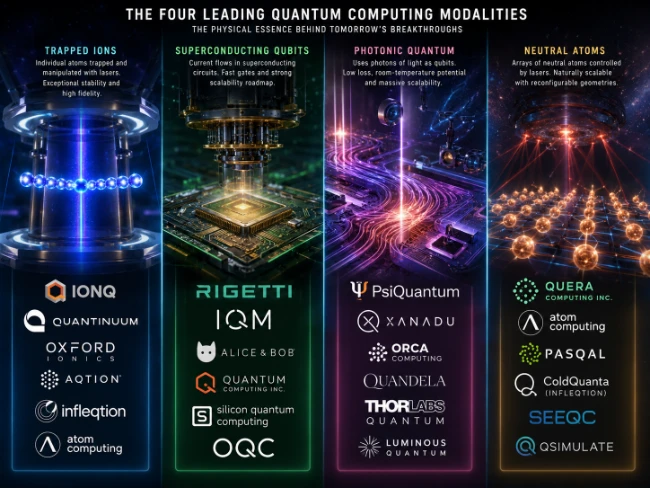
(Image by ChatGPT)
The myth of quantum computing was its potential to take us from a civilization mostly crawling around the surface of our planet to one able to zip thrustlessly through parsecs of space. Guess what? That myth is rapidly becoming scientific reality as we are on the verge of entering the era of quantum possibilities thanks to quantum systems able to accelerate technological advances by several orders of magnitude.
Materials and energy sources we have only been able to see in sci-fi movies or accounts of UFO sightings are within the capabilities of quantum processors that think septillions instead of billions.
Yes, at last quantum computing has begun moving from the scientific curiosity phase into a brutal engineering competition involving national governments, military agencies, hyperscalers, chip firms, pharmaceutical companies and venture capitalists throwing around billions of dollars. And despite the huge resources available to tech giants like IBM, Google,Microsoft and Amazon Web Services, some of the most intriguing contenders are startups.
That shouldn't be surprising. Historically, giant incumbents don't always dominate technological revolutions. The personal computer, internet search, social media and AI revolutions all produced newcomers that outmaneuvered much larger companies. Quantum computing may prove even more vulnerable to disruption because nobody yet knows which hardware architecture will ultimately win.
This is still a race without a clear map.
Some firms are betting on trapped ions. Others believe superconducting qubits will scale fastest. Others are convinced photons, neutral atoms or silicon-spin qubits will dominate. A few think today's leading architectures may eventually look as obsolete as vacuum tubes.
What makes the stakes enormous is the possibility that fault-tolerant quantum computers could eventually unlock what looks today like alien-level technological capability.
Quantum systems could potentially simulate molecular interactions with absurd precision, revolutionizing drug discovery, battery chemistry, fertilizer production and material science. They could crack optimization problems that defeat classical supercomputers. They may accelerate AI training and inference in ways still poorly understood. They could transform cryptography, logistics, aerospace engineering and climate modeling.
The first companies to achieve stable, scalable, energy-efficient quantum acceleration won't merely own another computing platform. They may own the next layer of civilization-scale infrastructure.
And several startups look surprisingly well positioned to get there first.
Quantinuum May Be the Most Dangerous Competitor
Among startups and non-tech-giant players, Quantinuum may currently have the strongest overall positioning.
The company emerged from the merger of Honeywell Quantum Solutions and Cambridge Quantum, combining strong hardware capabilities with advanced quantum software and cybersecurity expertise. That combination matters because quantum computing won't succeed through hardware alone. Whoever commercializes practical quantum systems will also need robust error correction, orchestration software and middleware.
Quantinuum uses trapped-ion qubits, one of the most respected approaches in the field. Trapped ions offer extraordinarily high fidelity and coherence compared with many superconducting systems. In plain English, they tend to make fewer mistakes and maintain quantum states longer.
That matters because error correction is the central nightmare of quantum computing.
Quantum bits are notoriously fragile. Vibrations, electromagnetic interference and thermal noise can all destroy calculations. Most current systems produce so many errors that scaling them into useful machines becomes extremely difficult.
The industry increasingly understands that raw qubit counts alone are almost meaningless. A machine with fewer but more reliable qubits may ultimately outperform a system boasting enormous but unstable qubit totals.
That's where Quantinuum has become dangerous. Many researchers believe its systems are among the most advanced in terms of real computational quality rather than marketing-friendly qubit numbers.
The company has also pushed aggressively into quantum cybersecurity, including quantum key distribution and encryption technologies likely to become critical once quantum systems threaten existing cryptographic standards.
IonQ Is Becoming the Nvidia of Trapped-Ion Systems
IonQ has emerged as perhaps the most commercially aggressive pure-play quantum company.
Like Quantinuum, IonQ relies on trapped-ion technology. But its strategy has focused heavily on accessibility and cloud integration. IonQ systems are already available through major cloud platforms, allowing developers and enterprises to experiment with quantum workflows without building specialized infrastructure.
That's a smart move.
One lesson from the AI boom is that ecosystems matter as much as hardware. Nvidia didn't dominate AI solely because it built GPUs. It won because CUDA created an ecosystem developers couldn't ignore.
IonQ appears to understand that dynamic.
The company has aggressively pursued partnerships with government agencies, defense contractors and hyperscalers while positioning itself as a broad quantum platform company rather than merely a hardware startup.
Critics argue that IonQ's commercial forecasts are sometimes overly ambitious. But even skeptics generally concede that the company has become one of the field's most important players.
Its scalability roadmap also looks increasingly credible.
One reason trapped-ion systems attract attention is that all ions in a chain are naturally identical. That reduces manufacturing inconsistencies that plague some other architectures. Scaling remains difficult, but many researchers increasingly believe trapped ions could become one of the first truly fault-tolerant quantum approaches.
PsiQuantum Is Making the Biggest Bet of All
If ambition alone determined the winner, PsiQuantum might already have the crown.
The company is pursuing photonic quantum computing, using photons rather than superconducting circuits or trapped atoms. Its core argument is brutally simple: photons are naturally resistant to many forms of environmental noise that destabilize other quantum systems.
In theory, photonic systems may therefore scale more efficiently and operate with lower energy requirements.
But what really distinguishes PsiQuantum is its manufacturing strategy.
Instead of inventing entirely new fabrication ecosystems, PsiQuantum aims to leverage existing semiconductor manufacturing infrastructure. The company has worked closely with major foundries and packaging technologies already used in advanced chip production.
That could turn out to be revolutionary.
Many quantum firms are effectively trying to build entirely new industrial stacks from scratch. PsiQuantum is attempting something closer to piggybacking onto the colossal machinery already developed for conventional semiconductors.
If that works, the scaling advantage could become overwhelming.
The company has openly discussed ambitions involving millions of qubits rather than merely hundreds or thousands. That's extraordinarily difficult and perhaps wildly optimistic. But if scalable fault tolerance ever emerges through photonics, PsiQuantum may suddenly look visionary rather than overambitious.
QuEra Is Quietly Becoming a Monster
One of the most intriguing companies in the field is QuEra Computing.
Spun out of research from Harvard and MIT, QuEra focuses on neutral-atom quantum computing. Neutral atoms are manipulated using lasers, allowing systems to arrange large arrays of qubits with remarkable flexibility.
Neutral atoms have recently become one of the hottest areas in quantum research because they appear naturally suited for scaling into large qubit arrays.
That scalability matters enormously.
A quantum computer isn't useful merely because it can sustain a few beautiful qubits in laboratory conditions. It needs to scale into systems capable of massive computation while keeping error rates manageable and power consumption reasonable.
Neutral atoms increasingly appear promising on all three fronts.
QuEra has also benefited from a series of highly publicized advances in quantum error correction and logical qubit stability. Some recent demonstrations from neutral-atom systems have significantly altered perceptions about how quickly useful fault-tolerant systems may emerge.
Importantly, QuEra also enjoys strong academic credibility. In frontier technologies, the concentration of elite researchers can become as important as access to capital.
The company increasingly looks like one of the most technically formidable challengers to both startups and tech giants alike.
D-Wave Could Win by Ignoring the Main Battlefield
D-Wave Quantum occupies a strange place in the quantum industry.
For years critics mocked the company because it focused on quantum annealing rather than universal gate-based quantum computing. Annealers specialize in optimization problems rather than general-purpose computation.
Many researchers argued that annealers represented a technological dead end.
But D-Wave kept building.
And unlike many quantum firms, it actually developed commercial customers.
The company has found applications in logistics, scheduling, manufacturing optimization and operational research. Those may sound less glamorous than breaking encryption or simulating exotic molecules, but they're commercially valuable.
There's also a possibility the industry underestimated the usefulness of specialized quantum accelerators.
Modern computing already relies heavily on specialization. GPUs dominate AI because they're optimized for parallel workloads. TPUs specialize even further. Networking chips, AI inference chips and video encoders all emerged because specialized acceleration beats generalized computing for many tasks.
Quantum computing may evolve similarly.
If optimization becomes one of the earliest commercially viable quantum use cases, D-Wave could end up looking unexpectedly smart for avoiding the industry's obsession with universal systems.
Rigetti Still Has a Puncher's Chance
Rigetti Computing remains one of the leading independent superconducting quantum firms.
Superconducting qubits currently dominate much of the industry, largely because IBM and Google aggressively pursued them early. The architecture benefits from compatibility with existing semiconductor techniques and relatively fast gate operations.
But superconducting systems also suffer from substantial coherence and error-correction challenges.
Rigetti's advantage is that it's focused almost entirely on quantum computing while giants like Google and IBM juggle countless competing priorities.
That focus can matter.
Small firms often move faster, iterate more aggressively and pursue unconventional strategies large bureaucracies avoid. Rigetti has also concentrated heavily on hybrid quantum-classical systems that integrate quantum accelerators into conventional computing environments.
That hybrid model may ultimately prove critical.
Early practical quantum computing probably won't replace classical computing. Instead, quantum accelerators may handle narrow computational bottlenecks while conventional systems do the rest.
The Future May Belong to Whoever Solves Energy Efficiency
One underappreciated aspect of the quantum race involves energy.
Today's AI boom has revealed a terrifying reality: advanced computation is becoming a power-consumption nightmare. Massive AI data centers increasingly require gigawatts of electricity and enormous cooling infrastructure.
Quantum computing could either worsen or alleviate that problem.
Some quantum architectures require extremely energy-intensive cryogenic systems operating near absolute zero. Others may eventually prove dramatically more energy efficient for certain classes of computation.
That means the winning architecture won't necessarily be the one with the biggest qubit count. It may be the system delivering the best ratio between useful computation and energy consumption.
This is one reason photonics and neutral atoms are attracting growing attention.
If a startup develops an architecture capable of fault-tolerant computation at dramatically lower energy cost than rivals, it could reshape the economics of the entire industry.
The Real Race Is Still Ahead
For all the excitement, practical fault-tolerant quantum computing remains brutally difficult.
Many timelines are probably too optimistic. Investors routinely underestimate how hard frontier engineering becomes when physics itself fights back.
But something important has clearly changed.
The field is no longer merely academic theater. The combination of improved error correction, rising qubit quality, better fabrication techniques and massive government funding has pushed quantum computing into a genuine industrial race.
And unlike previous computing revolutions, this one may not belong to incumbents.
IBM, Google and Microsoft remain formidable. Their engineering depth, cloud ecosystems and financial resources are immense. But startups possess advantages too: sharper focus, architectural flexibility, elite specialized talent and the willingness to gamble on unconventional approaches.
Some of today's startups may vanish completely within a decade.
But one of them may also become the Nvidia, Intel or Microsoft of the quantum era.
And whichever company finally delivers scalable, fault-tolerant and energy-efficient quantum acceleration may unlock technological capabilities so transformative that future generations will view today's digital civilization as primitive.
© 2026 by Asian Media Group Inc.
Recent Articles
- Charles Schwab Working with Cboe to Enter Prediction Market
- Mexico's Love Affair with All Things Korean — Until Thursday's Kickoff
- The Making of a Striking Tiger
- Japan's World Cup Prospects Brighter Than Their Single Group Point Might Suggest
- International Stars in the Red Devils' Lineup Suggests a Deep World Cup Run for S. Korea
- Italy's Meloni Says Trump 'Totally Invented' Story That She Begged Him for Photo
- Lebanon Ceasefire Agreed After US-Iran Talks in Switzerland Scrapped
- Qantas Bets on Sleep and Light Science to Sell 20-Hour Flights
- High-Wire Diplomacy Delivered US-Iran Deal but the Tricky Part's to Come
- Pentagon Asks for $80 Billion for Iran War Bills