

The Steep US Descent from Visionary Leader to Global Bad Cop
By Tom Kagy | 05 May, 2026
Under Trump the US shrinks humanity's potential by abusing military and consumer muscle instead of promoting international cooperation toward a prosperous and stable future.
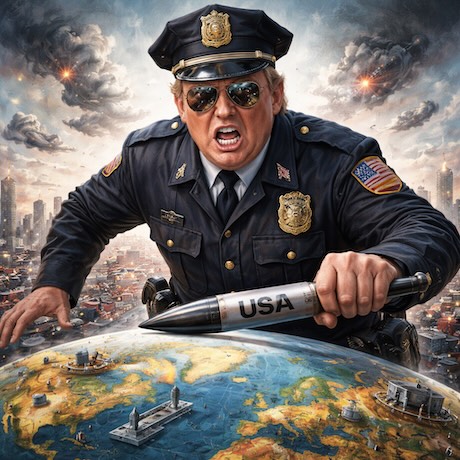
Following World War II the US saw itself as a nation whose strength could help shape a more stable and prosperous world by building institutions, alliances and rules that encouraged common goals.
True, during the Cold War US policy often reflected self-interest. Yet the US helped create the United Nations, NATO, the World Bank, and the global trading system. It invested diplomatic energy in bringing rivals together and encouraging long-term stability.
Even critics had to acknowledge that the US had become the world’s visionary scoutmaster.
Donald Trump changed all that.
Instead of acting as a convener or architect of cooperation, the US increasingly behaved like the world’s bad cop. The country didn’t present itself as a nation trying to expand humanity’s possibilities but rather like a nation using its economic size and military weight to pressure, threaten, and extract concessions.
Trump openly rejected the idea that alliances were valuable unless they produced immediate financial benefits. NATO partners were scolded as freeloaders. Long-standing trade agreements were treated as scams designed to cheat the US. International organizations were portrayed as parasites living off American taxpayers.
In Trump’s worldview, cooperation wasn’t a tool for solving global problems. It was a trap.
That philosophy had populist appeal at home. After decades of globalization, many Americans felt that the US had been too generous with the rest of the world. Factories had moved overseas. Jobs had vanished from small towns. Politicians had promised that free trade would lift everyone’s fortunes, but the benefits often seemed concentrated in big cities and corporate boardrooms.
Trump’s message was simple: the US had been played for a sucker.
But turning the country into a global bad cop doesn't solve those frustrations. If anything, it makes the underlying problems harder to fix.
The world’s most important challenges aren’t problems that any single nation can bully its way through. Climate change doesn’t stop at borders. Pandemics don’t check passports. Nuclear proliferation, financial instability, and mass migration all spill across national lines. They require coordination, trust, and long-term planning.
A nation that’s constantly threatening allies and shredding agreements doesn’t build that trust.
Instead, other countries start hedging their bets. They look for ways to reduce dependence on the US. They form new regional partnerships. They invest in their own technological ecosystems and financial systems that bypass American influence.
Ironically, the more aggressively the US tries to dominate the global system, the faster that system evolves to function without it.
We’re already seeing signs of that shift. Countries that once aligned automatically with Washington now weigh their options more carefully. Even close allies have begun exploring ways to protect themselves from sudden changes in US policy by aligning more with China or the EU. Trade agreements are increasingly negotiated without American participation.
The US still has enormous advantages—economic scale, technological leadership, and unmatched military capabilities. But leadership isn’t just about strength. It’s about credibility and vision—something for which Trump seems to have no feel.
Great powers don’t lead by intimidating others but by persuading others that cooperation with them will produce a better future. The US achieved that kind of leadership after World War II because it offered a compelling vision: a world where open markets, democratic governance, and international rules could reduce conflict and expand prosperity.
That vision wasn’t perfect, and it often clashed with American actions. Still, it provided a framework that many countries wanted to join.
Trump replaced that framework with something far narrower—business negotiations conducted at knifepoint. Each interaction becomes a zero-sum deal where one side wins and the other loses.
But the world’s most important relationships don’t work that way.
When nations collaborate on science, trade, and development, both sides can gain. The global economy grew dramatically over the past half century precisely because countries found ways to cooperate rather than constantly undercut one another.
The US benefited enormously from that system. American companies gained access to global markets. American universities attracted the world’s brightest students. American culture, technology, and finance became central pillars of the international economy.
In other words, the US didn’t just lead the system. It thrived as its leading beneficiary.
By contrast, acting like a global bad cop shrinks the possibilities for everyone—including the US itself. When allies are treated as adversaries, the incentives for collaboration disappear. Scientific partnerships weaken. Trade networks fragment. Diplomatic coordination becomes harder.
The world becomes smaller, meaner, and less imaginative.
When the US behaves like a visionary leader, it pushes the world toward ambitious goals. It encourages nations to think about eradicating diseases, building international infrastructure, or expanding technological cooperation.
When the US behaves like a bad cop, the message is that every country should fend for itself. That global problems are someone else’s responsibility. That the smartest strategy is to grab whatever advantage you can before someone stronger takes it away.
That mindset doesn’t inspire progress but rather suspicion and fragmentation.
The tragedy is that the US still has the capacity to lead in a far more constructive way. Its research institutions remain the most dynamic in the world. Its economy still generates innovation at extraordinary scale. Its cultural influence still shapes global aspirations.
But leadership requires not only power but the willingness to imagine a future that others want to help build.
If the US chooses instead to play the role of the global bad cop, it won’t just diminish its own influence. It’ll shrink humanity’s sense of what’s possible. The country that once helped organize the modern world will become just another powerful nation competing for short-term advantage. And become much poorer and weaker for it.
© 2026 by Asian Media Group Inc.
Recent Articles
- Newsom Says Trump Sending Agents to Homes of Friends, Family
- North Korea Touts Industrial ‘Miracles’ as Output Exceeds Targets
- Global EV Registrations Rose 3% in May
- China's Industrial Output Grew Faster in May but Retail Sales and Investment Slowed
- Asia Markets Temperate in Assessing Likely Delayed Impact of Iran Deal
- Japan's Auto Shops Unlikely to See Quick Relief from US-Iran Deal
- Hermanos Coreanos, Clarkson Crowned, Jung Hoo Lee Sets Record
- California Congressman Dave Min Presses Trump on “Pay-To-Play” Pardons
- China's Heavy Truck Electrification to Hit Diesel Demand
- Trump Push into Highly Dangerous Plutonium Unlikely to Fix US Nuclear Fuel Crunch