

Why the TSMC Moat Won't Be Breached Soon — Not Even by TSMC Arizona
By Tom Kagy | 19 Mar, 2026
The blithe assumption that TSMC's virtuosity in fabricating cutting-edge chips can be duplicated or transplanted ignores the myriad factors on which its current global dominance is founded.
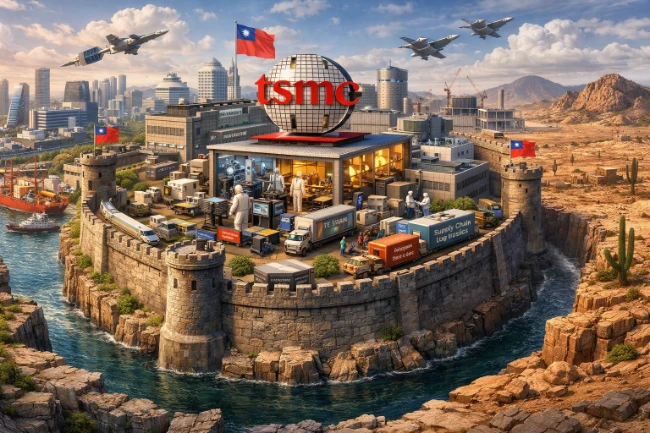
(Image by ChatGPT)
The peculiar hubris of American leaders devoid of technical insight is believing that money equates capability.
Nowhere is this ignorance more dangerous — or more expensive — than in the current US scramble to replicate what Taiwan Semiconductor Manufacturing Company has spent nearly four decades building in the hills and science parks of northern Taiwan.
Foolish leaders who treat $5 trillion taxpayer dollars per year as theirs to squander like some legacy from a slumlord dad, make grand promises about supply chain sovereignty. Groundbreakings are attended with great fanfare. Yet the factories that are supposed to liberate the United States and Europe from semiconductor dependence keep getting delayed, over budget, and quietly downgraded in scope and scale—or abandoned outright after billions have been squandered.
The reason isn't lack of will or money. The reason is that TSMC's dominance isn't a product so much as a civilization that's alien to Americans.
Simple but Brilliant Promise
To understand why its moat is so deep, start by understanding what TSMC is.
Morris Chang founded the company in 1987 with a simple premise: make chips for other people and never compete with your customers.
This pure-play foundry model unlocked the entire fabless semiconductor industry for the United States and Europe. Without TSMC Nvidia would likely not exist as we know it. Qualcomm and AMD as well as Apple Silicon may have been mere daydreams.
By choosing not to design chips, TSMC became the indispensable partner to everyone who did. That original act of strategic restraint compounded, decade after decade, into an institutional knowledge base of staggering depth.
Muscle Memory of Individual Workers
Every unusual design that passed through TSMC's fabs — every new thermal challenge, every exotic materials problem, every low-yield mystery that its engineers had to solve — added another layer to a body of tacit knowledge that can't be distilled and installed elsewhere. That institutional memory—or rather, cellular structure—doesn't live in documents but in people, in teams, in the almost instinctive way that experienced engineers recognize and respond to problems too subtle to articulate in a manual.
This crucial point always gets lost in policy discussions by people who have never built a crystal radio, much less anything requiring actual precision.
Chip fabrication at the leading edge isn't some recipe that can be followed given the right ingredients. The closest metaphor may be the operation of a great restaurant. The difference between a serviceable meal and a transcendent one is made up of thousands of small decisions made in real time by people who have embedded nuances into muscle memory.
TSMC operates roughly 1,200 distinct process steps to manufacture a leading-edge chip. Each step has tolerances measured in atoms. The difference between a wafer that yields 85% working chips and one that yields 60% — a difference worth billions of dollars annually — often comes down to adjustments so fine and so contextual that they can't be taught, only learned through personal experience. TSMC Taiwan has had thirty-five years to accumulate that experience. TSMC Arizona is starting from virtually zero.
Cloning TSMC in Arizona
The workforce problem isn't solvable on the timeline that clueless politicians have in mind. When TSMC broke ground on its first Arizona fab, it found quickly that the local talent pool wasn't up to the task. The company flew in thousands of engineers from Taiwan, which created its own frictions — cultural clashes between management styles calibrated for Hsinchu Science Park and workers formed by American workplace expectations, resentments among local hires who felt sidelined, and the simple logistical strain of running a high-pressure manufacturing operation with a bifurcated workforce.
These aren't a reflection of the competence of any individual or local populace. They're simply an ecosystem mismatch. The best semiconductor engineers in the world are disproportionately concentrated in Taiwan because Taiwan has spent decades building the universities, the supplier networks, the adjacent industries, and the professional culture that produces and sustains them. You can't clone that by opening a campus in Chandler and posting job listings.
Unique Supply Chain
The supply chain problem compounds the talent problem. A leading-edge fab doesn't operate in isolation. It depends on a dense web of specialty chemical suppliers, gas suppliers, equipment service companies, materials manufacturers, and precision parts fabricators, most of whom, in Taiwan, are located within an hour's drive of the fab.
When something goes wrong at three in the morning — and in semiconductor manufacturing, something is always going wrong at three in the morning — the relevant expert or the critical component can arrive before dawn. In Arizona, that component may be on a plane from Japan or Germany. That isn't an inconvenience. It's a structural flaw and a financial risk that makes the Arizona operation inherently less efficient as a business propostion.
TSMC has estimated that chips made in Arizona will cost roughly 50% more than the equivalent chips made in Taiwan. That gap may narrow over time, but it can't close because it reflects not just labor costs but the full weight of an immature industrial ecosystem.
Geoglogical Constraints
Then there are the physical constraints that no amount of political will can overcome quickly. Arizona is a desert. A leading-edge fab consumes tens of millions of gallons of water per day at a time when the Colorado River compact is under sustained legal and hydrological stress. TSMC has invested heavily in water recycling, and the company has been a responsible actor on this front, but the underlying scarcity is a geological fact, not a policy variable. Power is another concern. Fabs require massive, absolutely stable electricity supply. Arizona's grid isn't improving fast enough to handle the load or the demand for absolute stability. These constraints aren't trivial, and are likely to add to the overall difficulty of transplanting TSMC on a meaningful scale. And they would apply to other nations that may seek a similar objective.
Bureaucratic Burden
The CHIPS Act itself introduces possibly insufferable complications. The grants come with profit-sharing provisions, restrictions on China operations, domestic content requirements, and compliance burdens that a foreign company unaccustomed to American federal contracting has found genuinely taxing.
The first fab, originally slated to open in 2024 producing chips on TSMC's N4 process, slipped into 2025. The second fab, targeting more advanced nodes and originally promised for 2026, has been pushed to 2028. Each delay is reported as a setback for American industrial policy. These are predictable symptoms of an enormously complex undertaking that was always going to be harder and slower than the press releases suggested.
Wither Arizona (or Any Other Place Not Taiwan)
This doesn't mean the Arizona project lacks value. Even expensive, slightly-behind-the-frontier chip production on American soil has real strategic worth in a world where geopolitical risk around Taiwan isn't zero. Over the coming decades, if the effort survives, the local workforce may mature, suppliers may establish American operations, and TSMC's own teams develop adjusted rhythms that can make a fab hum albeit at a lower level of cost-efficiency.
The question isn't whether Arizona will produce chips but whether it will produce chips at the frontier, at competitive cost, at scale — and whether it will do so on any timeline that meaningfully reduces dependence on Taiwan in the scenarios where such dependence actually becomes a crisis. In other words, will it prove worth the cost in practice, not in the simplicity of the political imagination.
What TSMC has built in Taiwan is a national industrial civilization evolved across four decades, through multiple generations of engineers, in a culture that deifies manufacturing excellence. It's the product of compound interest on human capital. The West isn't wrong to want some of that capacity on its own soil. But the first step toward getting it is giving up the comfortable illusion that it's something that can be bought with an appropriation.
Recent Articles
- Iran Tightens Control of Strait on Persisting US Blockade
- US Accelerates Access to Therapeutic Psychedelics
- What country would you live in if you can't live in the US?
- Beijing Building Satellite Town for Booming Space Industry
- China Humanoid Robot Half-Marathon to Showcase Big Advances
- Asian Chefs Dominate NYC’s Michelin Star Scene
- NBA Playoff Oddsmakers Favor a Repeat
- Innocent Indian American Ambushed As a Pedophile by Racist Livestreamer
- $166 Billion in Tariff Refunds to Begin Processing Monday
- Top Kpop Agencies Mull Creating Coachella-Style Global Festival